Navigating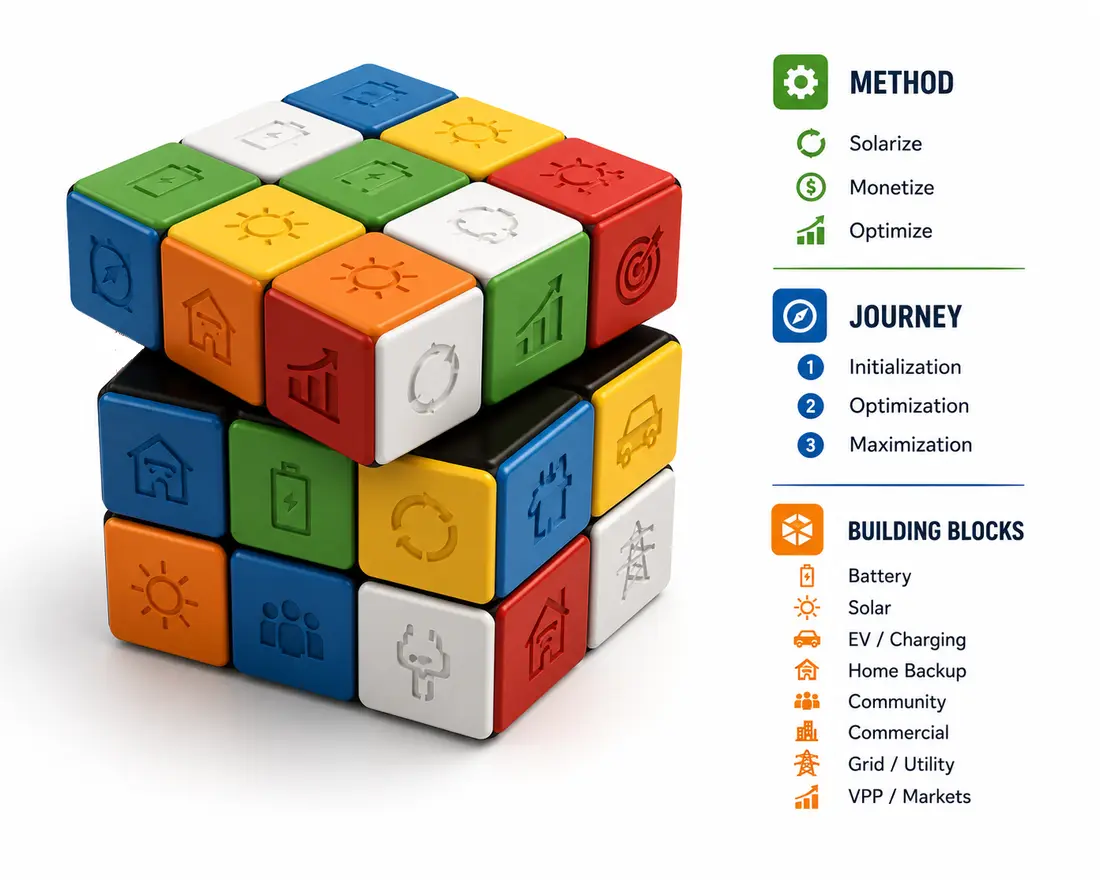
Summary
Solarize, Monetize, Optimize: How to move on to the next phase of solar energy ROI and growth
Better Questions. Better Decisions. Better Energy Systems.
A methodology for building personal energy wealth
Nobody likes planning.
It sounds like work.
Yet we plan holidays.
We plan birthday parties.
We even plan what time to phone the deli so the takeaway is ready when we get there.
Why? Because the planning promises something we actually want.
Solar planning?
Now that sounds painfully boring.
Until you realize you’re not really planning solar.
You’re planning a buffer against rising costs.
Backup when utilities can’t back you up.
Returns on an investment, that you actually get to see and enjoy in your lifetime.
A system that keeps paying you back every day you use it.
Turns the tables a bit, eh?
Suddenly the planning doesn’t feel like the boring part anymore.
It feels like an asset with some tangible promises.
…and the penny drops:
Solarize ➡️ Monetize ➡️ Optimize
Three Words. One Energy Strategy.
…and what this method really means
1. SOLARIZE
Not “buy solar.” > Enter the energy game.
Acquire energy capability.
Begin participating in renewable energy.
It’s the decision to stop being a passive electricity consumer.
Ways to Solarize:
- Understand your energy profile
- Start with portable backup
- Start with rooftop solar
- Start with a battery ecosystem
- Start with Community Solar
- Add portable panels
- Add fixed panels
- Build your first module
The important part isn’t where you start.
It’s that every decision leaves room for the next one.
2. MONETIZE
Most people think monetization means:
Sell excess electricity.
No. That’s only one form. The concept is much broader.
We’re talking about extracting every possible form of value from the infrastructure you’ve built. Every improvement adds another layer of return.
That includes:
Direct savings
- lower electricity bills
- peak shaving
- TOU arbitrage
- self-consumption
- reduced imports
Financial returns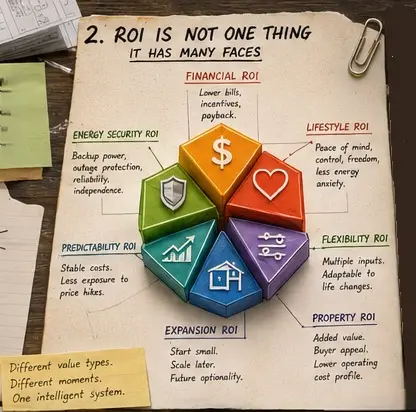
- tax incentives
- rebates
- feed-in tariffs
- Virtual Power Plant participation
- Renewable Energy Credits (where applicable)
Risk reduction
This is the one nobody calls monetization…
but it is.
- avoiding spoiled food
- avoiding downtime
- avoiding generator fuel
- avoiding outage losses
- protecting home offices
- protecting medical equipment
Those have economic value.
Lifestyle value
Again…
…not cash. Still ROI.
- comfort
- resilience and stability
- convenience
- mobility
- independence
- quieter living
- predictable energy costs
Capturing value? That’s much richer than “sell electricity.” It is where those decisions begin paying you back.
3. OPTIMIZE
This isn’t tweaking settings. It’s learning. It’s becoming a better operator.
It’s the human in the ecosystem – continuously improve both the system and the way you use it.
Examples:
- charging habits
- appliance timing
- battery management
- seasonal adjustments
- monitoring
- maintenance
- expanding wisely
- improving comfort
- increasing resilience
- continuous ROI
This is where the system becomes a partnership instead of a purchase.
That’s a methodology.
Because the best energy systems don’t stop evolving after installation.
Neither do the people using them.

Incremental Infrastructure – Building Energy Systems Like Lego Blocks
Most people think solar starts with roof panels.
Sometimes it does. Sometimes it starts with a battery.
Sometimes a portable power station.
Sometimes just truly understanding your electricity bill – for the first time after 12 price hikes and 27 outages…
The important thing isn’t where you start.
It’s whether today’s decision supports tomorrow’s.
Solar used to be a case of phone the professionals, get the turnkey solution, at (huge)X amount.
It left a lot of people out of the renewable energy movement, and in many cases stuck in the dark.
…and where there’s problems, there’s power(for finding a solution)
So many folks start with backup instead of a full system take-over.
Solar Is Not a Product. It’s a Progression.
Imagine you’re building an expandable energy ecosystem.
Take this one example of how modular thinking usually unfolds in real life:
Problem 1
The power is off.
Solution?
Portable power station.
Done.
Three months later…
Problem 2
This is great… but how do I recharge it cheaply?
Ah…
Now we’re talking solar panels.
Not because we wanted to sell panels.
Because the next question naturally appeared.
Then…
Problem 3
Portable panels work… but I use this every day.
Maybe fixed panels now make sense.
Problem 4
Hmm… batteries are filling by lunchtime.
Should I add another battery?
Problem 5
Electricity prices just went up.
Time to revisit ROI.
Problem 6
Bought an EV and now need the EV charger setup
Back to planning.
It’s almost like a branching story.
Every solved problem reveals the next one.
Every module solves a different problem, at a different time.
Every problem solved increases the value of the whole system, which means another piece of the ROI puzzle falling into place.
How do I start without painting myself into a corner?
Because that fear is everywhere in solar.
The moment you begin researching solar, you quickly run into a flood of information:
Solar Panel Comparison chart.
Solar Battery Guide Solar Inverter and Controller guide
Financing.
Tax credits.
Feed-in tariffs.
Monitoring apps.
Backup power.
System sizing.
Utility policies.
People are terrified of making the wrong first purchase.
They worry they’ll waste money, buy something incompatible, or discover six months later that they should have done it differently.
A big problem is most solar websites treat solar like a product purchase, creating the general notion that going solar is a single decision:
Get a system. Lower the electricity bill. Done.
But real-world solar rarely works that way. Because solar behaves more like an ecosystem that evolves over time.
So I’m not here today saying, “Here’s the right system.”
But am saying, “You don’t have to know your final destination today. You just need a plan that keeps your options open.”
Priorities can change:
- before installation
- during installation
- after installation
- after living with the system for months or years
A homeowner researching solar for the first time has very different questions from someone already trying to optimize battery usage or reduce grid dependence.
Yet most information online mixes everything together.
That’s why people feel overwhelmed.
Not because solar is impossible — but because the information lacks structure.
It isn’t organized around the decisions people actually need to make.
The 3 Phases of Solar
Navigating Solar was built around a simpler approach: Break the solar journey into phases.
Not categories.
Not hype, or endless technical jargon.
Just clear stages of progression.
The Phases Matter Because You Won’t Stay in One Phase
Three simple ideas. One continuous journey. Every article, calculator and guide on NavigatingSolar exists to help you move forward through one—or all three—of them.
The phases are not set structures, instead they act as decision categories before spending money.
That means each phase can be visited and revisited at any given time during your solar journey.
Example: You begin with a single portable power station.
During Initialization, you compare costs and estimate savings.
Before purchasing, you briefly visit Maximization to understand future battery expansion options.
Months later, after using the system, you move into Optimization to improve charging habits, energy usage, or Time-of-Use savings.
A year later, you’re considering your second modular system component —this time planning rooftop solar that complements what you already own…
Back to Initialization, use the ROI Calculator
Then Curious how much more capacity you should add?
Jump to Maximization – Compare battery capacity again.
Then back to Initialization – recalculate the payback timeline and savings.
The journey isn’t linear. Good planning means moving between phases whenever a new decision needs better information.
Because when solar information is structured properly:
- decisions become easier
- overwhelm decreases
- system planning improves
- financial mistakes reduce
- long-term value increases
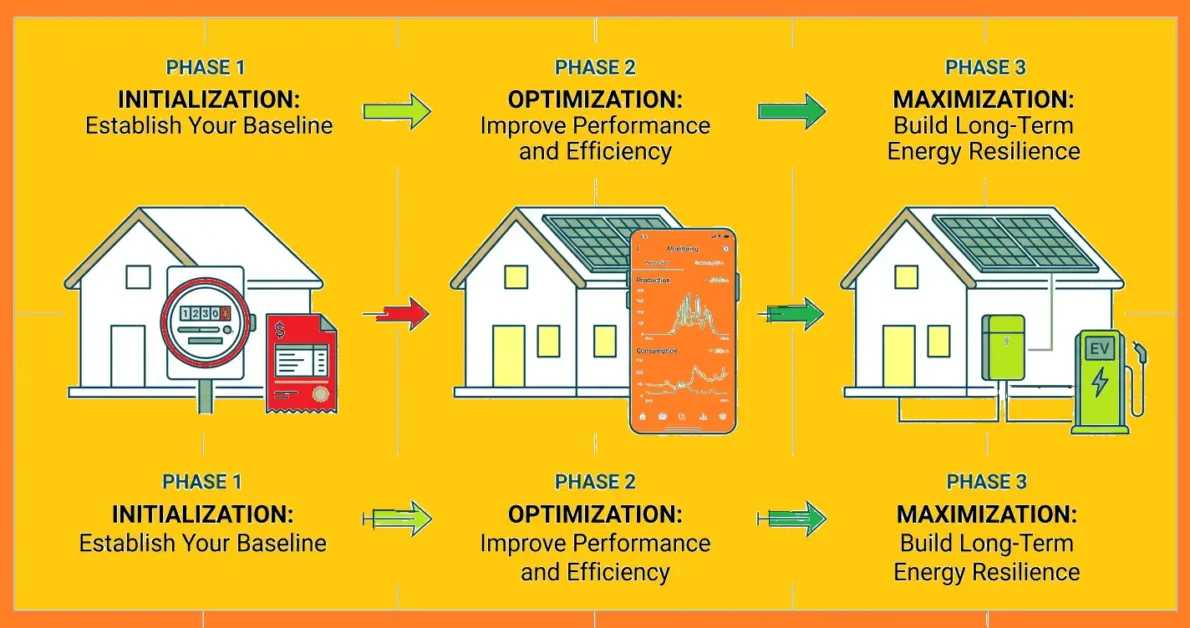
The phases don’t exist to tell you what to buy first. They exist to help you ask the right question at the right time.
Phase 1 — Initialization
Establish Your Baseline
This is where most people should start. Before comparing equipment or requesting quotes, you need to understand:
- your energy usage
- your roof suitability
- your utility structure
- your financial goals
- whether battery storage even makes sense for your situation
This phase is about reducing expensive mistakes.
Because poor solar decisions usually happen before installation:
- oversized systems
- undersized systems
- poor financing
- misunderstanding incentives
- unrealistic savings expectations
Initialization creates clarity before commitment.
Typical Focus Areas
- Solar readiness
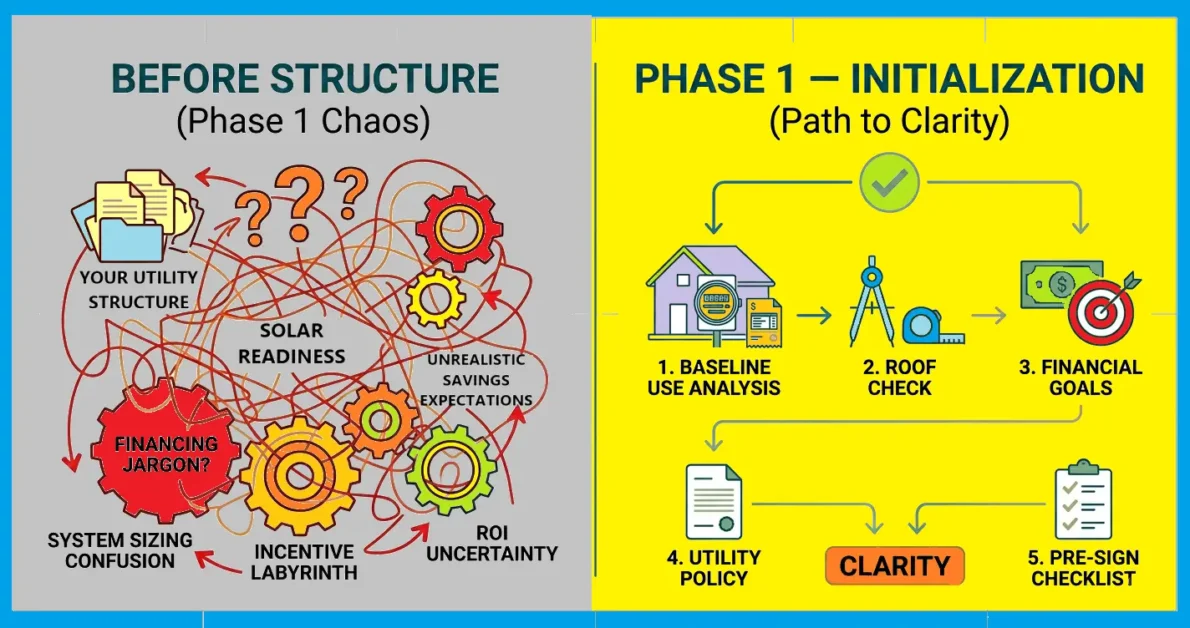
- System sizing
- long-term ROI calculations
- Utility bill analysis
- Incentives and tax credits
- Installer preparation
- Baseline energy understanding
Helpful Starting Points
- Solar Readiness Checklist
- System Size & Cost Calculator
- Solar ROI Calculator
- Savings Calculator
- Pre-Sign Paperwork Checklist
→ Start Here : Phase 1 – Initialization
Phase 2 — Optimization
Improve Performance And Efficiency
Most homeowners think solar ends after installation. In reality, this is where the learning often begins. Once a system is installed, new questions appear:
- Why is my bill still high?
- Am I using my solar correctly?
- When should batteries charge?
- How do Time-of-Use rates affect savings?
- Is my system performing normally?
- How do I improve self-consumption?
Optimization is about improving the relationship between:
- production
- consumption
- timing
- storage
- utility interaction
This is where solar becomes an active energy strategy rather than a passive power producer.
Typical Focus Areas
- Monitoring production
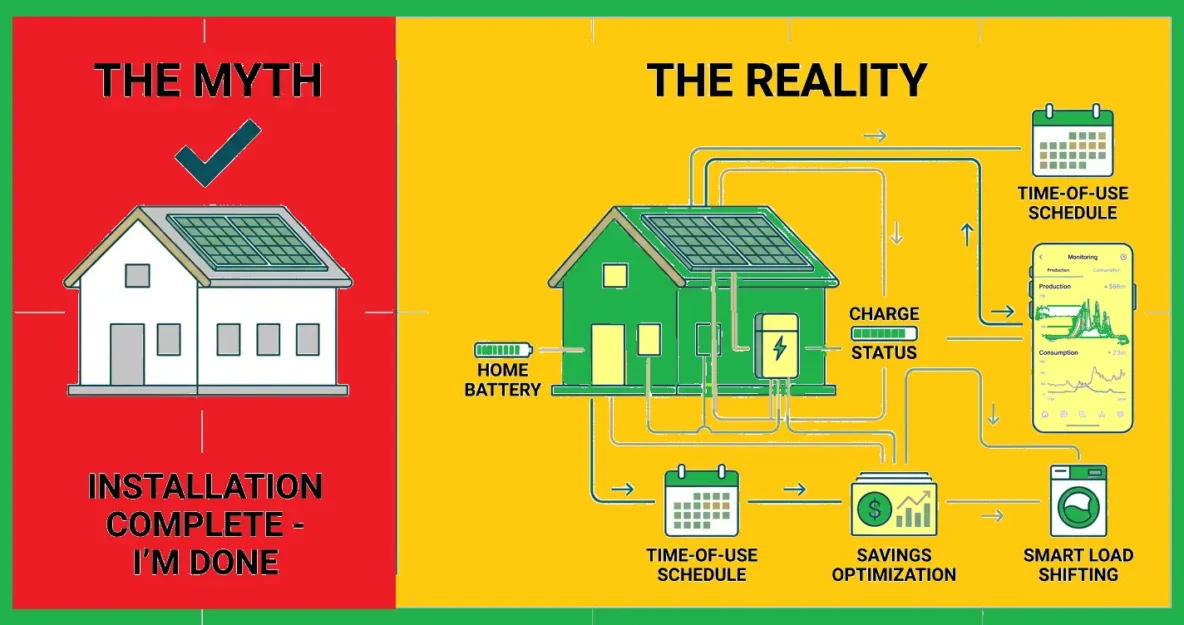
- Usage timing
- Load shifting
- Time-of-Use optimisation
- Battery behaviour
- Appliance strategy
- Revisiting Long-term ROI calculations
- Seasonal adjustments
- System troubleshooting
Helpful Tools
- Utility Mastery guide
- Troubleshoot Checklist
- Seasonal Maintenance Checklist
- Solar Warranty & Permits Vault
Phase 3 — Maximization
Build Long-Term Energy Strategy for Resilience
This phase is less about saving money month-to-month. It’s about control, resilience, and long-term value.
At this stage, homeowners begin thinking differently:
- backup power expansions
- levels of energy independence
- battery expansion
- EV integration : How to charge an EV more cost effectively?
- future utility changes
- rising electricity costs
- long-term infrastructure planning
Solar stops being “just panels.” It becomes part of a larger energy strategy.
Typical Focus Areas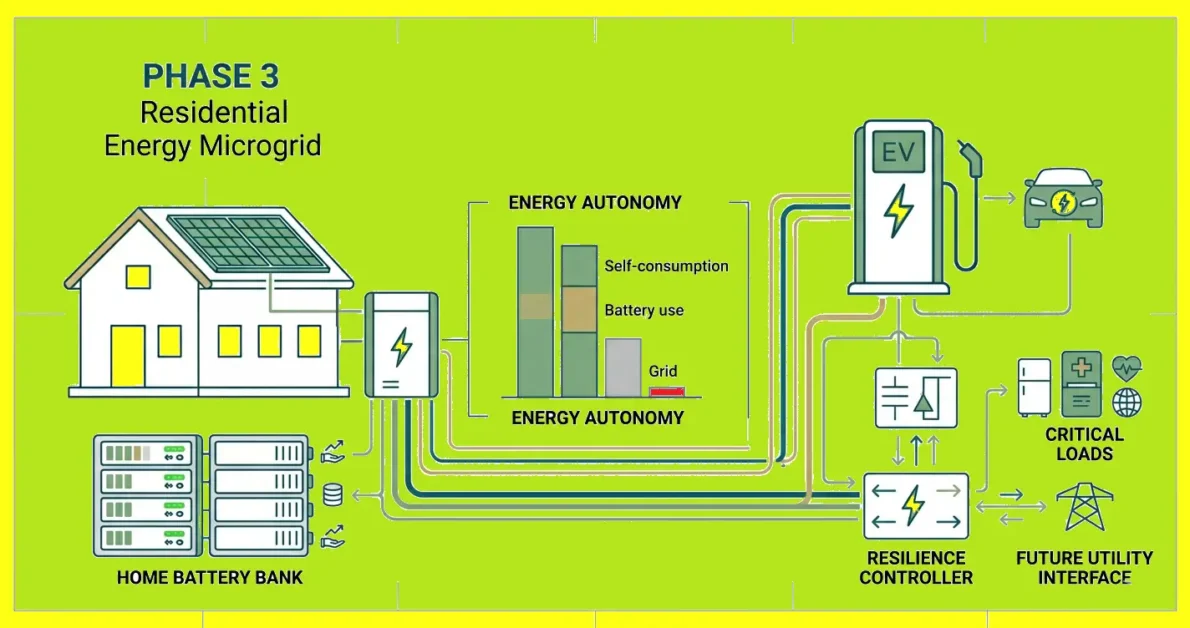
- Battery storage planning
- Backup systems
- EV charging systems and panel upgrades
- Long-term ROI leverage
- Energy effiencient upgrades
- Infrastructure expansion
Helpful Tools
Solar Isn’t a Purchase – It’s an Energy Policy of Options
The internet often treats solar like a one-time transaction. But homeowners quickly discover that solar evolves:
- your usage changes
- your priorities change
- your utility policies change
- technology changes
- energy costs change
The best solar systems are not always the most expensive systems, they are the one built around the users needs and continuity
They become the systems designed around:
- real usage
- realistic expectations
- strategic planning
- gradual improvement over time
A philosophy of incremental infrastructure, and its ecosystem should reflect that too,
not brands or just financial ROI and payback timeline calculations
but options of:
- Portable solar panels
- Fixed solar panels
- Mounting systems
- Charge controllers (where relevant)
- Expansion batteries
- Transfer switches
- Smart energy monitors
- EV chargers
Each one isn’t “another product.”
It’s the solution to the next problem in an energy journey
…that’s why this is a solar site—not a battery site
because it’s actually a really important guardrail.
Batteries don’t create energy.
Solar does.
Batteries don’t recharge themselves.
Solar does. Or the grid at a more expensive long-term prices.
With solar, you’re not just storing electricity at whatever price — you have the potential to generate your own electricity, at better costs while feeding the ecosystem of your choice over time.
That’s why the site can embrace portable power, battery ecosystems, and incremental infrastructure without losing its identity.
Solar remains the foundation that makes those systems increasingly valuable over the long term.
That’s the purpose of NavigatingSolar. Not to overwhelm you with information. But to help you move through the process with clearer thinking, better structure, and practical guidance.
At the end of the day, everything eventually circles back to the same question:
Where does tomorrow’s energy come from?
That’s your anchor throughout all these decisions.
A battery buys you time.
Solar changes the economics.
…2050 and still receiving the ROI that comes with investing
…because that’s the difference between buying solar like it’s an appliance or investing in a personal energy ecosystem.
That’s why understanding the difference between “energy” and “electricity” starts with your usage and habits.
The place where any energy research starts.
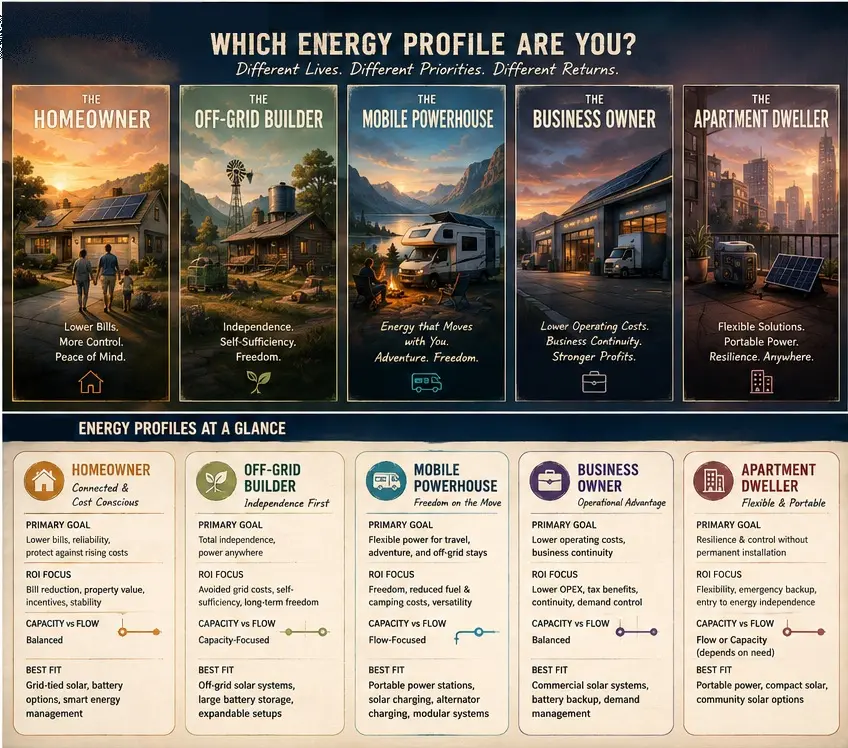
There isn’t a single “correct” way to begin building an energy system.
Some homeowners want the simplicity of a professionally installed rooftop solar system.
Others prefer starting with portable backup power and expanding over time.
Many discover that a modular energy ecosystem lets them spread costs while keeping future options open.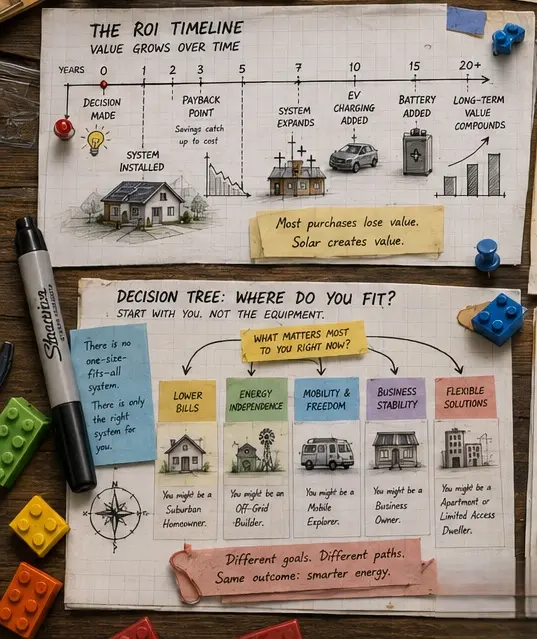
Businesses often need a completely different approach focused on resilience, operating costs, and long-term infrastructure.
Wherever you’re starting, the important thing is choosing the path that fits your goals, budget, and energy profile—not somebody else’s.
Your first decision doesn’t need to be your biggest.
It simply needs to leave room for your next one.
Good energy systems aren’t built in a day. They’re built through a series of well-planned decisions that continue delivering value long after the first purchase.
Solar decisions become much easier when you can compare information, estimate costs, and explore different scenarios at your own pace.
The Navigating Solar Toolkit brings together practical calculators, planning checklists, comparison tools, and structured guides designed to help homeowners move through the solar process with more clarity.
Whether you are:
- estimating system size
- comparing savings potential
- exploring battery storage
- reviewing incentives
- preparing for installer quotes
- or optimizing an existing system
…the Toolkit and Articles act as guides to help turn questions into a structured decision tree.
Explore the path that matches your next question
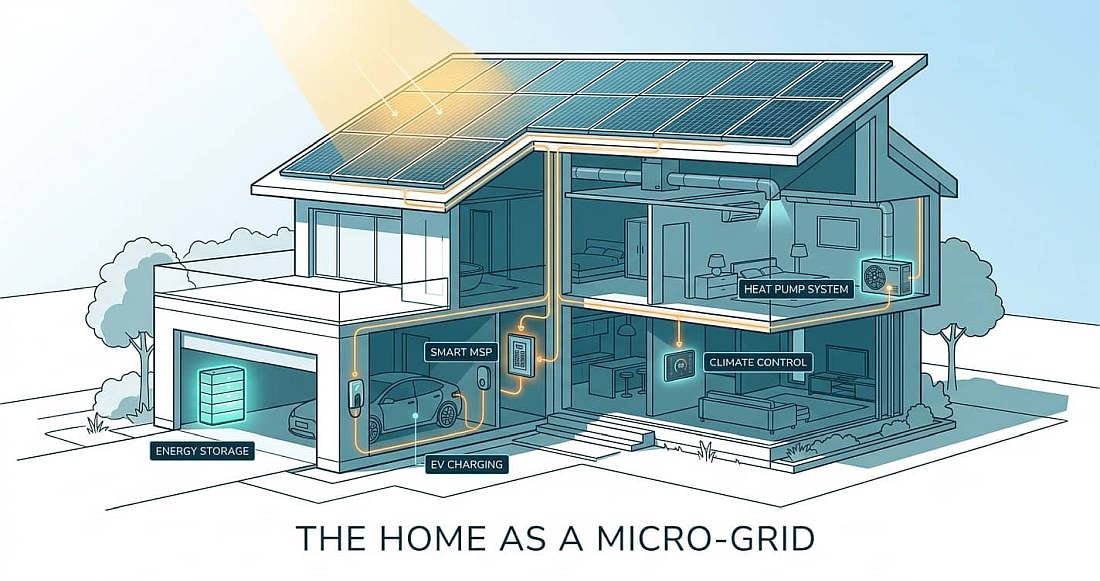 Traditional Residential Solar
Looking for a professionally designed rooftop installation?
Also known as EPC – Evaluation, Procurement, and Construction
Compare vetted residential installers, financing options, and complete turnkey solar solutions built around your home’s energy profile.
→ Compare Residential Solar Solutions
🔋 Portable Backup Power
Just need reliable backup without committing to a permanent installation?
Explore portable power stations, solar generators, expansion batteries, and portable solar panels for homes, apartments, RVs, travel, and emergency preparedness.
→ Explore Portable Backup Solutions
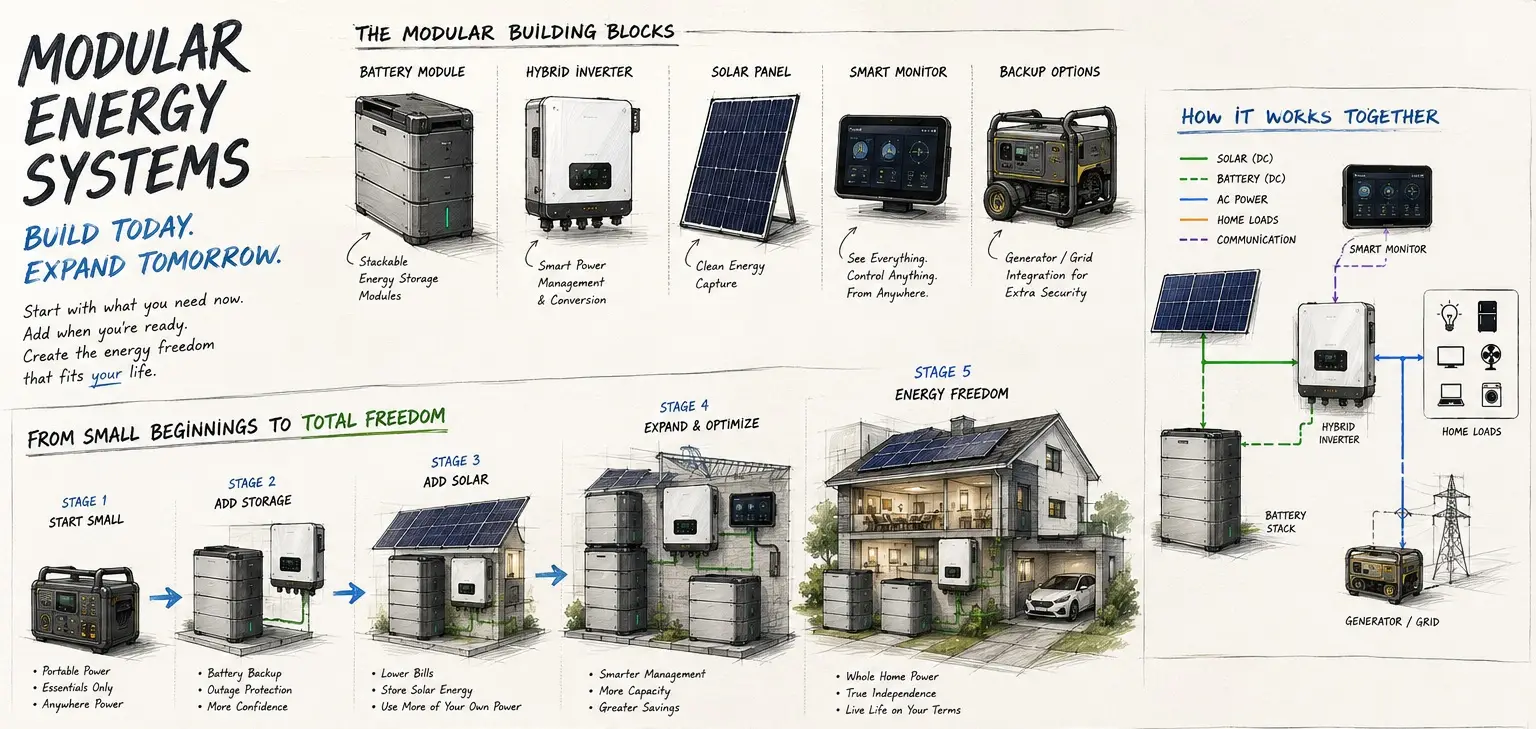
⚡ Modular Energy Ecosystems
Prefer building your energy system over time?
Expandable ecosystems let you start with one component today and grow into a larger integrated energy solution as your needs and budget evolve.
Before talking to installers, spend a little time exploring what’s available on the market.
Looking at complete systems, individual components and different brand compatibilities make it much easier to understand the recommendations you’ll receive later.
Understand how each system links to your home and utility, before settling on product choice.
Explore what these systems look like, how they work and what the modules are for each.
Here’s a visual aid:
Steps: Follow the link below – Choose a system (hybrid, grid-tied or off-grid) – Choose a size – Hover over the product image and see how it transforms into a home energy system.
➡️ See how it works
→ Explore Expandable Energy Ecosystems
🤖 Smart Energy Management Ecosystems
This automated approach to energy management is becoming an increasingly popular choice for folks to consider.
Some homeowners prefer integrated Smart Energy Ecosystems, where batteries, solar generation, EV charging and selected household loads communicate automatically to manage energy throughout the day.
If you’re interested in an integrated whole-home approach, EcoFlow’s Ocean range demonstrates how batteries, solar generation, EV charging and smart controls work together as a connected energy ecosystem. These systems can be professionally installed and expanded over time as your household’s energy needs evolve.
➡️ Explore Smart Energy Ecosystems
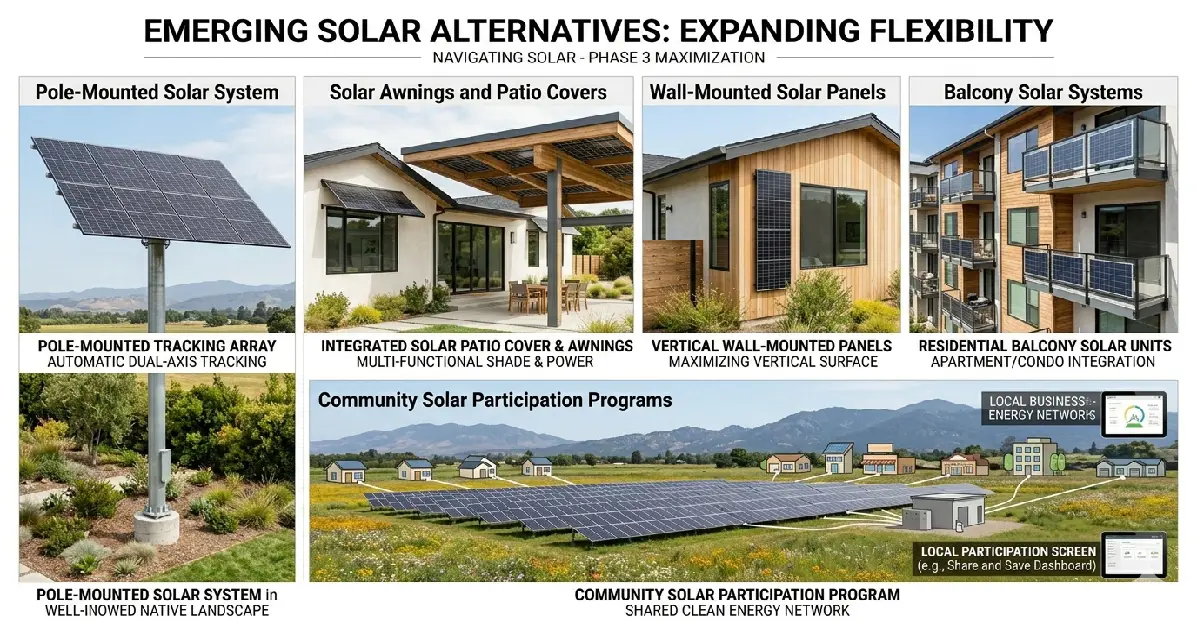
☀️ Alternative Solar Mounting Solutions
Not every solar panel belongs on a roof.
Ground mounts, pergolas, carports, sheds, awnings, balconies, RVs and portable systems can sometimes deliver a better solution depending on your property and goals.
→ Explore Alternative Mounting Solutions
🌎 Community Solar
Can’t install solar where you live?
Community Solar allows many homeowners, limited access properties and renters to benefit from solar generation without owning rooftop panels.
For some households, it can be one of the smartest ways to begin lowering electricity costs.
🏢 Commercial Energy Solutions
Commercial solar is a different discipline altogether.
It goes far beyond a simple quote form.
Businesses, farms, workshops, industrial facilities, schools and larger properties often face very different energy challenges from residential homeowners.
Larger systems involve very different planning considerations:
from demand profiles and operational resilience
to financing,
energy management and
long-term infrastructure strategy.
but the same planning principles still apply:
Start by understanding the problem you’re trying to solve.
Is the goal backup during outages?
Lower operating costs?
Reducing peak demand charges?
Supporting future expansion?
Improving energy resilience?
Or preparing for opportunities such as Virtual Power Plant participation as commercial energy markets continue to evolve?
Depending on the size of the operation and the outcome you’re working toward, the right solution may be anything from a modular energy ecosystem that expands over time to a fully engineered commercial EPC installation.
The technology changes. The scale changes.
The planning mindset doesn’t.
Why We Recommend These Solutions
NavigatingSolar isn’t an installation company. We’re not here to sell you a particular brand, installer, or technology.
Our job is different.
Our job is to help you make better energy decisions.
That means spending far more time asking questions than pushing products.
We don’t expect you to trust us because we say we’re trustworthy.
We’d rather earn that trust by showing our reasoning.
What’s why you’ll find calculators before quotes,
comparisons before recommendations,
and questions before products throughout NavigatingSolar.
We believe informed decisions last longer than impulse purchases.
When we recommend an installer, manufacturer, calculator, guide or service, it’s because we believe it has earned a place within the planning process we’ve built throughout this website.
Some recommendations may earn us a commission if you decide to use them.
That never changes the way we evaluate them.
Our goal isn’t to recommend the most expensive solution.
It’s to recommend solutions that genuinely fit different energy profiles, budgets and long-term plans.
Sometimes that’s a complete rooftop installation. Sometimes it’s a portable power station.
Sometimes it’s a modular ecosystem that grows over several years.
Sometimes the best recommendation is simply to wait until the numbers make better sense.
Solarize – Monetize – Optimize
Because good planning, a bit of method behind the madness, creates better decisions.
And those usually produce better long-term returns.
Whatever path you choose, remember this:
your first energy decision doesn’t need to solve every problem—it simply needs to make the next decision a better one.
Educational transparency.
NavigatingSolar is an Independent Educational Resource. We are not solar manufacturers or installers – we research them.
Why these suggestions?
Navigating Solar doesn’t recommend companies simply because they offer affiliate programs. We believe readers should always understand why something is being recommended. We begin with the homeowner’s decision—not the product. We identify where people struggle to make informed choices, then evaluate products, services and partners that genuinely solve those problems.
Not every recommendation earns us a commission. Partnerships are selected to fit the educational framework—not forcing the educational framework to fit whatever affiliate programs happened to exist. If a company doesn’t fit the decision framework and ethos, we don’t include it—whether it has an affiliate program or not. If we believe a better solution exists, we’ll recommend it regardless of whether it generates a commission.
➡️ Our goal is to help you make the right decision—not the fastest purchase.
Recommended further reading:
Solar Incentives by State in 2026
7 Solar Installation Mistakes to Avoid (Including Hidden Costs Most People Miss)
UPGRADES THAT GIVE THE BIGGEST ROI
Types of solar-powered systems
Which Type of Solar Consumer Are You?