 Navigating
Summary
Understanding TOU, Net Metering, and Buyback programs is not just about reading your bill; it’s about mastering your energy flow.
Optimize Solar Savings with TOU Strategy and Credit Systems
What TOU, Net Metering and Buyback means for your Solar Savings
If you’ve been following the news about utility companies, you’ve probably heard the term Time-of-Use (TOU) rates. For the average consumer, this sounds like another confusing utility trick.
But for the solar homeowner, TOU is a strategic opportunity.
This post is your 60-second crash course on TOU, and more importantly, how it connects to the two main ways you get paid for your excess solar power: Net Metering and Buyback Programs.
Understanding this trifecta is the key to maximizing your solar savings and making your system an absolute financial powerhouse.
The Solar Savings Encyclopedia
How to:
Initialize ➔ Optimize ➔ Maximize
Your Solar Energy & Savings
- What to Know Before you Buy
- How to Integrate after Installation
- How to Optimize Savings
Why TOU Matters for Solar Homes
Time-of-use pricing becomes especially important once solar is part of your home energy system.
That’s because solar generation is not constant — it follows a daily production pattern, typically peaking during daylight hours.
When electricity prices vary by time of day, the value of solar increases or decreases depending on when energy is used versus when it is produced.
Understanding TOU helps homeowners:
- shift energy usage into solar production hours
- reduce reliance on expensive peak-rate electricity
- improve overall system efficiency
- and better evaluate whether battery storage makes financial sense
In simple terms, TOU rates and solar production patterns are deeply connected.
🔋Part 1
Time-of-Use (TOU) Rates: The Core Concept
TOU Explained in 60 Seconds
Understanding TOU rates is one of the first steps in optimizing solar performance.
Once you understand when electricity is cheapest and most expensive, you can start aligning your usage patterns — and later evaluate whether storage or system adjustments make financial sense.
The Optimization phase explores how timing, monitoring, and behavior changes can significantly improve long-term solar outcomes.
Imagine your utility company charges you based on when you use electricity, not just how much.
That’s the essence of TOU.
-
The Problem: The electrical grid is most stressed when everyone gets home from work (typically 4 PM to 9 PM). This is when demand is highest, and the utility has to fire up expensive, often less-clean, power plants to meet it.
-
The Solution: TOU rates are designed to encourage you to shift your energy usage away from these Peak Hours by making them significantly more expensive [1].
| Time Period | Typical Cost | When It Happens | What It Means for You |
|---|---|---|---|
| Peak | Highest (e.g., $0.40/kWh) | Late Afternoon/Early Evening (e.g., 4 PM – 9 PM) | Avoid using grid power! |
| Off-Peak | Lowest (e.g., $0.15/kWh) | Overnight and Midday (e.g., 10 PM – 7 AM) | Best time to run appliances! |
| Mid-Peak | Medium (e.g., $0.25/kWh) | Morning and Late Evening | The in-between time. |
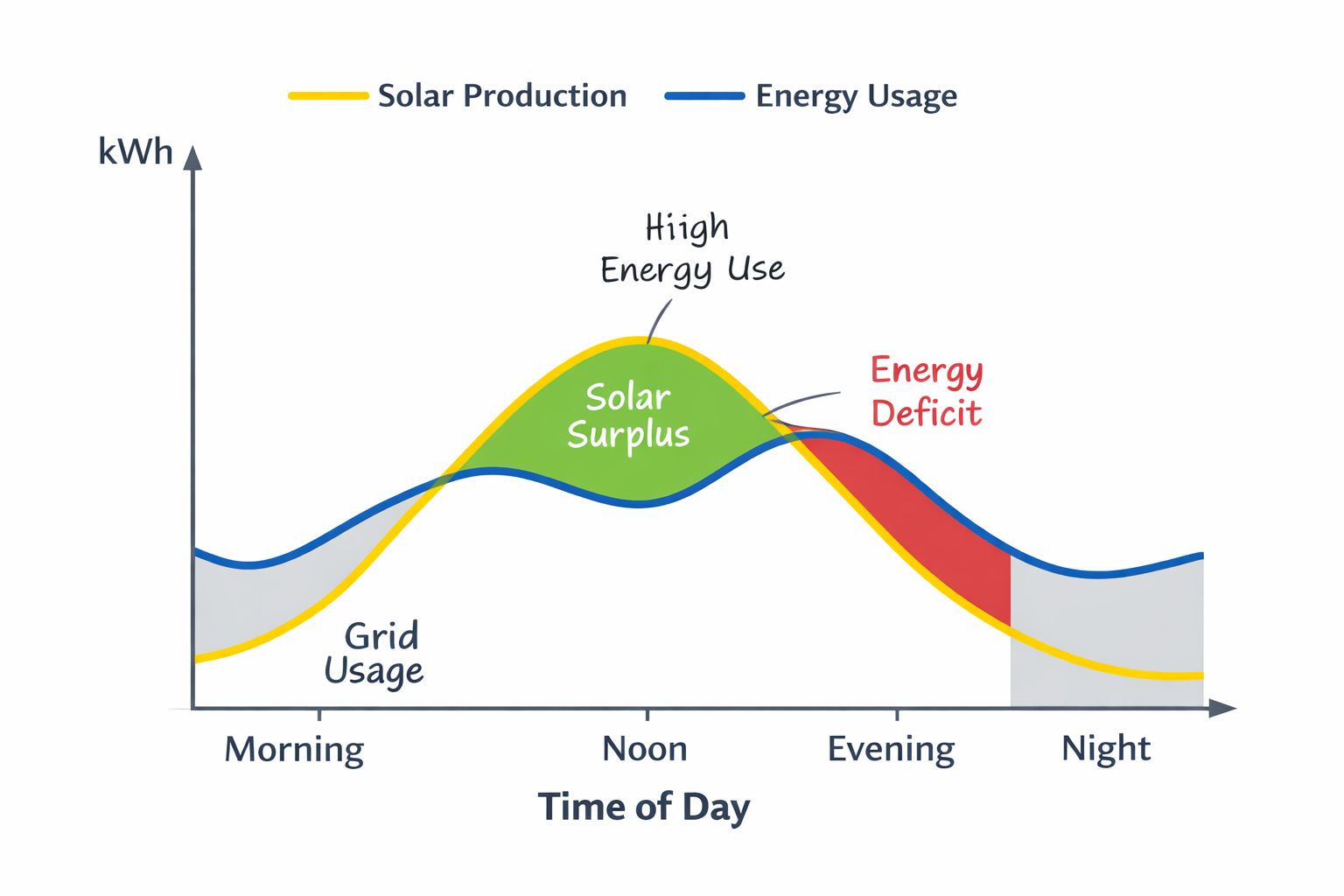
🎯 The Solar Homeowner’s Strategy: Your solar panels produce power during the cheapest time (midday Off-Peak), but you consume the most grid power during the most expensive time (evening Peak). This is where your solar strategy—and especially a battery—becomes critical.
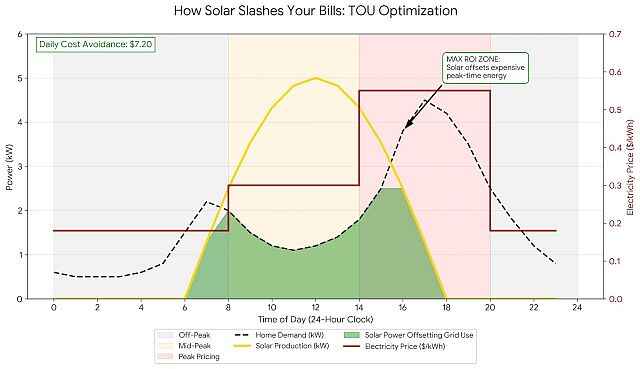
TOU: EXPLAINED Optimizing Solar Savings with TOU strategy and Credit Systems.
🔋Part 2
Net Metering: The Gold Standard for Solar
Net Metering is the most favorable policy for solar homeowners, and it’s the foundation of the original solar savings model.
What is Net Metering?
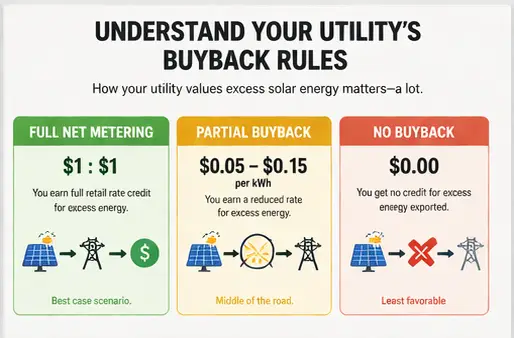
Net Metering is a billing mechanism that credits solar customers for the electricity they add to the grid at the full retail rate [2].
How It Works: The Spinning Meter
-
When you produce more than you use (midday): Your meter spins backward. You are essentially selling your excess power to the utility at the same price you would pay to buy it.
-
When you use more than you produce (nighttime): Your meter spins forward. You are buying power from the utility.
-
The Result: At the end of the month, you are only billed for the “net” difference between the power you consumed and the power you generated. If you generate more than you consume over the billing cycle, you receive a credit on your bill.
🎯 The Net Metering Advantage: Under Net Metering, the value of your solar production is maximized because every kWh you export is worth the same as every kWh you import. This is a powerful, simple, and highly effective way to zero out your electric bill.
🔋Part 3
Buyback Programs: The New Reality
As solar adoption has grown, many states and utilities have moved away from full Net Metering and implemented Solar Buyback Programs (sometimes called Net Billing or Feed-in Tariffs).
What is a Buyback Program?
A Buyback Program credits solar customers for the electricity they add to the grid at a rate that is less than the full retail rate [3].
How It Works: The Split Rate
-
When you produce more than you use (midday): You are selling your excess power to the utility at the wholesale rate (the utility’s cost to generate power), which is often much lower than the retail rate you pay.
-
When you use more than you produce (nighttime): You are buying power from the utility at the full retail rate.
🎯 The Buyback Challenge: Under a Buyback Program, the value of your exported solar power is significantly reduced. You are buying high and selling low. This change in policy has fundamentally shifted the solar strategy, making the addition of a battery almost essential.
🔋Part 4
The Strategic Connection:
TOU + Buyback + Battery
When you combine TOU rates with a Buyback Program, the financial incentive to simply export power to the grid disappears. This is where the solar battery becomes the ultimate financial tool.
The Old Strategy (Full Net Metering):
-
Export all excess power to the grid during the day for a full retail credit.
-
Use the credits at night.
The New Strategy (TOU + Buyback):
The goal is to maximize self-consumption and avoid buying Peak power.
-
Midday (Off-Peak): Your solar panels generate power. Instead of exporting it for a low Buyback rate, the power is used to charge your battery.
-
Evening (Peak): When the utility rate jumps to $0.40/kWh, your battery automatically discharges to power your home. You are avoiding buying the most expensive power the utility offers.
-
Overnight (Off-Peak): The battery is depleted, and you use the cheapest grid power for the rest of the night.
🎯 This strategy is called Energy Arbitrage—using your battery to store low-value energy (midday solar) and deploy it to offset high-value energy (evening Peak grid power).
🎯 The Battery ROI: In a TOU/Buyback environment, a solar battery can increase the value of your solar savings by 5x or more compared to a system without storage [4]. It turns your solar system into a true financial optimizer, ensuring you never have to pay the utility’s highest rates.
TOU Arbitrage and Solar Power Production
Conclusion
🏆 Mastering Your Energy Flow 🏆
Understanding TOU, Net Metering, and Buyback programs is not just about reading your bill; it’s about mastering your energy flow.
-
If you have Full Net Metering, your solar panels are a fantastic investment on their own.
-
If you are on TOU Rates or a Buyback Program, a solar battery is no longer a luxury—it is a financial necessity to maximize your solar savings and achieve the best possible Return on Investment.
Talk to your installer about your specific utility’s rules.
🔑 Knowing the difference between these programs is the first step to better solar outcomes and optimized results

Winning with Solar
Interactive eGuide 2/2
Your Advanced Guide to Going Solar
Post-Installation Mastery, Advanced Equipment, & Long-Term Savings
Read More
Solar Incentives by State in 2026
US Solar Tax Credits : 2026 Updated Facts
Solar ROI Leverage : Strategy, Sequence and Timing
UNDERSTANDING INCENTIVES (Bonus Cheat Sheet)
References
[1] Enphase. “Time of Use (TOU) rates explained: A smarter way to…” Enphase Blog.
[2] NY Engineers. “Solar Buyback vs. Net Metering: Key Differences Explained.” NY Engineers Blog.
[3] Base Power Company. “understanding solar buyback, net metering, and…” Base Power Company Blog.
[4] Sunlux. “T.O.U. Rates and Battery Optimization: How to Maximize Your Solar Savings.” Sunlux Blog.