 Navigating
Summary
Going solar is smart for the planet—and your wallet. Incentives like SRECs, state tax credits, property and sales tax exemptions, and utility programs can dramatically reduce upfront costs and increase long-term returns. Act now to maximize your savings and start earning from clean energy.
Why Solar Incentives Influence More Than Upfront Cost
Incentives Shape Timing, Financing, and System Design
Going solar is an investment, and like any smart investment, you want to maximize your return and minimize your initial outlay.
🚨 This is where incentives come in.
They are the powerful financial mechanisms put in place by governments and utilities to make your decision to go green not just environmentally sound, but financially brilliant.
Forget the confusing acronyms and the fine print. This is your comprehensive guide to the ” what, where, how, and how much” of solar incentives. We’re going to show you how these programs aim to reduce your cost and create a powerful motivation to join the clean energy revolution.
US States Incentives Cheat Sheet
See which Solar Incentives are available in your State and what to know before applying.
Incentives Influence Timing, But Should Not Create Panic
Why Solar Incentives Feel Confusing
One of the biggest sources of confusion in solar is that terms like rebates, incentives, credits, and tax benefits are often used interchangeably — even though they are not the same thing.
Different companies, installers, and information sources may also emphasize different parts of the system depending on what they are trying to explain or sell.
This creates a situation where homeowners are often trying to compare:
- tax credits
- rebates
- utility incentives
- performance-based programs
- and regional funding schemes
as if they are all the same type of benefit.
They are not.
Understanding the differences is key to making clear financial decisions.
Incentives Should Support Decisions, Not Pressure Them
One of the biggest mistakes homeowners make is allowing incentive deadlines or promotional messaging to force rushed decisions.
Solar incentives absolutely matter.
They can significantly influence long-term system affordability and payback timelines.
But incentives are only one part of a much larger equation.
A well-planned system with realistic expectations will usually outperform a rushed decision made purely out of fear of “missing out.”
While incentives absolutely affect long-term system economics, rushed decisions often create other problems:
- oversized systems
- poor financing structures
- weak installer comparisons
- or systems that do not align with future energy goals
Good planning balances incentive awareness with calm decision-making.
The goal is not simply capturing the largest possible incentive, credit or rebate.
The goal is understanding how:
➖energy usage
➖financing
➖system sizing
➖utility pricing
➖and long-term operational costs
work together over time.
Good solar planning creates clarity first.
The incentives simply help support the process.
The goal is building a system that still makes sense years after installation.
Incentives Change — Good Solar Planning Matters More
The 3 Layers of Solar Incentives
To understand how solar incentives affect long-term value, it helps to separate them into three distinct categories. These are often mixed together in marketing, but they operate very differently in practice.
🟢 1. Rebates (Upfront Cost Reduction)
Rebates reduce the initial cost of installing a solar system. They are typically applied at or shortly after installation and immediately lower the total purchase price.
They are usually:
- limited by funding availability
- region-specific
- offered by utilities, local governments, or installers
Rebates are the most direct form of cost reduction, but they are also the most variable and market-dependent.
🟢 2. Incentives (Ongoing Savings Structures)
Incentives refer to programs that reduce your ongoing electricity costs after installation. These can include utility programs, performance-based credits, or structured billing mechanisms.
Common examples include:
- net metering programs
- time-of-use billing advantages (indirectly through solar alignment)
- local utility incentive schemes
These systems don’t reduce the upfront cost — instead, they improve long-term monthly savings and influence how quickly a system pays for itself.
The Local Boost – Understanding State and Utility Incentives & Credit Systems
Many states, counties, and even local utility companies offer their own incentives that stack on top of solar installation credits. These vary widely, so you must check what is available in your specific location.
Unlike rebates, which reduce upfront installation costs, solar credit systems are typically tied to how your system performs or how energy is accounted for over time.
The most common credit-based structures include:
Federal Tax Credits
Note: Only applies to systems installed before 2026
These reduce your taxable income or tax liability based on a percentage of your system cost. They are claimed after installation and directly reduce what you owe in taxes.
State or Local Tax Credits
Some regions offer additional tax-based incentives on top of federal programs. These vary widely and may be time-limited or income-dependent.
Utility Credit Systems: Net Metering / Buyback Credits
In many areas, excess solar energy sent back to the grid earns you credits on your utility bill. These credits offset future energy consumption.
A. Utility Credit Systems and Long-Term Solar Savings
One of the most important — and most misunderstood — parts of solar incentives involves how utility companies handle excess solar energy.
When a solar system produces more electricity than a home uses at a given moment, that energy may be sent back to the grid. Depending on the utility provider and local regulations, homeowners may receive credits or compensation for that exported energy.
The structure of these programs directly affects long-term solar value.
Net Metering
Net metering allows homeowners to earn credits for excess electricity sent back to the grid. These credits can then offset electricity used later when solar production is lower, such as at night or during poor weather.
In regions with strong net metering policies, solar systems often achieve faster payback periods because exported energy retains higher value.
Buyback Programs
Some utilities use buyback systems instead of traditional net metering.
Under these structures, exported solar energy is purchased by the utility at a predetermined rate. However, these rates are often lower than the retail price homeowners pay for electricity.
This changes the economics of solar significantly and can increase the importance of:
- self-consumption
- battery storage
- and energy usage timing
Utility-Specific Solar Incentives in the US:
Your local utility may offer its own programs, such as:
-
Performance-Based Incentives (PBIs): Payments based on the actual energy your system produces over a set period, rather than upfront installation cost.
Each system affects solar economics differently, but they all influence long-term savings, payback period, and return on investment. -
Low-Interest Loans: Financing options specifically for solar and energy efficiency upgrades.
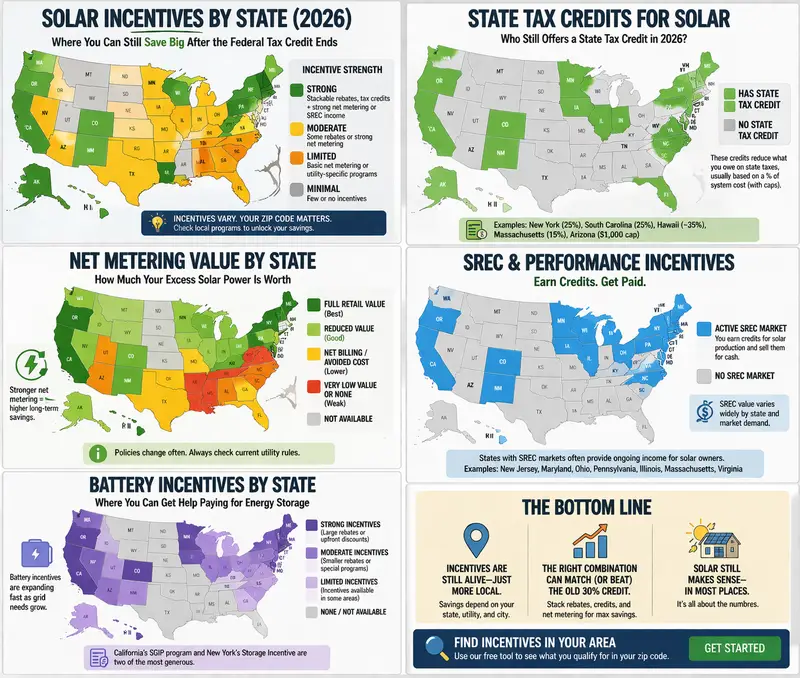
B. Solar Tax Credit Systems in the US:
1. 💵State Tax Credits
Some states offer their own income tax credits, similar to the federal ITC, but at the state level. For example, some states offer a percentage of the system cost (e.g., 25%) up to a certain dollar limit (e.g., $5,000) [7].
2. 💵Property Tax Exemptions
In many states, installing a solar system increases the value of your home. However, a property tax exemption ensures that the added value from your solar installation is not included in the assessment of your property for tax purposes. This means you get the benefit of the increased home value without the burden of higher property taxes.
3. 💵Sales Tax Exemptions
Some states exempt solar equipment from state sales tax. This is an immediate, upfront saving that can reduce the total cost of your system by 5% to 8% or more, depending on your state’s sales tax rate.
🟢 3. The Income Stream : SRECs (Solar Renewable Energy Credits)
In certain regions, solar systems generate tradable credits based on the amount of electricity they produce. These credits can be sold for additional income depending on local market demand. Solar Renewable Energy Certificates (SRECs) are a performance-based incentive that can provide you with a recurring stream of income for years.
What is a SREC?
An SREC is a tradable commodity that represents the environmental benefit of generating one megawatt-hour (MWh) of electricity from your solar system [5].
Think of it this way: when your panels generate electricity, they create two products:
-
The physical electricity you use to power your home (which saves you money on your utility bill).
-
The SREC, which is the certificate proving you generated clean energy (which you can sell for cash).
SRECs are:
- not available everywhere
- highly region-dependent
- subject to market price fluctuations
- typically a long-term revenue stream rather than an upfront benefit
For some homeowners, SRECs meaningfully improve ROI. For others, they do not apply at all depending on location.
How Does it Work?
-
You Generate: Your solar system produces electricity.
-
You Earn: For every 1,000 kilowatt-hours (1 MWh) your system generates, one SREC is created and credited to your account.
-
You Sell: Utilities in certain states are mandated to purchase a certain amount of renewable energy. They buy SRECs from you (or through an aggregator) to meet these state-mandated requirements.
📌 Crucial Consumer Takeaway: SREC markets are state-specific and only exist in states with a Renewable Portfolio Standard (RPS) that includes a solar carve-out (e.g., New Jersey, Massachusetts, Maryland, etc.) [6]. The price of an SREC fluctuates based on supply and demand within that state’s market, and the income can be substantial, often adding thousands of dollars to your system’s lifetime savings.
📌 Incentives change—systems last decades.
Make sure your setup qualifies now and later.
Grab this Bonus Guide to see what’s available in your State
US States Incentives Cheat Sheet
DownloadSee which Solar Incentives are available in your State and what to know before applying.
Why These Systems Matter
Two homes with identical solar systems can produce very different financial outcomes depending on how exported electricity is credited.
This is one reason solar ROI varies so much by:
- location
- utility company
- policy structure
- and future regulatory changes
Understanding utility credit systems helps homeowners evaluate:
- long-term savings potential
- battery value
- system sizing decisions
- and how much energy should ideally be used directly inside the home versus exported to the grid.
Why It Matters to Structure a Solar Incentive Stack
These three categories are often grouped together as “solar incentives,” but they influence solar economics in very different ways.
- Rebates affect your starting cost.
- Incentives affect your monthly savings and payback period.
- SRECs affect long-term income potential in specific regions.
- Financing Options may also play a role
Understanding this separation is essential for evaluating real solar value, because each layer impacts a different part of the financial timeline.
When combined correctly, they help explain why two identical solar systems can produce very different financial outcomes depending on location and policy structure. It mostly comes down to strategic solar planning and smart system design.
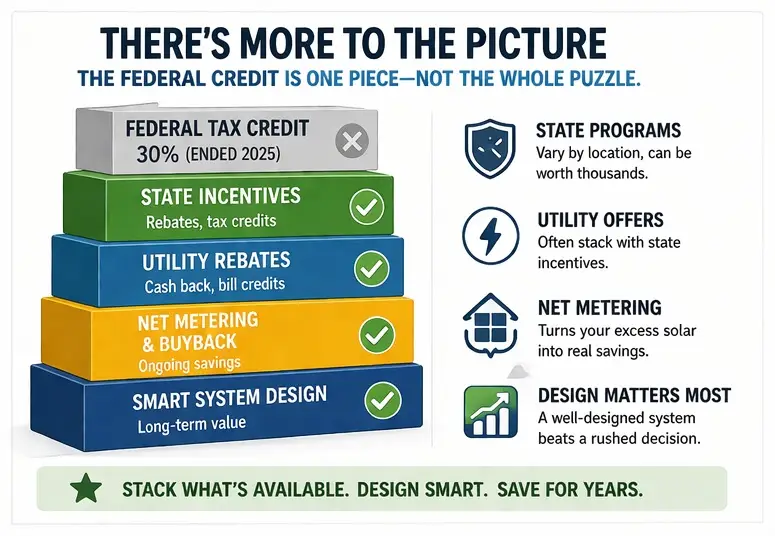
The Combined Motivation: How Incentives Transform the ROI
The true power of solar incentives is their cumulative effect. They work together to dramatically shorten your payback period and boost your long-term return on investment (ROI).
| Incentive Type | Financial Mechanism | When You Receive It | Key Benefit |
|---|---|---|---|
| Tax Credits | Tax Credit (upto 30% of cost) | When filing taxes for the installation year. | Largest single reduction in upfront cost. |
| SRECs | Tradable Commodity (per MWh) | Recurring income for 5-15 years (market dependent). | Creates a reliable, long-term income stream. |
| State Tax Credit | State Tax Credit (Varies) | When filing state income taxes. | Further reduces the net cost of the system. |
| Property Tax Exemption | Tax Exemption | Annually, for the life of the system. | Protects you from increased property taxes due to home value increase. |
The Early Bird Catches the Worm!
These incentives are not permanent. They are designed to kickstart the clean energy transition. We’ve all seen how quickly a big (beautiful???) bill can land change, and not always favourably so. By taking advantage of these programs now, you are essentially getting a massive discount on an asset that can generate electricity for your home for the next 25+ years.
Remember:
New installs from 2026, do not qualify for the federal Solar ITC.
BUT
This has made the focus turn toward local utility programs and State incentives.
Read these 3 articles:
Solar Incentives by State in 2026
Why Some States’ Solar Incentives Pay More
US Solar Tax Credits: 2026 Updated Facts
Incentives vary by location. Always check with your local utility and installer before signing.
Use the Quick Guide below to see what your State offers.
US States Incentives Cheat Sheet
See which Solar Incentives are available in your State and what to know before applying.
Speak to Solar Experts You Can Trust
and who understand incentives, rebates, and utility policies.
Quote Request Tool
Connect with Local US Installers trusted by homeowners nationwide — step-by-step, practical, and pressure-free.
Affiliate Disclaimer:
This link may connect you with solar providers through our partner network.
We may earn a commission if you choose to engage — at no extra cost to you.
Why Use This Service?
Choosing the right installer can feel overwhelming — especially when options vary by location.
Instead of guessing, you can start by seeing which providers are actually available in your area.
✔️ Fast connection to available solar providers
✔️ No obligation to move forward
✔️ Simple, guided process
✔️ Options based on your location
✔️ Explore multiple options at your own pace
Learn More on How This Tool Works
https://navigatingsolar.com/
Frequently Asked Questions
What is the difference between a solar rebate and a solar incentive?
A solar rebate usually reduces the upfront installation cost of a solar system, while solar incentives often improve long-term savings through tax credits, utility programs, or energy credits.
How does net metering work?
Net metering allows homeowners to receive credits for excess solar electricity sent back to the grid. These credits can offset electricity used later when solar production is lower.
What are SRECs in solar energy?
SRECs (Solar Renewable Energy Credits) are tradable credits earned from solar electricity production in certain regions. Homeowners may sell these credits for additional income depending on local programs.
Do all states offer the same solar incentives?
No. Solar incentives vary widely depending on state policies, utility companies, local regulations, and available funding programs.
Why do solar incentives affect long-term ROI?
Solar incentives can reduce installation costs, improve monthly savings, shorten payback periods, and increase the overall financial return of a solar system over time.
References
[1] Internal Revenue Service. “Residential Clean Energy Credit.” IRS.gov.
[2] SEIA. “Solar Investment Tax Credit (ITC).” Solar Energy Industries Association.
[3] SolarTech Online. “Solar Investment Tax Credit (ITC) 2025: Complete Guide To…” SolarTech Online Blog.
[4] EnergySage. “Federal Solar Tax Credit In 2025: How Does it Work?” EnergySage.
[5] Solar United Neighbors. “Solar Renewable Energy Credits (SRECs).” Solar United Neighbors.
[6] Palmetto. “SRECs: Solar Renewable Energy Credits and You.” Palmetto Blog.
[7] GreenLancer. “A Guide to Government Solar Incentives.” GreenLancer Blog.
[8] DSIRE. “Database of State Incentives for Renewables & Efficiency.” DSIREUSA.org.