 Navigating
 Phase 1: Initialization
System Sizing & Home Solar Readiness Prep
Most uncertainty fades once you understand the math. Let’s map your roof, size your system, and check your readiness.
LET’S MAP THIS OUT
This phase reduces uncertainty, and offers a clear perspective to use as foundation.
It also better prepares you for approaching professionals.
Before choosing hardware or financing, you need three things:
- ⚙️ Physical readiness
- ⚙️ Energy clarity
- ⚙️ Financial framing
Everything else builds on this.
📌
What you need to start:
You landed in the right place!
You’ll find everything you need to start on this website:
– Solar Readiness Checklists
– System Sizing & Cost calculator
– ROI & Payback Calculator
– Savings Calculator
– Guides for info & deeper understanding of solar hardware, system performance, and savings mechanisims
– Trusted Resources for quotes
📌 On this page
Actionable next steps & calculators for:
📌 Note:
If you haven’t yet, take the
– it’s the best starting block and aids with clarity before you begin the process of calculating costs.
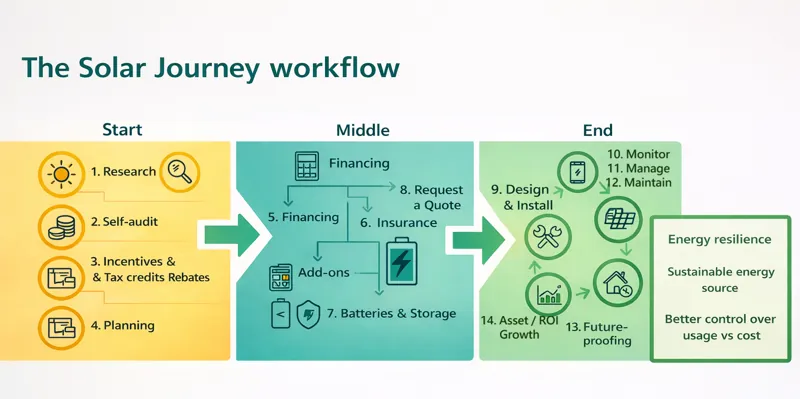
Step 1
Launch Sequence
Before you speak to an installer, establish your baseline.
This readiness checklist walks you through the essential items every homeowner should verify before requesting quotes.
It covers your usage history, roof condition, financial position, and local incentives.
Take a few minutes to work through it – it explains the what and why.
It’s a solid starting point for beginners and a great reminder to those who already own a system.
💡 Clear preparation now prevents expensive mistakes later.
❓Did you take the Smart Start Quiz?
Click here if you skipped it, then follow the prompts back here.
❓Why solar preparation matters:
-
Prevent undersized or oversized systems
-
Get the most power from your roof
-
Increase your solar savings potential
-
Identify roof or shading limitations early
-
Plan for battery storage and future upgrades
-
Understand costs, incentives, and payback
How ready are you?
Interactive Tool
Solar Readiness Checklist
Step 2
Roof Readiness
Once you know what your usage and power needs are, it’s time to look at panel placement.
This determines whether your roof is fit for installation, which panels will work best, or if alternative mounting options should be considered.
Alternative mounting
Roof not fit? Don’t let that stop you!
You have options.
🟠 Ground-Mounted
Panels installed in your yard or open land. Great for rural properties.
🟠 Carports / Pergolas
Stylish structures that double as shade and power generators.
🟠 Community Solar
Join a shared solar farm and earn credits. No roof needed.
🟠 Solar Shingles
Integrated into roof tiles. Ideal for aesthetics or strict HOAs.
Interactive Tool
Positioning
In many parts of the US, south-facing roofs perform best, but east- and west-facing arrays can also be viable depending on usage patterns and incentives.
Shade & Clouds
Note major shading: Look for trees or buildings casting shadows between 9am-3pm.
Cold Climates
Structural
Many standard residential roofs can support solar installations, but this should always be verified.
Roof age matters.
If your roof is approaching the end of its lifespan, it’s often worth addressing repairs or replacement before installing solar.
A qualified professional can advise based on your specific situation.
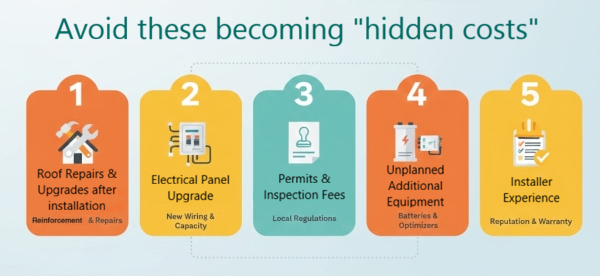
What else to be aware of
(costs not always mentioned upfront)
➜ Electrical panels or wiring may need updates, especially in older homes.
➜ Tree trimming or vegetation management.
➜ Permit requirements and local codes.
Downloaded your guide yet?
Visit the Library to download & collect them all.
Useful guides for this phase:
➡️ The Starter Kit Guides
➡️ The Hardware Guides
➡️ Solar Savings Encyclopedia
➡️ Appliance Cheat-Sheet Schedule
The Blog
Categories:
➡️ Solar Equipment & Tech
➡️ Solar Financing Incentives
These offer deeper information for getting started with solar.
Step 3
Understanding Your Energy Needs
Consumption first. Panels second.
Solar systems are sized based on how much electricity you actually consume, not just square footage.
It’s easier to know which system to choose when you know how much energy you use.
Current usage and future plans influence system size and design choices.
🟡 Related Articles
Looking for more info?
Browse these articles
➜ Types of solar-powered systems
Interactive Tool
Let’s measure your energy consumption and usage patterns
Where to find your usage
Look for a section labeled “kWh Usage” or “Energy Consumption”.
A graph showing 12 months is the gold standard.
💡 What is 1 kWh?
Running a 1000-watt appliance for 1 hour.
e.g. Running a 100W lightbulb for 10 hours = 1 kWh
Your Usage Patterns
Most households peak at specific times of day and season.
Knowing this helps later with battery planning.
Summer: High usage (AC cooling).
Winter: High usage (Heating systems).
Evenings: Lighting + Entertainment.
Step 4
Calculate Your Needs
Right-sized systems tend to align better with actual usage and long-term needs.
Now that you have your bill, it’s time for the Big Reveal!
Estimate both the system size you need, and the potential costs involved.
📌 Remember
Solar is not one-size-fits-all.
Good system design considers both current needs and future plans.
Ask yourself:
➜ How long do you plan to stay in this home?
➜ Will energy use increase (EVs, heat pumps, home offices)?
➜ Do you want flexibility for storage or system expansion later?
➜ Discuss future scenarios with your design and installation partners during consultations.
Planning ahead early often reduces constraints later.
Learn all about Solar Hardeware Components here
System Size & Cost Calculator
Interactive Tool
Step 5
Financial Mapping
Solar is a Living Asset.
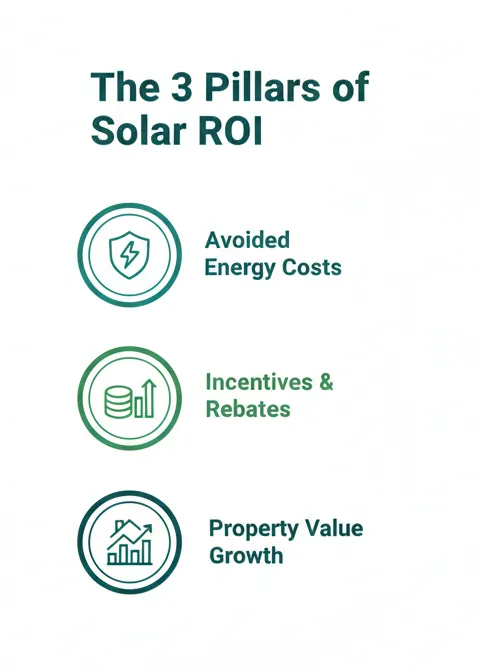
Solar value doesn’t come from the panels alone.
It develops over time through avoided electricity costs, available incentives, and how your system interacts with changing energy rates and household usage.
Understanding these factors early helps you map the long-term financial potential of going solar
Financial mapping helps homeowners understand where that value comes from and how it evolves.
ROI & Payback Calculator
Interactive Tool
Estimate payback timelines & ROI
For informational purposes only. Always consult a licensed professional.
Solar Savings Calculator
Interactive Tool
Explore long-term savings
Savings grow as utility rates rise. That’s the math most sales pitches skip.
The Funky Formula shows why savings grow as utility rates rise.
For informational purposes only. Always consult a licensed professional.
Looking into Solar Battery Storage too?
Battery storage only works if your solar system can properly charge it.
👉 First, calculate your system size&cost, annual savings,and ROI & Payback Period above, then
Go to:
Learm more about Solar Finances & Incentives here
PVWatts Solar Production Calculator
For advanced solar production modeling, the National Renewable Energy Laboratory provides the PVWatts Calculator.
This tool uses real solar irradiance data, weather patterns, and system design parameters to estimate energy production from photovoltaic systems across the United States.
It is widely used by solar installers, engineers, and researchers.
Explore the official tool here:
Provided by the National Renewable Energy Laboratory (NREL)
📌 Rebate & Incentive Reminder
Solar incentives vary by state, utility, and installation date.
Always confirm eligibility, deadlines, and application requirements with your local energy office or tax professional.
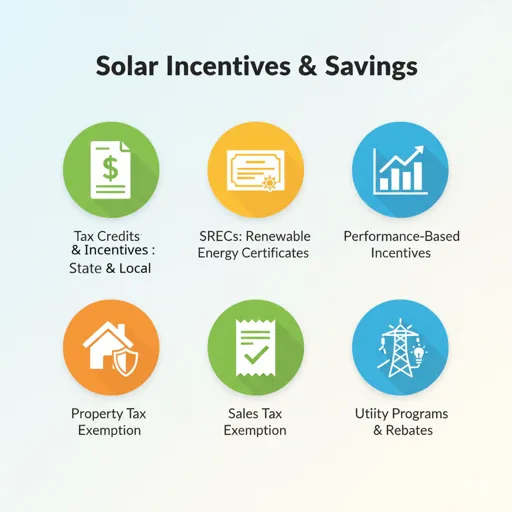
🟡 Do you know?
…about the state and local incentives for your area?
💡 GOOD TO KNOW
During this phase, many homeowners
✅ Research financing options: Cash, Loans, Leases
✅ Check local and state incentives
✅ Inquire about tax credits
✅ Ask about Utility credit systems & rules
✅ Double-check they have the right insurance for solar.
✅ Get clued-up on warranties and permits
✅ Plan for future growth & expansion
✅ Compare quotes
A thorough installer discussion often includes:
➜ System design trade-offs
➜ Warranties & service terms
➜ Permits & inspections
➜ Insurance considerations
➜ Expansion options
💡Quick Tips:
Solar incentives and rebates can be a big help — but they vary widely by state, utility, program, and installation date.
✅ Check if your system type and size qualify.
✅ Confirm the incentive program is still active
✅ Deadlines and caps can change — confirm current rules, deadlines, caps and paperwork requirements.
✅ Some incentives require specific installer certifications.
✅ Always verify details with your utility, state energy office, or a tax professional.
✅ Think of it as a friendly nudge — don’t assume eligibility without checking first. Your ROI depends on accurate info!
🟡 Related Articles
Something you don’t want to skip
NavigatingSolar has a Blog Category
dedicated to Solar Finances & Incentives
There you will find info on:
- Incentives
- Tax Credit Systems
- Rebates
- Solar Financing
Step 6
Solar Warranties & Permits
Interactive Tool
The Pre-sign Paperwork Checklist
For informational purposes only. Always consult a licensed professional.
Solar & Permits
Installers usually handle
* building permits
* electrical permits
* interconnection applications
Homeowners should still verify
* permits were submitted
* inspections were passed
* utility issued Permission to Operate
📌 Protection Beyond Installation
Solar systems come with equipment warranties and require local permits.
Understanding both ensures your system is approved, protected, and supported over its lifetime.
Before you sign contracts, verify you have these specific warranties and permits.
What Comes Next?
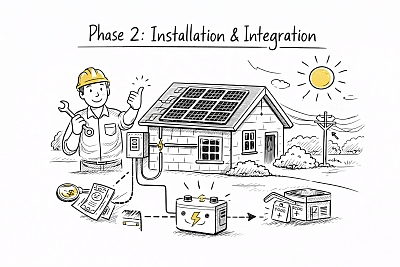
Once sizing, readiness, and financial framing are clear,
the process moves into detailed system design and installation.
This includes
-
-
- final layouts,
- equipment selection,
- permits,
- scheduling,
- and inspections
-
— handled by licensed professionals.
That’s when this tool becomes useful:
Solar Quote Request Tool
Request multiple solar quotes from professional installers in your area
Learn More about how this process works →
Affiliate disclaimer
We’re an independent resource and don’t provide solar installation or quotes directly.
Affiliate Disclaimer
Some links on this page may connect you with solar providers through our partner network, including MySunSaver.
We may earn a commission if you choose to engage — at no extra cost to you.
🔗 NavigatingSolar Partner Disclosure
By continuing, you agree to be contacted by a provider from our partner network, including MySunSaver.
Your information will be handled according to our Privacy Policy and the partner’s Terms of Service.
NavigatingSolar.com
Solar Knowledge Hub
Free Solar Tools, Guides & Homeowner Resources
Research ➜ Plan ➜ Prepare ➜ Install
Info & Facts
Blog Articles and Deep-Dives into:
- Solar Hardware
- Solar & Money
- Strategy & Insights to Solar Savings
Reference Library
Read – Return – Refer
- Step-by-Step Guides
- Trusted Links to factual, up-to-date solar info
Tools
Your Dashboard holds all the solar planning tools in one place
- Solar Calculators
- Preparation Checklists
- Maintenance Checklists
Resources
Install & Protect
- Solar Installation & Equipment
- Solar Insurance
- Solar FAQ
Phase 1 Complete!
You now have the data and clarity needed to move forward.
Next, we explore optimization and performance.
On the next page:
🔸 How to get the most from your solar system
🔸How to boost Solar Savings and shorten the Payback Period🔸Utilizing Utility Credit Systems to Save More