 Navigating
 Phase 2: Optimization
Solar System Optimization:
Maintenace & Performance
How to Maximize System Performance & Energy Savings Strategies
In this phase, ownership turns into stewardship – and strategy nurtures success.
Installing solar is only the beginning.
Owning it well is where value is protected
— or quietly eroded.
The real savings come from how well you manage, monitor, and maintain your system over time.
You’ll learn how to turn your solar installation into a high-performance energy system that reduces costs, avoids failures, and adapts to seasonal changes.
📌 What Solar Optimization Can Do
When managed correctly, a solar system can:
✓ Increase energy savings by 10–25%
✓ Extend equipment life by 5–10 years
✓ Detect performance issues early
✓ Reduce grid dependence during peak hours
Solar optimization isn’t about installing more panels —
it’s about using the system you already own more intelligently.
Observation and Operation phase
What you’re now doing is fine-tuning governance, not fixing gaps.
You’re just stepping into the operator phase now.
📌 Below you will find some handy tools to start with – they are also part of your dashboard.
Your Solar Control Center
Think of your solar system like a small power plant attached to your home.
To run it efficiently, you need visibility into:
• Energy production
• Home energy usage
• Battery storage cycles
• Grid imports and exports
Modern monitoring tools turn this data into a simple dashboard you can check in seconds.
That’s where the 3M Optimization Strategy comes in.
Solar Savings Optimization Strategies
Optimizing system performance, daily savings, and long-term ROI
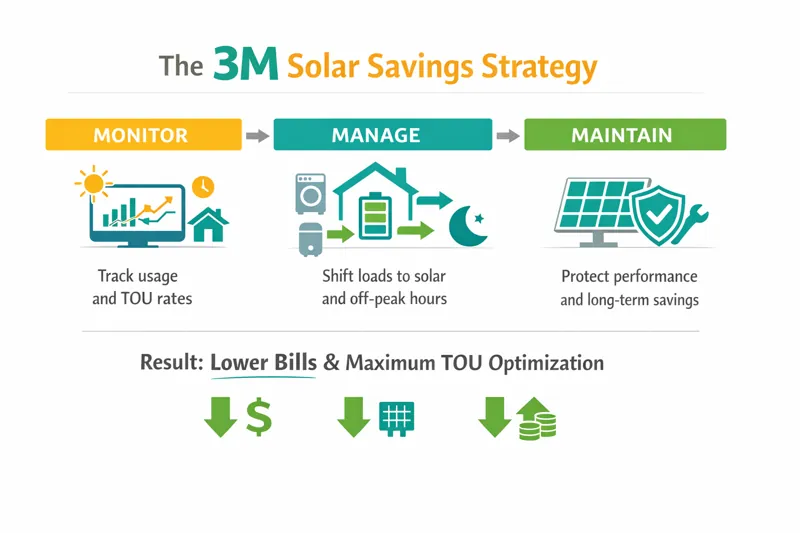
The 3 M Strategy
Solar owners who get the best results follow three simple habits:
Manage
⬇️
Monitor
⬇️
Maintain
Mostly automated, this system allows you to
➜ practice load-shifting effectively
➜ optimize system performance
➜ gives you greater visibility and control over usage, costs, and performance dynamics.
Here, consistency is key.
Grab the eGuide and see the steps below.
Get the Tools Here
Your NavigatingSolar Dashboard,
— the central hub for all your home solar planning.
Access calculators to size your system, step-by-step checklists, interactive quizzes, and guides — everything you need to plan, track, and optimize your solar energy journey — in one place.
Step 1
MANAGE
The Performance Check-Up
Daily awareness of your system’s performance.
The goal of this step is simple:
Know what “normal” looks like for your system.
Once you know the baseline:
• performance drops become obvious
• faults are detected early
• seasonal changes make sense
💡Did You Know?
Big mistake most homeowners make?
Thinking solar is a set-and-forget system…
💡Solar Performance Benchmark
As a rule of thumb:
• Check your monitoring app once per week
• Compare output on similar sunny days
If production drops 10% or more without explanation, investigate:
• panel dirt buildup
• shading changes
• inverter alerts
• system faults
Step 2
MONITOR
Track production, consumption, and battery behavior.
How do I see what my system is doing every day?
That’s where monitoring apps, battery logic, and inverter dashboards come in.
Once your system is running, the most valuable habit you can develop is watching the data.
Modern solar systems give homeowners visibility into:
• Energy production
• Home consumption
• Grid imports and exports
• Battery charging cycles
Even a quick weekly check can reveal early warning signs long before problems become expensive.
Interactive Tool
What you should be Monitoring
Production Monitoring
Track how much energy your system generates daily.
Consumption Monitoring
Understand when your home uses electricity.
Battery Monitoring
See charge cycles, peak-hour discharge, and backup capacity.
Inverters & Hardware
Your inverter and monitoring hardware determine how detailed your system data will be.
Some systems show basic production numbers, while advanced setups track:
• panel-level performance
• home energy consumption
• battery charge behavior
Troubleshoot checklist
Know what’s normal — and what needs attention.
Before calling a pro (and paying a fee), run this 30-second diagnostic to fix common errors yourself.
Disclaimer: For guidance only. Not a substitute for professional advice. Follow all warranties and manufacturer instructions.
Solar Monitoring Apps
Most modern systems include a mobile or web dashboard that acts as your solar command center.
Monitoring apps allow you to:
✓ track daily energy production
✓ compare performance over time
✓ receive system alerts
✓ monitor battery storage levels
✓ identify efficiency changes
Many homeowners discover that simply watching their energy patterns helps reduce electricity bills.
Tracking your system:
✅ A simple spreadsheet is enough during Phase 2.
✅ Monitoring apps are optional now, but become more useful in Phase 3, when you start maximizing performance, managing batteries, and optimizing usage.
Step 3
MAINTAIN
Small actions. Big lifespan impact.
Protect your long-term investment.
Even a well-installed solar system loses performance if maintenance is ignored.
Protect the system with seasonal care.
• prevent degradation
• avoid warranty issues
• protect output
Together these habits help you maximize performance and prevent costly failures.
Interactive ToolS
Seasonal Checklist
Dust, dirt, and pollen can noticeably reduce production if left unchecked.
Keep your system operating efficiently year-round.
Here’s a handy checklist for that – you can also find it in your toolkit.
Select a season, and tick the box!
Click the image below to open your
NavigatingSolar Toolkit!
Find these tools, bonus downloadables and more — all in one place.

💡 Cleaning Pro-Tips
✅ Morning Only:
Wash before 8 AM to avoid thermal shock (cracked glass).
✅ No Soap:
Use de-ionized water or a hose rinse. Soap leaves residue.
✅ Safety First:
If you can’t reach it safely, hire a pro.
💡 Seasonal checks help ensure:
• panels remain clean
• wiring connections stay secure
• shading issues are detected
• monitoring alerts are reviewed
A few simple checks each season can protect your investment and maintain peak output.
Full System Protection
Maintenance is only one part of what keeps your whole system protected.
Learn more about
Step 4
Warranty Vault
The Warranty Tracker
Don’t let your coverage expire without a final check-up.
Use this tool to help you keep track.
Interactive ToolS
Solar Warranty Vault
Track each component individually.
Green means you are covered.
The Complete Solar Savings Optimization Strategy
This optimizes system performance, production and savings, and nutrures long-term ROI
Step 5
Mastering Your Utility Bill:
Timing, Billing Rules, and the 3M Strategy
This is where long-term value is often gained or quietly eroded.
In many cases, billing rules like credits, net metering, TOU (Time Of Use) rates, influence outcomes more than hardware alone.
Solar panels generate electricity — but utility billing rules determine its value.
The real advantage comes from understanding how your utility measures, credits, and charges for electricity — this is essential to harnessing the full value of your solar system.
Most solar systems succeed or fail financially in the interaction between:
- production,
- usage timing, and
- billing structure.
When timing, billing rules, and the 3M strategy work together, solar production is converted into maximum financial value
— without this awareness, savings often slip away through utility billing mechanics.
The Utility Value Chain
1️⃣ Produce
Your system generates electricity during daylight hours.
2️⃣ Align
Energy use, load shifting, and export timing interact with utility rate structures and credit rules.
3️⃣ Capture Value
Savings occur when production and usage align with billing mechanics such as TOU pricing and net-metering credits.
3M Strategy
🟠 Monitor your utility billing patterns
🟠 Manage when energy is used or exported
🟠 Maximize the value captured from your solar system
The “Hidden Profit Leak”
If this step is ignored:
Solar energy may still be produced — but its financial value is reduced through unfavorable billing timing, lower credits, or missed self-consumption opportunities.
When timing, billing rules, and the 3M strategy work together, solar production is converted into maximum financial value — without this awareness, savings, valuable energy credits and cost advantages often slip away through utility billing mechanics.
The TOU Reality — explained
Many solar systems generate most of their power when electricity is cheapest, but households use the most energy when electricity is most expensive.
Without load-shifting or storage, that mismatch can quietly reduce the financial value of your solar production.
Why this matters
Under Time-of-Use (TOU) billing:
➜ midday electricity = low value
➜ evening electricity = high value
But solar panels produce mainly midday.
So unless homeowners:
➜ shift loads (laundry, EV charging, etc.)
➜ increase self-consumption
➜ use batteries or smart scheduling
they often export cheap energy and buy expensive energy later.
The Solar Value Formula
Solar Savings = Production × Timing × Billing Rules
Solar is an energy strategy, not just hardware.
➜ Panels create production.
➜ Household behavior determines timing.
➜ Your utility decides the billing rules.
When these three align, solar performs at its full financial potential.
When they don’t, part of that value quietly disappears
Solar panels often generate electricity when power is cheapest, while households use the most energy when rates are highest — managing this timing difference is where real optimization happens.
Panels → Production
Utility → Value
The 3M Strategy → A savings tool
🟠 Here, it’s a strategy of timing rather than numbers.
Here’s how:
3M Strategy first:
You want to measure, track and monitor usage vs production first – data collection is important, especially in the beginning.
It helps identify where energy is under utilized and money is left on the table.
The aim
is to reduce your consumption during expensive peak-times, and have your solar system do most of the energy work during peak production times.
It starts with a simple
Load-shifting Strategy
💡 Make the most of free energy during peak production times
💡 Store low-value energy and use it during expensive peak times – if you have a battery.
It helps identify where energy is under utilized and money is left on the table.
The aim?
Is to reduce your consumption during expensive peak-times, and have your solar system do most of the energy work during peak production times.
Self-Consumption Strategy
If you are on a “Buyback” plan, your goal is to export less and use more. Run high-energy appliances (Dishwasher, Pool Pump, EV Charger) between 10 AM and 2 PM while the sun is shining. This power has already been generated by your system.
🟡 Read more about Incentives and Credit Systems here
🟡 Related Articles
Looking for more info?
Visit our Blog for the full selection of informational articles on Solar & Savings Strategies
These articles are a good place to start:
➜ Solar ROI Leverage : Strategy, Sequence and Timing
➜ SOLAR APPLIANCES CHEAT SHEET
🟠 Solar is unusual in that you actively use the asset every day, while its long-term value is shaped by time and rates.
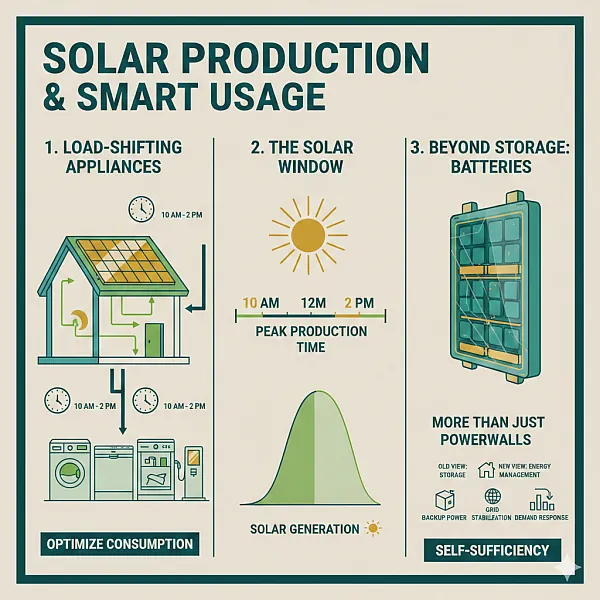
Both self-consumption and load-shifting are powerful strategies for reducing bills and improving system economics over time.
Whether a battery makes sense now or later depends on your rates, usage, and goals — but flexibility remains one of solar’s strengths.
Before adding batteries, revisit your numbers.
A battery doesn’t just store energy — it changes how your entire system performs.
➜ Check your daily energy usage (kWh)
➜ Look at your evening/night consumption (when batteries matter most)
➜ Understand your peak vs off-peak rates (TOU)
➜ Estimate how much energy you actually need to store. Here’s a tool:
Solar Battery Capacity Calculator
THEN:
➜ Recalculate your system usage vs storage needs
➜ Revisit your ROI and payback period (batteries can shift timelines)
➜ Check your real savings based on when you use energy (especially peak vs off-peak)
➡️ Use our Solar Calculators and Research Toolkit to see how adding storage changes your setup.
For Professional Advice on Solar Battery Solutions
Solar Battery Quote Tool
Get in touch with battery experts in your area for professional guidance.
Affiliate disclaimer
We’re an independent resource and don’t provide solar installation, equipment or quotes directly.
Affiliate Disclaimer
Some links on this page may connect you with solar providers through our partner network, including MySunSaver.
We may earn a commission if you choose to engage — at no extra cost to you.
🔗 NavigatingSolar Partner Disclosure
By continuing, you agree to be contacted by a provider from our partner network, including MySunSaver.
Your information will be handled according to our Privacy Policy and the partner’s Terms of Service.
📌 Solar Credit Systems - an overview
Time-of-Use (TOU) Rates
Many utilities charge more for power during “Peak Hours” (usually 4 PM – 9 PM) when demand is high.
Peak Hours:
Expensive. Everyone is cooking and watching TV.
Off-Peak:
Cheap. Late night and early morning.
The Solar Window:
Solar produces mostly at mid-day (Off-Peak or Mid-Peak), but you use power at night (Peak).
This is why batteries are becoming essential for TOU plans.
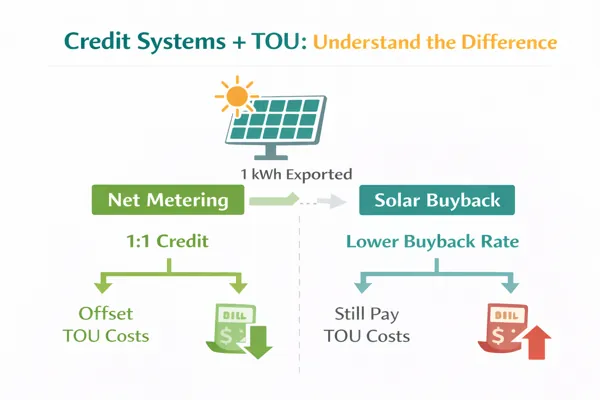
Net Metering vs. Buyback
How does your utility pay you for the extra energy you send to the grid? The difference matters.
➜ Net Metering
1-for-1 Credit.
You give the grid 1 kWh during the day, and get 1 kWh back for free at night.
It’s like a piggy bank.
➜ ➜Buyback / Net Billing
Wholesale Price.
The utility buys your extra power at a low rate (e.g., $0.05) but sells it back to you at full price (e.g., $0.15).
This gap can significantly reduce the value of exported energy.
🟡 Related Articles
Looking for more info?
Visit our Blog for information on Solar Incentives, Tax credits and Rebates
These articles are a good place to start:
➜ UNDERSTANDING INCENTIVES (Bonus Cheat Sheet)
Utility & Billing Clarity Checklist
Ask your installer or utility company these questions before signing.
Pre-Install Utility Checklist
🔴 Disclaimer
Policies vary by utility and region.
Always confirm details with your utility provider and installer.
Match Your Optimization Strategy to Your Energy Ecosystem
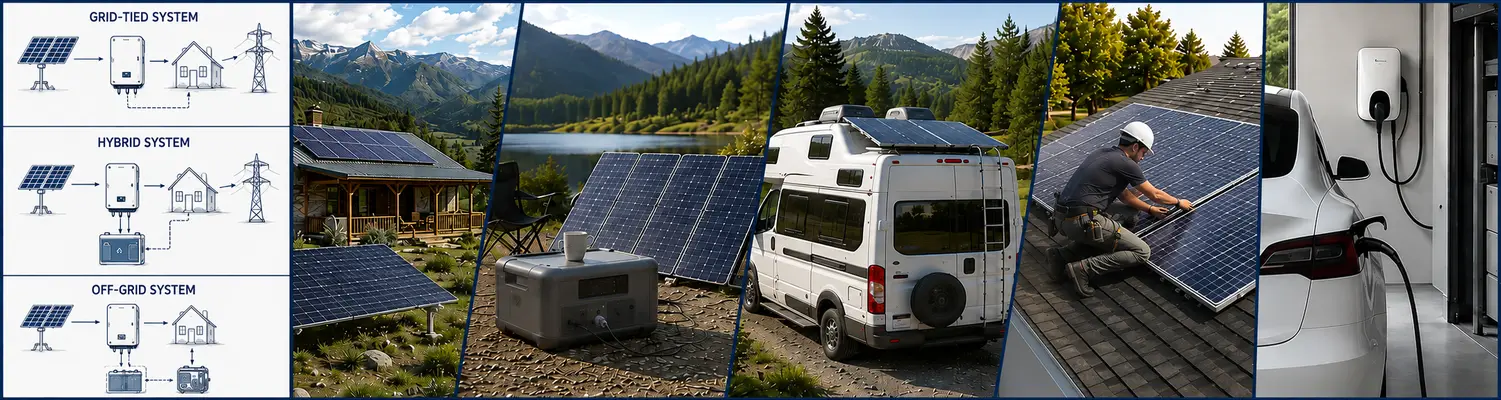
What is Your Future Energy Goal?
Let’s find the solution that helps your optimize system performance and long-term savings.
Milestone Moment
At this stage, many homeowners
move from passive consumption to active participation in their energy system.
The honeymoon phase fades — replaced by informed, optimized ownership.
Next Steps…
You start looking beyond your roof at the possibilities out there, at opportunities that can make your system and investment work even better for you.
✔️ Fast connection to multiple providers
✔️ Used by homeowners across the US
✔️ No obligation
✔️ Simple, guided process
✔️ Options based on your location
Affiliate disclaimer
We’re an independent resource and don’t provide solar installation, equipment or quotes directly.
Affiliate Disclaimer
Some links on this page may connect you with solar providers through our partner network, including MySunSaver.
We may earn a commission if you choose to engage — at no extra cost to you.
🔗 NavigatingSolar Partner Disclosure
By continuing, you agree to be contacted by a provider from our partner network, including MySunSaver.
Your information will be handled according to our Privacy Policy and the partner’s Terms of Service.
That’s when Battery Storage
becomes more important
…where things start becoming more intentional.
Battery storage shifts from a “nice to have” into a strategic advantage — helping you store, manage, and use energy on your terms.
When speaking to a battery expert
➜ Ask about Smart Battery Management Systems (BMS)
➜ Make sure your setup is aligned with how you actually use energy
➜ Ask about Expansion and Compatibility features
Solar Battery Quote Tool
Get in touch with battery experts in your area for professional guidance.
See Availability →System Optimized?
Your value engine is tuned. Now timing and leverage matter.
On the next page:
🔸Battery storage & sizing🔸Energy Independnce🔸Grid participation
🔸Learn about Community Solar