 Navigating
Summary
💰 Rebates
A rebate is essentially a direct discount or a cash payment you receive shortly after your solar system is installed. It’s money back in your pocket, and it’s one of the best ways to reduce your out-of-pocket costs right away.
Why Solar Rebates and Incentives Feel So Confusing
Upfront Cost Reduction vs Ongoing Rewards Systems
In our last conversation, we talked about “Understanding Incentives” – the big financial drivers for solar & the long-term income from SRECs.
Those solar incentives are powerful, but they often require you to wait until tax season or rely on a volatile market.
Today, we’re talking about something simpler, more immediate, and incredibly motivating:
💰Solar Rebates
A rebate is essentially a direct discount or a cash payment you receive shortly after your solar system is installed. It’s money back in your pocket, and it’s one of the best ways to reduce your out-of-pocket solar costs right away.
Let’s break down what rebates are, how they differ from tax credits, and how you can make sure you capture every dollar available to you.
Why Solar Rebates Feel Confusing
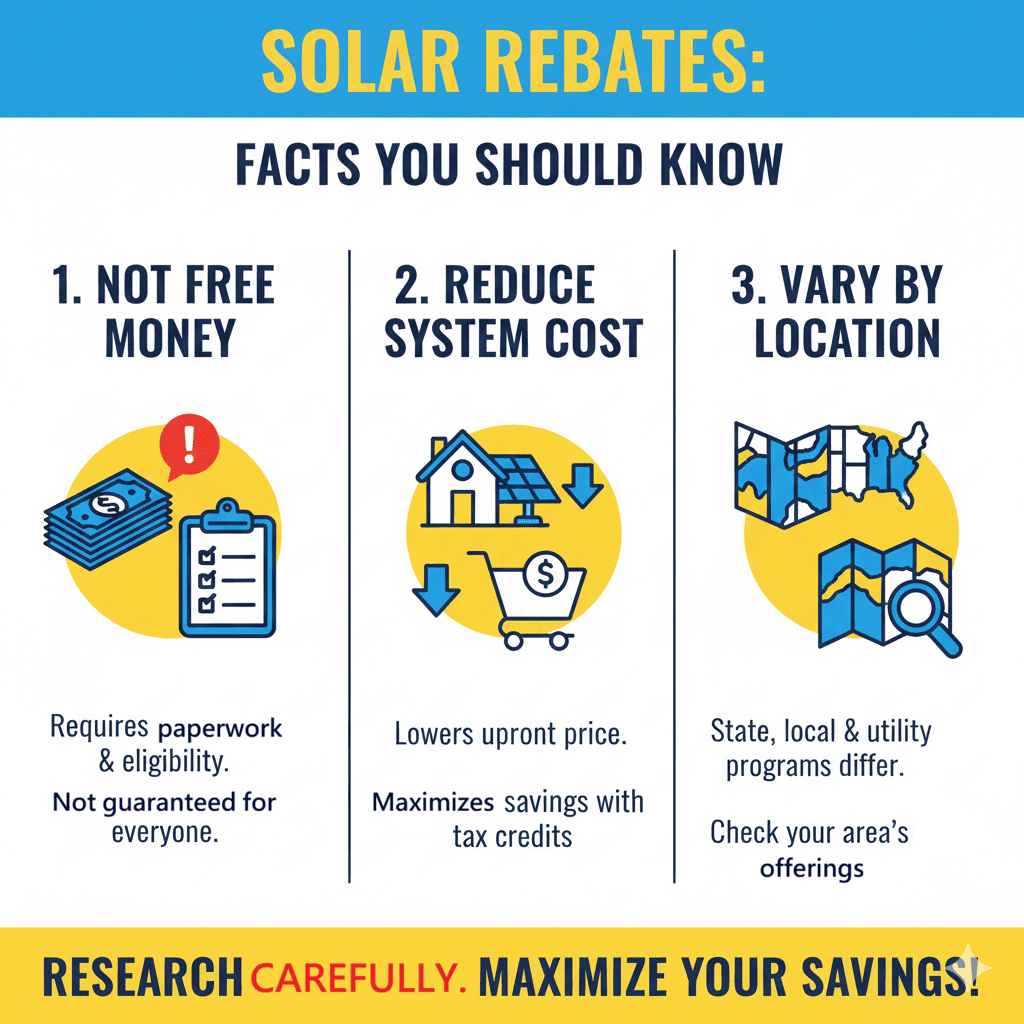
One of the biggest frustrations for homeowners researching solar is discovering that rebates and incentives are not standardized everywhere.
Programs often vary depending on:
- state policies
- utility companies
- local governments
- income requirements
- installation type
- and program funding availability
This is why two homeowners in different regions may receive very different financial outcomes even when installing similar systems.
Understanding rebates is less about memorizing every available program and more about understanding how incentive structures influence overall system cost and long-term planning.
US States Incentives Cheat Sheet
See which Solar Incentives are available in your State and what to know before applying.
Sorting Through the Noise
One of the hardest parts of researching solar is not finding information — it is figuring out which information to trust.
Different installers, utility companies, financing providers, and websites often explain incentives differently depending on:
- location
- sales models
- financing structures
- or what they are trying to sell
That can make the process feel overwhelming very quickly.
This is why preparation matters.
The more clearly you understand your own energy usage, goals, and available options before requesting quotes, the easier it becomes to compare systems calmly and identify what actually makes sense for your situation.
If you decide to explore installer options, start with verified providers operating in your area and compare carefully rather than rushing into the first offer presented to you.
The goal is not pressure — it is clarity.
If you want to explore available solar providers in your area, the quote tool can help you compare options based on your location and energy needs without needing to navigate the process blindly.
Start with understanding first.
Then compare with confidence.
Quote Request Tool
Connect with Local US Installers trusted by homeowners nationwide — step-by-step, practical, and pressure-free.
Affiliate Disclaimer:
This link may connect you with solar providers through our partner network.
We may earn a commission if you choose to engage — at no extra cost to you.
Rebates Reduce Cost — They Do Not Eliminate Planning
Rebates and solar incentives can significantly improve immediate and long-term affordability, but they should not replace proper planning.
A system that receives solar incentives but is poorly designed, oversized, undersized, or financed incorrectly can still create long-term frustration.
Good solar decisions come from balancing:
- incentives
- system sizing
- energy usage
- financing structure
- and long-term operational goals
Incentives are tools within the planning process — not shortcuts around costs.
💰Solar Rebates vs. Tax Credits: The Key Difference
The terms “tax credit,” “rebate,” and “incentive” are often used interchangeably, but they are fundamentally different in how they impact your wallet.
| Feature | Solar Rebate | Solar Tax Credit |
|---|---|---|
| Mechanism | Direct Cash Payment or upfront discount on system cost. | Reduction in Tax Liability (money you owe the government). |
| Timing | Received relatively quickly (weeks to months) after installation. | Received after filing your federal income taxes for the year of installation. |
| Who Pays | State governments, local municipalities, or utility companies. | The Federal Government (IRS). |
| Impact | Reduces the net cost of the system immediately. | Reduces your tax bill for the year. |
| Availability | Highly localized, temporary, and often first-come, first-served. | National, stable (30% through 2032), and available to all eligible homeowners. |
📌 Crucial Consumer Takeaway:
A rebate is like a coupon you cash in for a discount on the price tag.
A tax credit is like a coupon you cash in to reduce your final bill at the end of the year.
You can, and should, take advantage of both!
💰 The “Where” of Solar Rebates: Who is Offering the Cash?
Solar rebates are highly localized and often temporary.
They are typically offered by three main entities:
1. Utility Company Rebates
These are often the most common and significant rebates. Utility companies offer them to encourage customers to go solar, which helps them manage peak demand and meet state-mandated renewable energy goals.
-
Example: A utility might offer a rebate of $0.50 per watt installed, which for a 10 kW system ($10,000 watts) would be a $5,000 cash rebate.
-
Key Feature: Utility rebates are often tied to specific equipment or performance standards (e.g., they might offer a higher rebate for installing a battery to reduce strain on the grid).
2. State and Local Government Rebates
Some states and municipalities offer rebates to kickstart local solar adoption. These are often funded by state-level programs and are designed to supplement tax credits.
-
Example: A state might offer a flat rebate of $1,000 for any residential solar installation, or a rebate specifically for low-to-moderate income households.
-
Key Feature: These programs often have strict funding caps and deadlines. Once the money is gone for the year, the program closes until the next funding cycle.
3. Manufacturer Rebates
Less common, but still valuable, are rebates offered directly by the solar panel or battery manufacturer (e.g., a $500 rebate for purchasing a specific brand of battery). These are often seasonal promotions.

Interactive Widget: Open the Pre-Sign Paperwork Checklist
💰 How Valuable are Solar Rebates?
The Impact on Your Upfront System Cost
Rebates are “valuable” because they provide an immediate, tangible reduction in the cost of your system. They are the closest thing to a direct subsidy you will receive.
Let’s look at a hypothetical example of how a rebate stacks with tax credits:
| Cost Component | Calculation | Amount |
|---|---|---|
| Total System Cost | (Initial Price) | $30,000 |
| Utility Rebate | (Example: $0.50/watt for 10kW system) | -$5,000 |
| Net System Cost | ($30,000 – $5,000) | $25,000 |
| Tax credits (25%) | ( upto 25% of Net System Cost) | -$6,250 |
| Final Out-of-Pocket Cost | ($25,000 – $7,500) | $18,750 |
In this scenario, the $5,000 rebate immediately reduces the cost you pay the installer, and it also reduces the base amount on which your 25% tax credit is calculated. This is why it is critical to understand the rules of each program.
📌 The Golden Rule:
Rebates are typically applied to the system cost before the tax credit is calculated, meaning it is applied to the lower, post-rebate price [1]. This is a good thing, as it reduces the amount of money you have to finance or pay upfront.
💰 The Application Process: Timing is Everything
Unlike the tax credit, which is claimed by you on your tax return, rebates are usually handled by your installer. Even less stress for you!
1. Installer Responsibility
A reputable solar installer will be intimately familiar with all local rebate programs and should:
-
Identify all eligible rebates for your address.
-
Reserve the rebate funds for your project (many are first-come, first-served).
-
Complete and Submit all necessary paperwork on your behalf after the installation is complete.
2. The Waiting Game
Because rebates are often tied to the final inspection and commissioning of your system, the cash payment or credit is usually issued a few weeks to a few months after your system is turned on.
3. The Risk of Expiration
The biggest risk with rebates is that they are temporary.
Funding can run out, or the program rules can change with little notice.
This is why it is crucial to work with an installer who is proactive about securing your rebate funds at the time you sign your contract.
Resource:
Learn more about:
➖How to choose installers,
➖What to know before hand,
➖and what to ask
Conclusion
💲Don’t Leave Money on the Table💲
Rebates are a fantastic, tangible benefit that can significantly reduce the initial cost of your solar system. They are a clear sign that your local utility or government is invested in your decision to go green.
While tax credits are the long-term anchor of your financial savings, rebates are the immediate cash injection that makes the transition easier.
When you shop for solar, make sure your installer provides a clear, itemized breakdown of every rebate you qualify for, the amount, and the timeline for receiving the funds.
Don’t just go solar—go solar smart, and claim every dollar you’ve earned!
US States Incentives Cheat Sheet
See which Solar Incentives are available in your State and what to know before applying.
for more articles on Solar Finance & Incentives
Solar ROI, IRR & Payback Explained
Solar Incentives by State in 2026
US Solar Tax Credits: 2026 Updated Facts
7 Solar Installation Mistakes to Avoid (Including Hidden Costs Most People Miss)
Connect with Verified Solar Installers Near You
Quote Request Tool
Connect with Local US Installers trusted by homeowners nationwide — step-by-step, practical, and pressure-free.
Affiliate Disclaimer:
This link may connect you with solar providers through our partner network.
We may earn a commission if you choose to engage — at no extra cost to you.
References
[1] EnergySage. “What’s the difference between a solar tax credit and a rebate?” EnergySage.
[2] IRS. “Residential Clean Energy Credit.” IRS.gov.
[3] EnergySage. “Solar Rebates and Incentives.” EnergySage.
[4] GreenLancer. “A Guide to Government Solar Incentives.” GreenLancer Blog.