 Navigating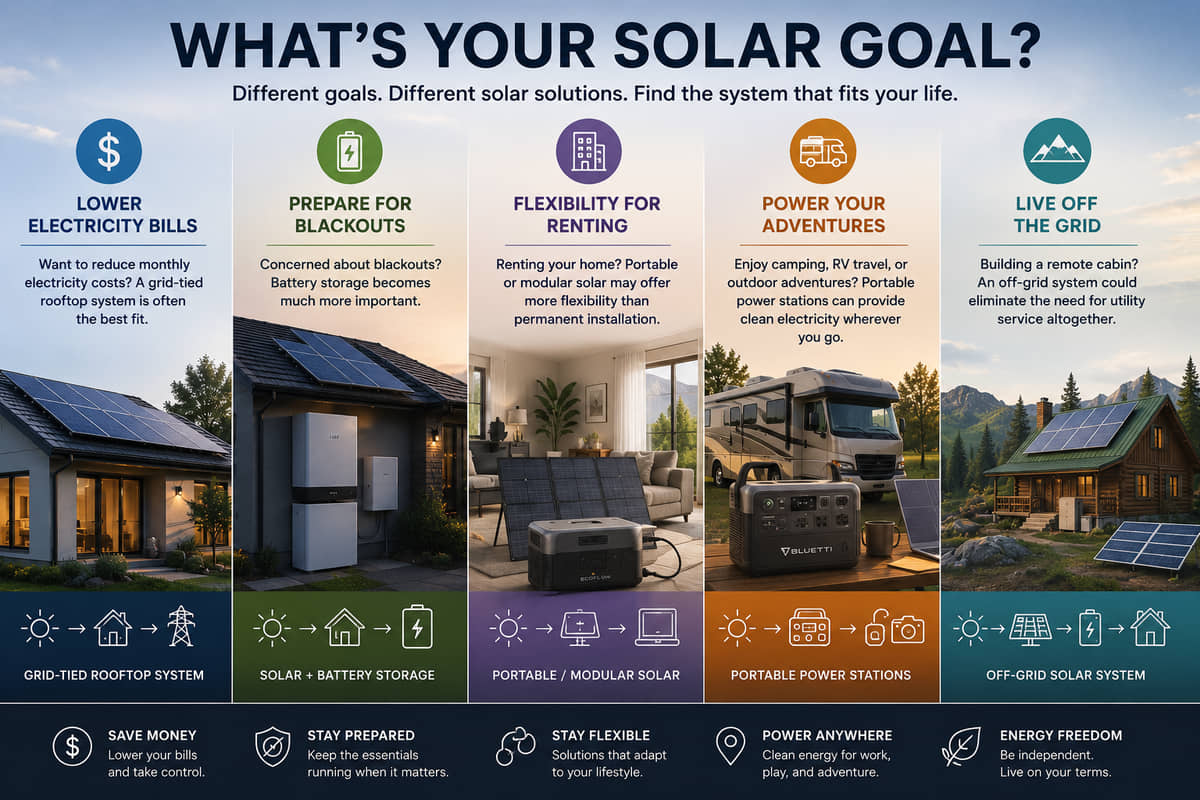
Summary
Going solar gives you the incredible freedom to choose where your energy comes from. Mastering the solar window gives you the financial freedom to choose when you pay for it—which, with smart habits, can be never.
Solar Doesn’t Save Money—Your Choices Do
Shaping your savings with hardware, habits, and energy strategy
Different solar setups create different operating rules — and therefore different savings outcomes.
A rooftop grid-tied system,
a solar + battery setup,
a modular portable power station,
an RV or mobile energy ecosystem system,
and a fully off-grid home all sit under the same “solar” label.
But in practice, they behave like different energy systems entirely.
They charge differently. They store differently. They fail differently.
And most importantly, they are used differently.
That difference changes everything.
Once solar is installed, the real question is no longer what you bought—it’s how that system is meant to be run in the context it lives in.
Trying to apply the same daily habits, expectations, or “best practices” across all of these systems is where most confusion begins.
This solar decisions manual is about those differences.
It focuses on how operating decisions change depending on the type of solar system in use, and why those decisions ultimately shape savings, comfort, and system performance more than the hardware itself.
Same Energy Concept, Many Ways to Run With It
Before any savings strategy, optimization habit, or daily routine can make sense, the first step is understanding the choice of solar system.
The hardware may look different, but it’s the operating environment that changes everything. This is where most “solar advice” breaks down. It assumes there is a universal set of best practices that applies across all installations. In reality, solar only becomes financially efficient when it is operated according to the rules of its specific system type.
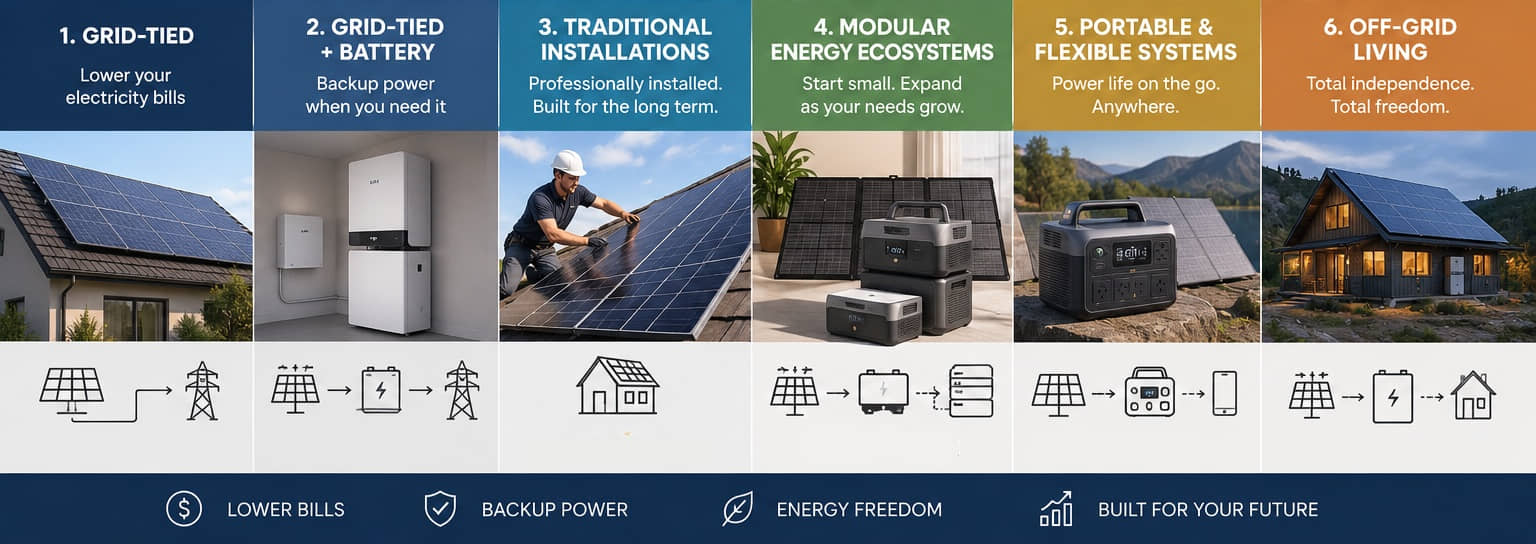
The System Type Dictates the Strategy Applied
Every type of system has it’s own playbook and rules, because the operating rules are not optional—they are built into the design of the system itself.
The rules change depending on how energy is generated, stored, accessed, and consumed.
Each of these setups creates a different relationship with energy:
- Some systems are optimized around timing and tariffs
- A grid-tied homeowner is operating within a buy-and-sell relationship with the grid, working with time-of-use pricing.
- Some are optimized around storage and discharge cycles
- A battery-backed homeowner is operating within a time-shifting system where energy has to be stored before it is used.
- Some are optimized around mobility and recharge opportunities
- A portable system user is operating within a recharge-and-deplete cycle, not permanent infrastructure.
- An RV system blends multiple inputs—solar power, alternator charging, shore power, and sometimes generator use—into a constantly changing energy balance between battery limits and travel patterns.
- Some are optimized around self-sufficiency and endurance
- Off-grid systems operate as fully self-contained environments where every unit of energy must be planned, stored, and protected with resilience as focus, rather than financial optimization.
Because of these differences, “saving money with solar” is not a single behavior. It is a collection of different operating strategies depending on the system in use.
What looks like optimization in one setup may be irrelevant in another. What looks like waste in one system may be necessary in another. What improves savings in one system may have no effect—or even a negative effect—in another.
Different solar systems types,
different energy environments & decisions,
different operating rules
Mapping a Solar System to Its Operating Decisions
To operate a system effectively, you first need to understand what decisions it actually puts in front of you.
Affiliate Disclaimer:
This article may contain affiliate links. NavigatingSolar independently researches products and selects partners based on how well they fit our educational framework, not simply because they offer commissions.
Learn more about how we choose partners.
Grid-Tied Solar Systems: The Timing and Tariff Game
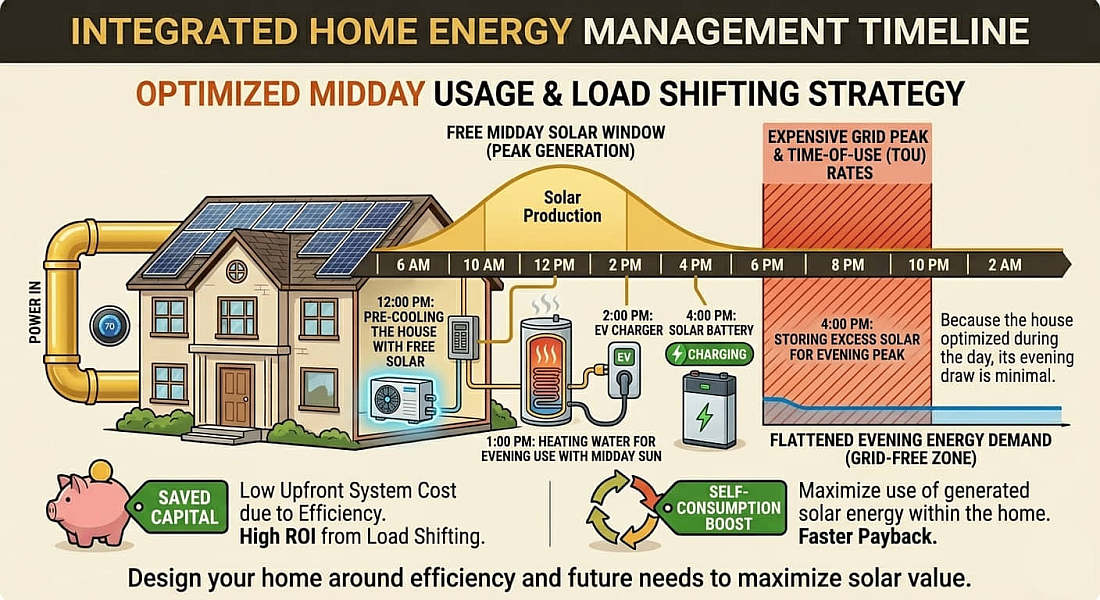
These can be Traditional Rooftop Solar Installations, or Modular Solar Ecosystems that tie into the grid. In a grid-tied system, the grid acts as both backup and reference point.
Energy flows in and out depending on production and consumption, but the financial outcome is shaped by timing and influenced by utility tariffs.
Grid-tied homes perform best when household demand follows solar production rather than utility pricing. In practice, this usually means shifting energy-intensive jobs into the middle of the day whenever possible.
Working With the Sun
A typical pattern might look like this:
- Morning: Normal household activity while solar production ramps up.
- Midday: Washing machines, dishwashers, pool pumps, water heating, EV charging and other larger loads move into peak production.
- Evening: Solar production ends, so household demand either reduces or returns to grid power.
The objective isn’t running the house differently. It’s simply moving flexible tasks into the hours when your own electricity is available.
The key decisions in this system are:
- Do you use electricity while it is being produced, or after production has ended?
- Do you export excess energy, or shift usage to consume it locally?
- Do you run high-load appliances during peak solar hours or during expensive grid hours?
In this setup, the system rewards self-consumption during production windows and punishes unnecessary evening or peak-time usage.
➡️ Curious how these different grid-tied systems are actually put together?
Seeing how different manufacturers build grid-tied, hybrid and modular solar systems makes it much easier to understand the architecture behind installer quotes.
A1 Solar Store has excellent diagrams, product layouts and system illustrations, making it one of the easiest places to visualize how different solar systems are assembled before making decisions.
While you’re there, browse their multi-brand marketplace to compare
complete solar systems,
panels,
inverters,
batteries
and individual components from a wide range of manufacturers.
➡️ Planning a traditional rooftop installation instead?
Learn what to ask installers, what to expect during the quoting process, and how to compare proposals from verified installers in your area.
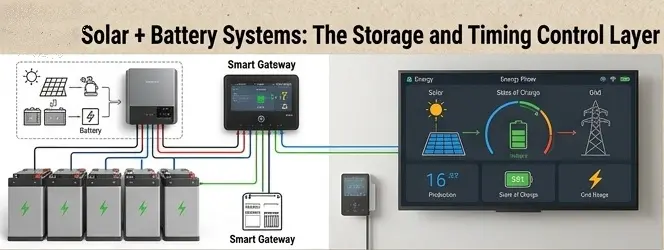
Solar + Battery Systems: The Storage and Timing Control Layer
Choosing When Energy Has the Most Value
Adding a battery changes the operating logic entirely.
Energy is no longer just used when it is produced—it can now be shifted forward in time.
Daily operation becomes less about chasing production and more about deciding when stored electricity delivers the greatest benefit.
Some households reserve batteries for outages. Others deliberately discharge them during expensive evening tariff periods. Others balance both.
The operating question becomes:
When is each stored kilowatt-hour worth the most?
The key decisions in this system are:
- Should excess solar be stored or exported?
- When should stored energy be used—immediately or during peak tariff periods?
- Should the battery be reserved for backup or actively cycled for savings?
Here, value is created through time-shifting energy from low-value periods to high-value periods.
➡️ Battery storage can be approached in different ways.
Some homeowners prefer integrated Smart Energy Ecosystems, where batteries, solar generation, EV charging and selected household loads communicate automatically to manage energy throughout the day.
Others prefer the flexibility of comparing batteries, inverters and individual system components from multiple manufacturers, allowing them to build or expand a system around their own priorities, budget and long-term plans.
Exploring both approaches is often the easiest way to understand what installers are recommending—and why one solution may suit your home better than another.
Explore Smart Energy Ecosystems
If you’re interested in an integrated whole-home approach, EcoFlow’s Ocean range demonstrates how batteries, solar generation, EV charging and smart controls work together as a connected energy ecosystem. These systems can be professionally installed and expanded over time as your household’s energy needs evolve.
Browse Residential Energy Storage Systems
If you prefer comparing different manufacturers, A1 Solar Store’s multi-brand marketplace lets you explore residential energy storage systems, batteries, inverters and compatible components side by side. It’s an excellent way to understand the building blocks of a permanent solar installation before committing to a particular brand or installer.
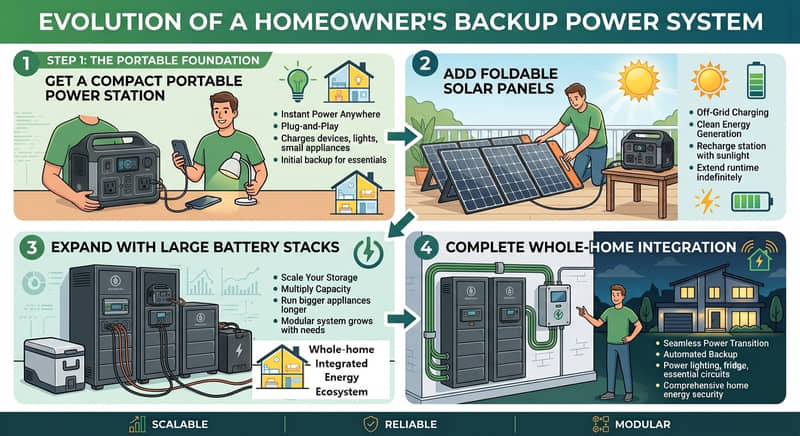
Modular Portable Power Systems: The Cycle and Recharge Economy
Portable systems don’t operate around permanent infrastructure, but within limited capacity cycles.
Energy availability depends on recharge opportunities and usage discipline.
Every decision affects the next recharge cycle. That’s why management matters more.
Users naturally begin asking different questions:
- Will I recharge again today?
- Should I power this appliance now or later?
- How much reserve should I keep?
Rather than maximizing solar production, portable systems reward efficient use of limited stored energy.
The goal becomes stretching every charge cycle as far as practical without compromising the reason the unit exists in the first place.
The key decisions in this system are:
- When should the unit be discharged versus conserved?
- When will the next recharge opportunity occur?
- Is the system being used for short-term portability or repeated daily cycles?
In this setup, efficiency is defined by cycle awareness and recharge planning, not continuous optimization.
➡️ Looking for a simpler way to add backup power?
Portable power stations combine the battery, inverter, charger and control electronics into a single unit, removing the need to match individual components or permanently modify your home’s electrical system.
They’re a practical solution for emergency backup, RV travel, camping, cabins, apartments and homeowners who want flexible power without committing to a permanent solar installation.
For many people, they’re also an excellent introduction to solar energy. As your needs grow, you’ll naturally begin asking whether portability, capacity, recharge speed or future expansion is most important. Those answers often determine whether a portable system remains the right solution or whether it’s time to consider a larger permanent installation.
Bluetti offers one of the strongest educational resources for comparing portable power systems, battery capacities, charging options and real-world appliance runtimes. Their comparison charts make it easy to visualise the differences between system sizes before choosing one that matches your needs.
→ Compare portable power systems
RV and Mobile Energy Ecosystems
An RV isn’t simply a portable house. It’s a mobile energy ecosystem.
RV systems combine multiple input sources into a single energy ecosystem.
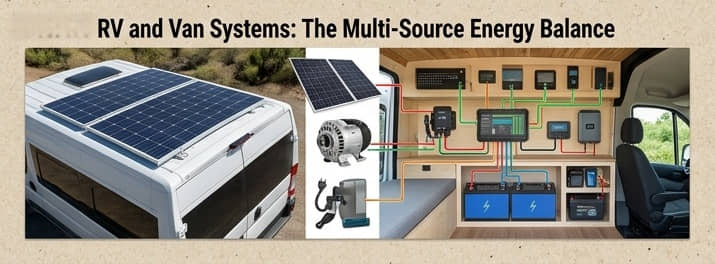
The Multi-Source Energy Balance
Solar is only one part of that ecosystem.
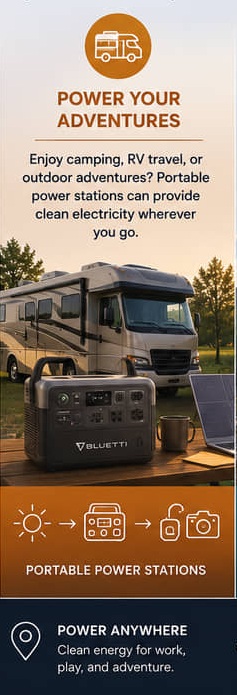 Driving introduces alternator charging.
Campgrounds introduce shore power.
Some owners also carry generators for extended cloudy periods or high-demand situations.
The operating decisions change depending on where the vehicle is, how long it will remain there, and what charging opportunities lie ahead.
A travel day may naturally favor alternator charging.
A campsite with electrical hookups may make shore power the obvious choice.
Several days parked in nature may shift the entire household rhythm around available sunlight.
Rather than optimizing one energy source, RV living is about knowing when each source makes the most sense.
The key decisions in this system are:
- Should energy be generated while driving via alternator or reserved for solar input?
- Should shore power be used to preserve battery cycles or avoided to save cost?
- How should energy be balanced between travel days and stationary days?
Here, optimization depends on balancing multiple energy sources rather than relying on one production method, bypassing solar and battery limitations.
➡️ If you’re interested to learn more about RV power supply, battery storage or charging solutions, we suggest looking at Bluetti systems, for great mobile lifestyle ideas made visual on the official site.
Bluetti offers one of the strongest educational resources for comparing battery capacities, charging options, portable power stations and complete mobile energy solutions.
For the more experienced traveler, a multi-brand solar marketplace is a bit like turning a kid loose in a toy store.
(I’m almost scared to share the next link! Apologies to all the wives – although I think you’d benefit in the long run – but just keep an eye on the budget(him).
This marketplace offers a comprehensive info base and good selection of hardware, listing specs, comparisons and current competitive pricing. Offerings from various industry leaders can be found and compared to build mobile battery storage systems, with the right inverters, converters, solar panels, and all the bells and whistles you’d want while traveling.
➡️ Visit a broader marketplace
It’s a useful place to see how different mobile power systems are configured before choosing equipment.
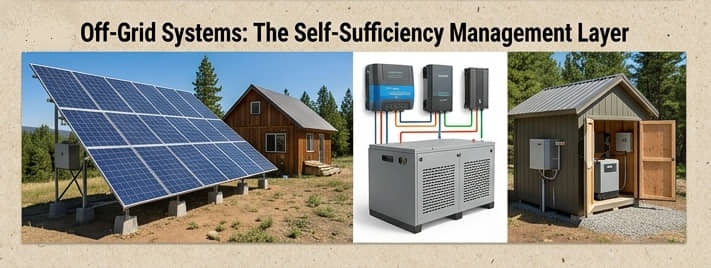
Off-Grid Solar Systems: The Self-Sufficiency Management Layer
Living With Your Own Energy Rhythm
Off-grid systems operate without external backup. Every unit of energy must be generated, stored, and allocated internally.
Off-grid living often appears restrictive to people accustomed to grid electricity. In reality, many owners describe the opposite experience. Instead of responding to utility tariffs, export rules or peak pricing, daily life gradually aligns with available energy.
Sunny days naturally become productive days. Cloudy days encourage lighter household tasks. Large jobs simply happen when generation comfortably supports them.
Rather than following someone else’s pricing schedule, the household follows its own energy conditions.
The result isn’t constant management. It’s familiarity.
Over time, available energy becomes another part of daily life, much like checking the weather before hanging washing outside.
The key decisions in this system are:
- How much energy can be safely used today without risking tomorrow’s shortage?
- Should high-load usage be delayed based on weather forecasts?
- When is generator use justified versus battery conservation?
In this environment, energy management becomes resource planning under uncertainty, not optimization of excess.
➡️ Curious what a modern off-grid system actually looks like?
Bluetti tells a great visual story about ready-to-use backup systems. It’s an easy way to understand off-grid power, portable energy systems, and how different system sizes are put together before diving into the technical details.
➡️ Browse Bluetti’s off-grid systems and real-world backup solutions.
➡️ For the more seasoned off-grid enthusiast, the next step is often exploring a Modular Solar Marketplace.
Because off-grid systems rely entirely on the right combination of panels, batteries, inverters, charge controllers and supporting components, comparing equipment from multiple manufacturers becomes part of the planning process.
A1 Solar Store makes it easy to compare complete systems, energy storage and individual components side by side, helping you understand how different system architectures are built.
Depending on your situation, I’d recommend looking at both.
Bluetti provides an excellent introduction to complete off-grid solutions, while A1 helps you explore the building blocks behind larger, more customised systems.
Ultimately, the goal isn’t choosing a brand first—it’s understanding where you are today, where you’re heading, and what you need your system to do for you.
Across every system, one pattern remains the same.
Solar savings aren’t created by panels alone.
They emerge from thousands of small operating decisions made over months and years.
Those decisions look different for every system type, but they all share one characteristic:
The better your daily habits fit the way your system was designed to operate, the more naturally performance, resilience and savings improve over time.
Solar Becomes Part of Everyday Life
Eventually, those decisions stop feeling like decisions at all.
They simply become part of the rhythm of the household.
That’s when solar stops being an installed product and starts becoming a lived system.
A Simple Way to Organize Your Home Energy Use
Putting Your System on Paper : See the Big Picture, Not a Schedule
One of the easiest ways to understand how your solar system is actually performing in daily life is to write things down.
Not in a technical way — just in a household way. The goal is not to control every action, but to reduce uncertainty about what matters most in each moment. A simple list is often enough to make energy patterns obvious.
Instead of guessing when or how energy is being used, break your home into three simple categories:
1. Your Daily Energy Flow
Solar systems don’t require rigid schedules to operate effectively. Instead, they respond to repeating patterns of availability and demand — and the real value comes from understanding what actually happens in a house, not what ideal schedules suggest.
A simple way to structure the day is:
- Morning (6–10am): Basic household startup load begins. Coffee machines, kettles, showers, geysers, fridges cycling, phones charging, school/work prep. ⚠️ Hidden reality: This is often where “silent stacking” begins — geysers reheating, heaters or aircon kicking in, and everyone starting their day at once.
- Midday (10am–2pm): Peak solar production window (in most systems). This is where high-load tasks should happen if possible. Washing machines, dishwashers, vacuuming, EV charging, pool pumps but also: remote work setups cooking lunch at home (yes, this is often overlooked) kids being home early / school holidays spontaneous appliance use (“just quickly” moments)
- Afternoon (2–5pm): Transition period. Solar output starts dropping, but household activity often increases. ⚠️ Hidden reality: This is one of the most underestimated load periods: school pickup / arrival home snack preparation entertainment systems turning on multiple rooms becoming active again This is where systems often get “quietly stressed” without anyone noticing.
- Evening (5–10pm): Peak household usage window — and usually zero solar production. This is where multiple small loads often combine without being noticed, creating higher-than-expected demand spikes. Cooking, lighting, entertainment, heaters/aircon, showers, and general household activity all overlap here. ⚠️ Hidden reality: This is where stacking becomes unavoidable — everything runs at once because life happens here, not on a schedule.
- Night (10pm–6am): Baseline consumption only — fridges, standby devices, security systems, routers. ⚠️ Hidden reality: This is where phantom loads quietly operate: chargers left plugged in, standby appliances, geysers cycling, devices “sleeping” but still drawing power.
This is not a fixed timetable — it is a real-world energy rhythm. The goal is not perfection, but awareness of where usage naturally clusters.
2. Weekly High-Load Tasks – Scheduled energy spikes
These are your weekly or recurring tasks that draw a noticeable amount of power in short bursts. They are important because they are not just about what you run, but also about how much runs at the same time.
Examples might include:
- Washing machine
- Tumble dryer
- Dishwasher cycles
- Pool pump maintenance or deep cleaning cycles
- Vacuuming or multiple-room cleaning days
- Ironing or bulk laundry days
- Sunday roasts or baking using the oven element – not just the stove hubs
On paper, these look like simple tasks.
In reality, they often overlap with everything else happening in the home.
A washing machine might be running while someone is cooking. A dishwasher might run while the kettle, oven, or microwave is in use. A pool pump might be running while lights, TVs, and chargers are already active.
This is where solar systems are often unintentionally stressed — not because of one large appliance, but because several medium loads stack at the same time.
Smart Load Stacking Starts Conversations
This stacking effect matters because solar systems (especially battery-limited or grid-tied systems with tariff sensitivity) don’t only respond to total daily usage — they respond to combined demand at any single moment, not to tasks individually.
That means a “normal Saturday” in a household can quietly become one of the highest-demand periods of the week simply because everyone is home, using appliances naturally, at the same time.
This is also why this section is less about scheduling and more about visibility.
When you place these tasks on paper, something important happens:
- You start seeing where energy demand overlaps
- You notice which tasks unintentionally collide
- You identify which appliances create peak demand moments when combined
- You realize how often “normal life” stacks multiple loads at once
This is not about forcing strict control over the household. It is about creating awareness of combined usage moments, where multiple appliances operate together and create short spikes in demand.
Even small adjustments — like shifting one task slightly earlier or later — can significantly reduce unnecessary peaks
In many homes, this is the first point where energy use stops being invisible and starts becoming a shared household decision.
It is also the section where planning naturally becomes a family conversation rather than an individual habit, because overlapping usage affects everyone at once.
Your Weekly Energy Awareness Check
Instead of managing solar minute by minute, most systems benefit from a light weekly review:
Are high-load tasks consistently aligned with energy availability?
Is stored energy being used effectively or left unused?
Are there recurring periods of unnecessary grid or backup usage?
Are system constraints being respected or ignored?
The key question here is not just what you do, but:
Can this be moved into solar production hours?
Does this currently clash with peak grid usage times?
Is it being done randomly, or grouped efficiently?
Instead of managing solar minute by minute, most systems benefit from a light weekly review: Are high-load tasks consistently aligned with energy availability? Is stored energy being used effectively or left unused? Are there recurring periods of unnecessary grid or backup usage? Are system constraints being respected or ignored?
The key question here is not just what you do, but: Can this be moved into solar production hours? Does this currently clash with peak grid usage times? Is it being done randomly, or grouped efficiently?
This is where most hidden savings or inefficiencies appear. This also creates awareness without requiring constant adjustment.
3. Monthly or Occasional High-Energy Tasks
These are larger, less frequent energy events that often get overlooked in planning.
Examples might include:
- Deep cleaning with high-pressure washers (walls, driveways, roofs)
- Baking or bulk meal preparation days
- Hosting events or increased household occupancy
- Water heating system maintenance or flushing cycles
- Seasonal appliance use (fans, heaters, etc.)
These tasks matter because they often happen outside of normal routines and can accidentally fall into expensive or inefficient energy windows. They usually happen in bursts of “real life energy use” — not planned consumption.
Your Seasonal Adjustment Layer
Solar systems naturally shift with seasonal changes in production and demand.
Rather than rewriting habits completely, adjustments tend to be small:
Longer days allow more flexible energy usage windows Shorter days require more deliberate prioritization of loads
Weather patterns influence reliance on storage or backup sources
Travel or lifestyle changes affect system dependency and timing
Solar systems naturally shift with seasonal changes in production and demand. Rather than rewriting habits completely, adjustments tend to be small: Longer days allow more flexible energy usage windows Shorter days require more deliberate prioritization of loads Weather patterns influence reliance on storage or backup sources Travel or lifestyle changes affect system dependency and timing
Seasonal adjustment is not a reset—it is a recalibration of timing and expectations.
Why this list matters
Most households don’t have an energy problem — they have a visibility problem.
Once energy use is written down, even roughly, patterns become obvious:
- Which tasks should move into solar production hours
- What to look for in seasonal changes like panel tilt & cleaning
- Which ones are better grouped together
- Which ones are quietly increasing grid reliance
- Which ones could be supported by storage instead of direct grid use
This is not about strict scheduling. It is about making energy use visible enough to improve naturally over time.
The Printable Operating Framework
To make this practical, the key is reducing complexity into a simple reference sheet:
- System type you are operating (grid-tied, battery, portable, RV, off-grid)
- Your primary energy decision focus (timing, storage, mobility, or self-sufficiency)
- Your peak energy window or availability pattern
- Your top three high-impact energy uses
- Your preferred strategy for surplus or shortage periods
This becomes your personal operating reference, not a strict rule set.
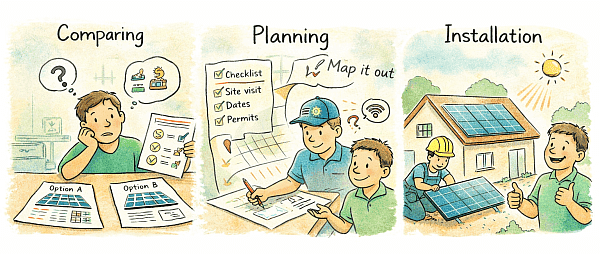
Map out your journey to going solar.
Build your own operating snapshot
If you’ve followed along this far, you already have the foundation. Now it becomes personal.
Use our Free Online Toolkit to map your system type and energy habits in one place.
➡️ Access the Planning & Research Tools, Checklists, and Solar Calculators.
➡️ Looking to learn more about traditional solar installations?
Our resource page is the best starting point to learn how to choose a solar installer, and what to ask.
➡️ Curated Solar EPC Network: Find Verified Installers Near You
For a Step-by-Step Guided Journey

NavigatingSolar.com
Understand Solar. Choose Smart. Take Control.
Which phase do you find yourself?
Phase 1: Initialization: Understand your solar readiness & current energy habits. Understand incentives & utility policy
Phase 2: Optimization: TOU Strategy, Monitoring, Maintenance
Phase 3: Maximization: See whether battery storage makes sense
Resources: Learn what to ask Installers & Insurers
Get multiple quotes from verified installers
Open the Library for downloadable guides
Access Tools, Calculators & Checklists
Read About Solar
If you already have solar, don’t skip this!
RELATED ARTICLES
➜ Solar ROI Leverage : Strategy, Sequence and Timing
➜ Inverters : The Brain of Your System
➜ Types of solar-powered systems
➜ Solar Battery Storage: Value vs Expense
➜ An Unbiased Comparison : Community Solar, Virtual Power Plants, and Solar Ownership
Educational transparency.
NavigatingSolar is an Independent Educational Resource. We are not solar manufacturers or installers – we research them.
Why these suggestions?
Navigating Solar doesn’t recommend companies simply because they offer affiliate programs. We believe readers should always understand why something is being recommended. We begin with the homeowner’s decision—not the product. We identify where people struggle to make informed choices, then evaluate products, services and partners that genuinely solve those problems.
Not every recommendation earns us a commission. Partnerships are selected to fit the educational framework—not forcing the educational framework to fit whatever affiliate programs happened to exist. If a company doesn’t fit the decision framework and ethos, we don’t include it—whether it has an affiliate program or not. If we believe a better solution exists, we’ll recommend it regardless of whether it generates a commission.
➡️ Our goal is to help you make the right decision—not the fastest purchase.