 Navigating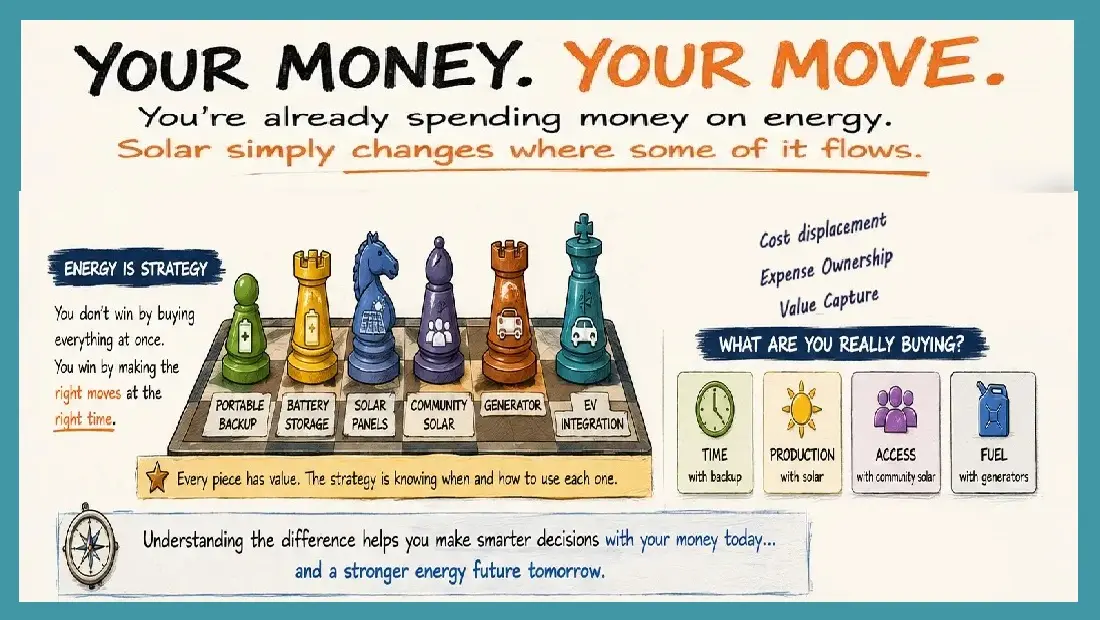
Renting Electricity or Owner of a Production Asset?
Investments Rarely Rain Dollars—So What’s the Return?
People have become familiar with paying the utility. Every month. Bill arrives. Money leaves. Life continues.
It’s predictable.
What’s upsetting isn’t paying for electricity.
It’s when the thing you pay for because it’s supposed to be predictable… becomes unpredictable. .
But what if someone gave you the opportunity to permanently reduce just one monthly household expense…
Which would you choose?
Fuel?
Electricity?
Water?
Food?
Internet?Most people answer that question surprisingly quickly.
The second question is harder.Which of those expenses can you actually influence?
That’s where solar becomes different from almost every other household purchase.
It isn’t simply about buying equipment.
It becomes less about comparing Energy Costs vs Solar Savings and more about deciding where tomorrow’s money will go.
What Are You Already Paying For?
People start by comparing:
Cost of Solar vs Cost of Electricity
Wrong equation. Those are different assets, different rules.
The real equation is: Cash Flow
What leaves my bank account every month?
Where does it go?
Can I redirect it?
That changes everything.
So, before thinking about savings…
Take a moment to think about where your energy money already goes.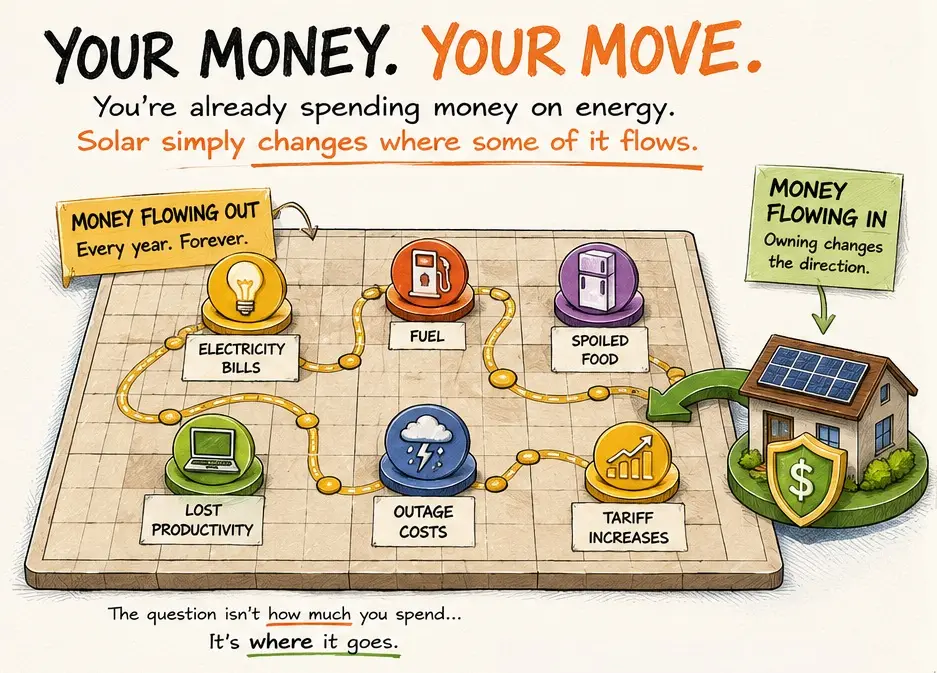
- Monthly electricity bills
- Fuel for vehicles
- Generator fuel during outages
Others are much harder to notice.
- Food spoiled during long blackouts
- Lost work when the power fails
- Emergency accommodation after severe weather
- Replacing equipment damaged by power surges
- Higher insurance risks
- Rising utility tariffs
- The constant uncertainty of not knowing what next month’s bill will be
You’re already paying for energy. Just in more ways than most people realize.
It Naturally Leads to The Wrong Question
“How much does solar cost?”
That’s understandable. It’s also incomplete.
Because no investment exists in isolation.
But, every investment is competing against the cost of doing nothing.
A solar asset is different.
Solar is an unusual kind of investment in the sense that it’s one of the very few investments that’s not static.
Most investments sit quietly on a statement somewhere until one day, hopefully, payout rains dollars.
Solar doesn’t.
You interact with it every single day.
Every load you shift.
Every battery you charge.
Every kilowatt-hour you produce instead of buying.
Using it doesn’t decrease the value – it helps grow it.
That’s why you’ll often find us making such a fuss about Optimization.
It’s not maintenance.
It’s value creation.
The Real Enemy Isn’t High Prices
It’s trying to survive with Uncertainty.
Expensive can be budgeted for.
Unpredictable cannot.
Nobody worries because electricity costs money. People worry because of what they don’t know:
That’s why electricity has become such an emotional topic.
Imagine asking yourself:
- What next month’s bill will be
- How much tariffs will rise
- What happens if my electricity price doubles over the next decade?
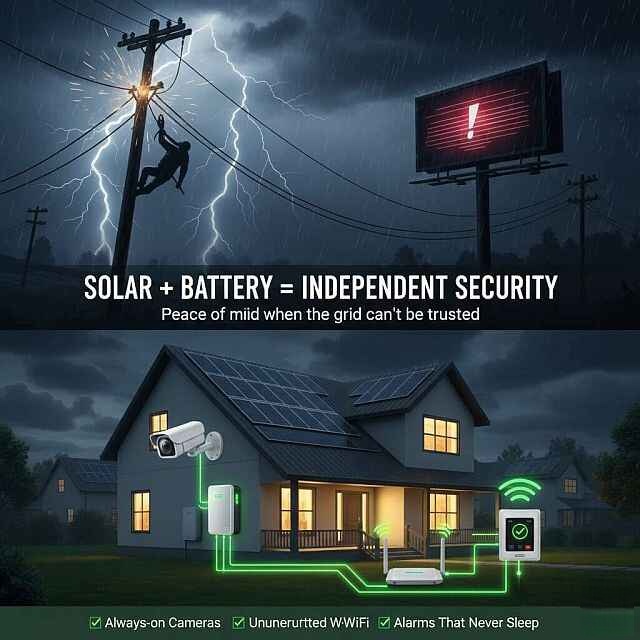
- When the next outage will happen?
- What happens if outages become more frequent?
- What if my home office loses power during an important meeting?
- What if someone in my family depends on medical equipment?
- What if another summer brings rolling blackouts?
- … and nights of sleeping with one eye open, worried about security?
- What if my EV becomes my biggest monthly energy expense?
- Will today’s “invest in renewable energy” solution still work in ten years?
These aren’t just “solar questions” or doubts and fear-mongering.
They’re household planning questions. Normal life questions.
Which gives predictability a different kind of “economic” value.
That doesn’t show up as cash in your bank account.
Every Energy Decision Should Be Compared to Something
This is where solar starts making more sense.
Because every component replaces—or reduces—another cost.
A battery isn’t just a battery.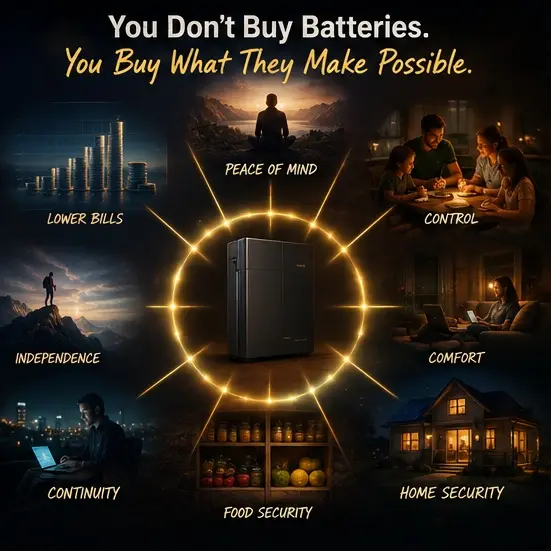
Compare it to:
- generator fuel
- spoiled groceries
- interrupted work
- medical equipment downtime
- security during outages
- peace of mind
Solar panels aren’t just panels.
Compare them to:
- buying electricity forever
- future tariff increases
- charging batteries from the grid
- producing your own energy instead
An EV charger isn’t just another appliance.
Compare it to:
- gasoline
- public charging
- fluctuating fuel prices
- using electricity you’ve already generated
A modular energy ecosystem isn’t simply buying equipment over time.
Compare it to:
- waiting years until you can afford a complete installation
- solving today’s biggest problem first
- keeping tomorrow’s options open
Suddenly the comparison isn’t equipment versus equipment.
It’s today’s decision versus tomorrow’s recurring expense.
A lens though which to view value
Is Battery Power Cheaper Than Grid Power?
That’s one of those questions that sounds obvious but hides several different answers. It’s also exactly the kind of question homeowners don’t know they should ask.
If a battery charges from the wall socket in about an hour, but powers your home for several hours afterwards… Have you somehow created cheaper electricity?
The short answer is:
Usually no.
If you charge a battery entirely from the grid and later use that energy, you generally pay slightly more than if you’d used the electricity directly.
The simple math
Imagine you have a 2 kWh battery.
You plug it into the wall. It draws about 2.2 kWh from the grid because charging isn’t 100% efficient (typically 85–95% round-trip efficiency).
Then later you use that stored energy.
You only get about 2.0 kWh back out.
You paid for 2.2.
You received 2.0.
You’ve effectively lost around 10%.
So if electricity costs:
- $0.20/kWh
Using the grid directly: 2 kWh × $0.20 = $0.40
Charging the battery first: 2.2 kWh × $0.20 = $0.44
You’ve actually paid more.
A battery doesn’t reduce the cost of electricity.
It changes when, where, and how you use the electricity you’ve already paid for.
That’s a very different promise.
So why do people do it?
Because the battery isn’t being used to create cheaper electricity. It’s being used to create different electricity.
You’re buying:
- portability
- backup
- resilience
- convenience
- time shifting
Not cheaper energy.
But…
Now the story changes. Suppose electricity costs:
- Midnight = $0.08/kWh
- 6 pm = $0.35/kWh
You charge overnight. Run the house in the evening.
Now you’re replacing expensive electricity with cheap electricity.
Even after efficiency losses… You can still come out ahead.
That’s called energy arbitrage.
Add solar…
Now it changes again.
The battery is no longer storing purchased electricity. It’s storing electricity you generated yourself.
Suddenly you’re comparing:
Battery vs Throwing away excess solar or Buying electricity later.
Now batteries make much more economic sense.
The question isn’t: “Is a battery cheaper?”
The question is: “Cheaper compared to what?”
Compared to:
- buying grid electricity immediately?
- buying expensive evening electricity?
- running a generator?
- spoiled groceries turned extra expense?
- no power during an outage which means lost work and profit?
- solar that would otherwise be exported?
Every comparison produces a different answer.
It’s also why we keep gravitating toward value capture instead of cost savings.
The battery isn’t magically printing money—it gives you control over energy in time.
That control may or may not have financial value depending on your tariff, your usage, your outages, and whether you’re feeding it with the grid or with solar.
That’s a subtle distinction, but it’s one of the most important ones on a whole.
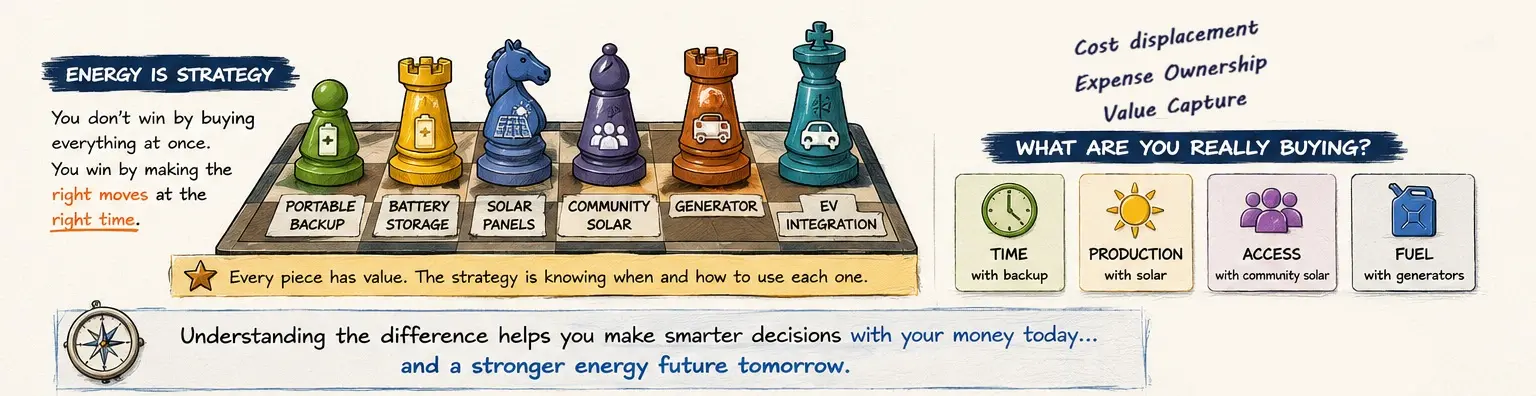
Value Capture is a form of Savings
Solar also doesn’t create money.
It simply redirects where some of that money flows, that was already leaving your bank account.
You’re already paying for basic needs: food and home security, transport, medical bills or insurance… Energy.
What are the returns on those?
The real comparison isn’t Solar vs Cash.
Instead it’s Cost displacement & Expense Ownership and Value Capture.
People own a house.
People own a car.
Yet very few people think about owning the production of one of life’s essential monthly expenses.
Electricity.
What Does Payback Mean To You?
This becomes philosophical.
Because “payback” isn’t one number.
Ask ten homeowners what payback means… You’ll probably get ten different answers.
For one family, it’s cutting the electricity bill, and finally knowing what a portion of next year’s electricity will cost.
For another, it’s keeping an oxygen concentrator running through an outage.
Someone working from home may value uninterrupted internet more than a slightly faster financial return.
An EV owner may care most about replacing fuel costs.
Every homeowner calculates payback differently. Because every homeowner values different outcomes.
That’s why there is no universal ROI.
There is only your energy profile, your priorities, and your definition of value.
Redirecting expenditure into ownership – It changes where future dollars go.
Some grid purchases disappear. Some outage costs disappear.
Some fuel disappears.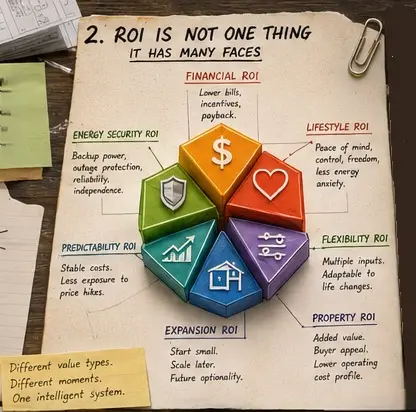
Some inconvenience disappears.
Some generator servicing disappears.
Some electricity gets shifted into cheaper tariff periods.
Money changes direction.
That’s the math.
Not payback.
Flow.
You’re displacing future expenses.
It’s not a spreadsheet exercise—it’s a question of ownership, predictability, and deciding which recurring expenses you want to keep renting forever and which ones you’re willing to invest in.
And here’s something I don’t hear discussed enough.
Inflation.
Not as an investment buzzword. As lived experience.
The electricity you don’t buy in 2038 isn’t bought with 2026 dollars.
It’s bought with 2038 dollars.
Every kWh your panels generate in the future is offsetting electricity at whatever that future price becomes.
So the asset isn’t just producing energy.
It’s producing protection against future price uncertainty.
That’s a layer of ROI and a different lens on “payback period.”
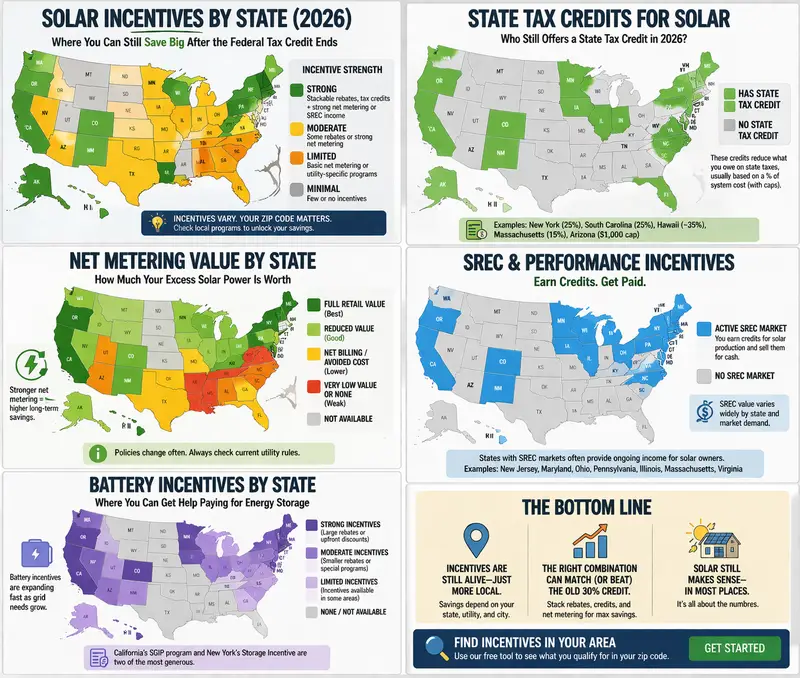 Where Incentives Fit Into the Picture
Naturally, the next question becomes:
Can someone help pay for all of this?
For many years, the answer began with the federal tax credit.
Today, the picture has changed.
Federal residential incentives have largely disappeared for new installations, while many state, utility and local programs continue to evolve.
They’re still valuable. Absolutely. Make use of them where you can! But they shouldn’t become the reason for investing. Don’t build your entire decision around them.
Think of incentives as a bonus – as a tailwind. Not the engine.
A well-planned energy investment should still make sense decades from now, because of the value it creates—not simply because a rebate happens to exist this year.
That’s why we’ve created a dedicated guide explaining how federal, state and utility incentives fit together, and why local programs now deserve far more attention than many homeowners realize.
Who owns the assets your money keeps paying for?
Sometimes the answer is the utility.
Sometimes it’s the gas station.
Sometimes it’s the generator manufacturer.
Sometimes, over time, it becomes you.
Imagine looking twenty years into the future.
Every month, money will still be leaving your bank account to pay for some form of energy.
The question is no longer:
“Should I buy solar?”
It’s:
“Which future energy costs do I want to continue renting—and which ones would I rather begin owning?”
That’s the real decision. Not whether to buy panels.
But whether you’re building an energy-producing ecosystem as asset, that builds value, creates returns and grows over time.
Or renting basic needs – where there are no other returns other than survival.
Where Do You Start Capturing Value?
By now, you’ve probably realized something.
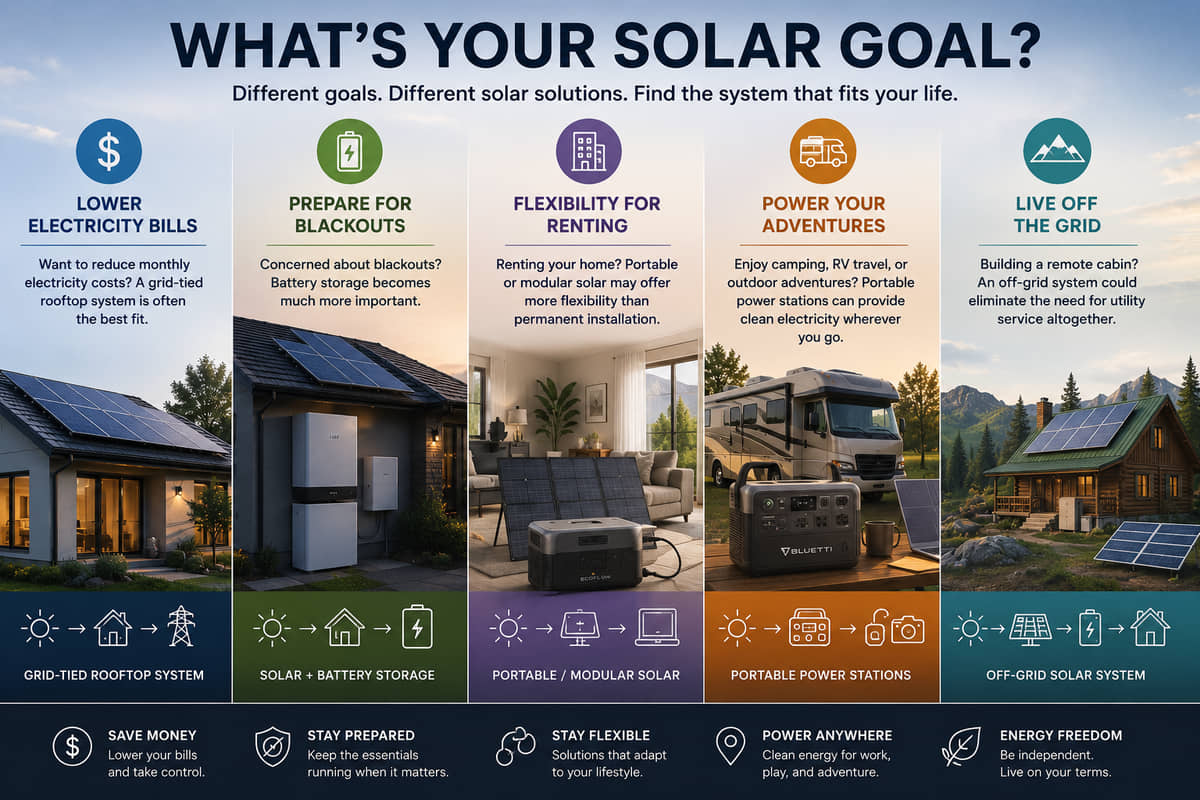
There isn’t a single “best” solar system.
There are different ways of solving different problems.
The right starting point depends on what you’re trying to stop paying for first.
Some focus on stability and predictability.
Some only care for the short-term gains and saving.
Others plan long-term results and spread the investment over time.
Everybody needs an energy strategy from day one. Even if that strategy changes as your needs change.
That’s why NavigatingSolar explores several different paths—not because one is better than another, but because each one captures value differently.
Affiliate Disclosure : This article may contain affiliate links. NavigatingSolar independently researches products and selects partners based on how well they fit our educational framework, not simply because they offer commissions. Learn more about how we select partners.
🔋 Start by Solving the Outage Problem
If your biggest concern is keeping the lights on, protecting food, working through outages, or running essential equipment, a portable power station is often one of the simplest places to begin.
You’re not replacing your home’s electrical system.
You’re buying time.
Time to keep the essentials running.
Time to work through an outage.
Time to decide what your next energy investment should be.
And if your needs grow later, many modern systems can become the first building block of a much larger energy ecosystem.
→ Explore Portable Backup Solutions
Portable power stations now range from compact apartment-friendly units to expandable systems capable of powering large sections of a home.
Many can later be paired with portable solar panels, expansion batteries, or even integrated into a broader backup strategy.
One example is Bluetti’s FridgePower.
Rather than trying to power an entire house, it focuses on the essentials—keeping a refrigerator running, maintaining Wi-Fi and security systems, and providing lighting during an outage. Its automatic switchover means it can detect a power failure, take over without intervention, and return to standby once utility power is restored.
For many households, that’s all the resilience they actually need.
⚡ Start Small. Build Strategically.
Build an Energy System That Can Grow With You
Life rarely changes all at once, and energy needs change along with it.
It depends what your long and short term goals are:
A growing family.
Immediate problem solving vs long-tern investment mindset
An EV in the driveway, that makes more sense for the traveling career person
A growing need for predictability – like in the case of medical equipment (that’s already costing a pretty penny)
When controlling your usage, makes more financial sense than controlling a bill with external forces deciding over cost and price.
A sporadic income or tighter budget one year—and more freedom the next.
Maybe you’re at a crossroads in life, unsure where you’ll be in a year’s time.
That shouldn’t exclude you from the renewable energy movement.
That’s why modular energy ecosystems have become such an interesting way to think about solar.
You’re not trying to predict every future need today.
You’re building an infrastructure that can adapt as those needs appear.
Start with backup.
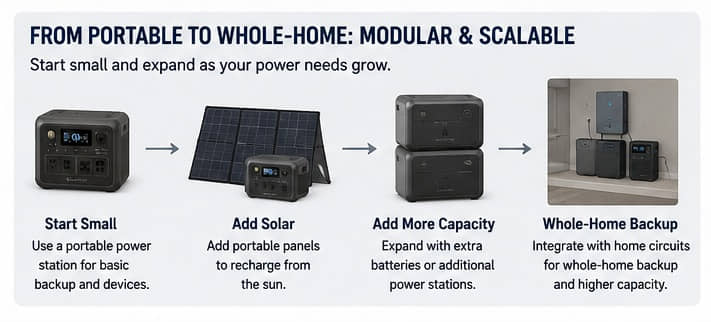 Add solar when it makes sense.
Expand battery storage later.
Keep it portable, or make it a permanent fixture in time
Every module solves today’s problem…
while making tomorrow’s solution easier.
It’s less about buying equipment.
It’s about keeping your options open without having to start over every time life changes.
Instead of waiting until you can afford everything…
You build infrastructure one decision at a time.
So before talking to installers, spend a little time exploring what’s available on the market.
Looking at complete systems types, individual components and different brand compatibility make it much easier to understand the recommendations you’ll receive later.
Understand how each system links to your home and utility, before settling on product choice.
Explore what these systems look like, how they work and what the modules are for each.
For excellent diagrams, product layouts and system illustrations, making it one of the easiest places to visualize how different solar systems are assembled before making decisions.
Here’s a visual aid:
Steps: Follow the link below – Choose a system (hybrid, grid-tied or off-grid) – Choose a size (essentials:3-5kW to whole-home: 10kw+) – Hover over the product image and see how it transforms into a home energy system.
→ Explore Modular Energy Ecosystems
☀️ Design the Platform Before You Add the Features
Nobody buys a house because they’re excited about the electrical wiring.
They buy it because it becomes the foundation for everything they’ll add later.
A well-designed rooftop solar system works the same way.
It isn’t simply there to lower today’s electricity bill.
It becomes the platform that feeds batteries, reduces future fuel costs through EV charging, powers smart home automation, and supports whatever energy technologies come next.
You’re not simply installing panels.
You’re building the part of the ecosystem that does the heavy lifting for decades.
If your goal is reducing long-term electricity purchases while maximizing long-term ROI, a professionally designed EPC (Engineering, Procurement & Construction) solar solution is often the strongest starting point.
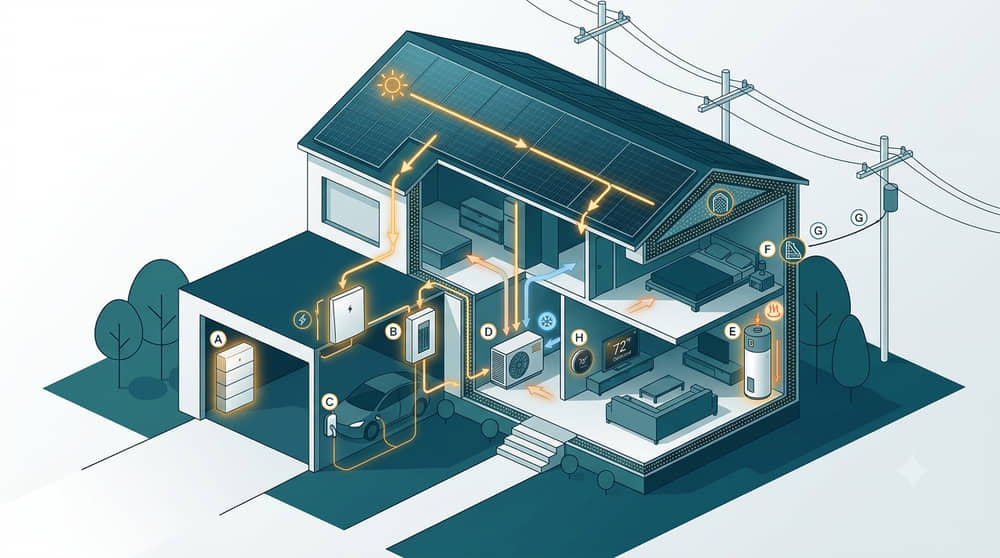
Professionals design the entire system around your energy profile, expected usage, and future goals—allowing you to implement the complete vision sooner.
The trade-off?
Instead of growing module by module as your budget allows, you’re investing in much of the infrastructure upfront and recovering that investment over time.
For many homeowners, that’s where the economics change most dramatically.
→ Compare Residential Solar Solutions
🌎 Can’t Install Solar?
Every homeowner deserves a path into renewable energy. The path just isn’t the same for everyone.
Not every homeowner has a suitable roof.
Maybe you’re part of an HOA.
Maybe local regulations make installation impractical.
Others rent or live in apartments or properties with poor solar access.
Maybe you’re simply not ready for a permanent installation.
Community Solar allows many households to benefit from renewable electricity without installing panels on their own property.
That means they don’t have to watch the renewable energy transition from the sidelines.
Now… ask almost any committed solar owner what they think of Community Solar and you’ll probably hear:
“Why would I pay for someone else’s panels when I could own my own?”
It’s a fair question.
Owning the infrastructure gives you greater control over your energy future. But for many households, it simply isn’t possible.
And that’s where people often compare two completely different ideas.
Community Solar isn’t another type of solar system.
It’s another way of accessing renewable generation.
Think about the questions each solution answers:
- Portable backup asks: “How do I keep the lights on when the grid goes down?”
- Battery storage asks: “When do I use my electricity?”
- Personal solar panels ask: “How do I generate my own electricity?”
- Community Solar asks: “Who generates my renewable electricity?”
Those aren’t competing answers. They’re answers to 2 different questions.
That’s why Community Solar and a modular energy ecosystem aren’t direct competitors.
One provides access to renewable generation.
The other builds ownership, storage, resilience and long-term control.
Understanding that distinction is one of the most important parts of comparing energy investments, because you’re not just comparing technologies.
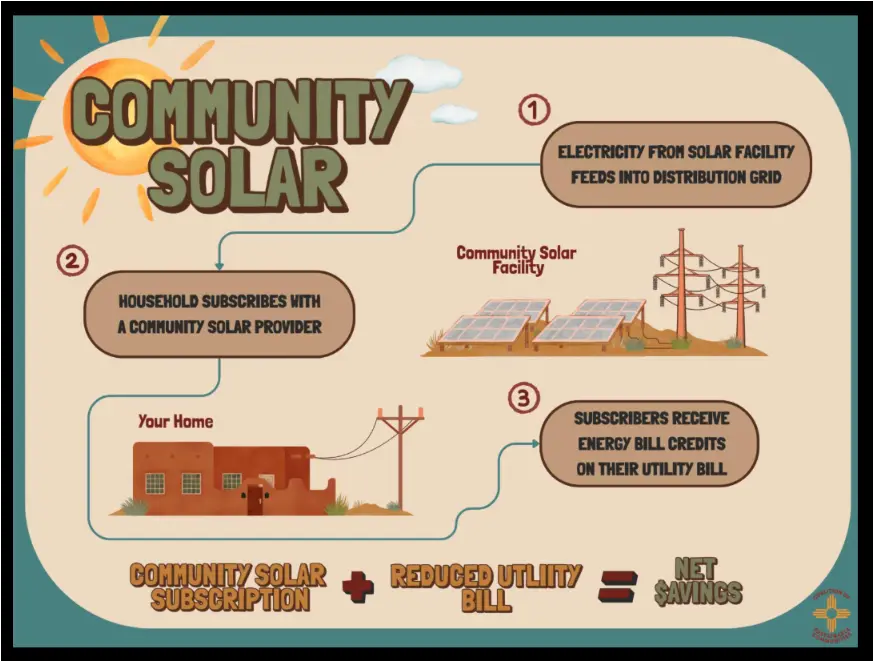
You’re comparing what you want to own, and what you’re comfortable accessing through someone else.
→ Explore Alternative Solar Mounting Options
→ Compare Portable Energy Systems
Next Steps for Homeowners
- Know your usage
- Know your energy goal
- Estimate your system size
- Check your state-specific incentives
- Compare utility programs and buyback rates
- Run a full ROI calculation (not just install cost)
- Consider future expansions early
- Get a custom quote based on your location
Free Independent Resource for Homeowners
Before comparing installer quotes, it helps to establish a realistic financial baseline.
The toolkit and guides can help you estimate potential savings, evaluate incentives, and understand how solar may perform based on your usage and location.
Go to NavigatingSolar.com for independent tools, solar calculators and guides – everything you need, in one place.
US Solar Quote Tool
For Home Solar System Installations and Solar Battery Quotes
Connect with Local US Installers
trusted by homeowners nationwide
— step-by-step, practical, and pressure-free.
Educational transparency.
NavigatingSolar is an Independent Educational Resource. We are not solar manufacturers or installers – we research them.
Why these suggestions?
Navigating Solar doesn’t recommend companies simply because they offer affiliate programs. We believe readers should always understand why something is being recommended. We begin with the homeowner’s decision—not the product. We identify where people struggle to make informed choices, then evaluate products, services and partners that genuinely solve those problems.
Not every recommendation earns us a commission. Partnerships are selected to fit the educational framework—not forcing the educational framework to fit whatever affiliate programs happened to exist. If a company doesn’t fit the decision framework and ethos, we don’t include it—whether it has an affiliate program or not. If we believe a better solution exists, we’ll recommend it regardless of whether it generates a commission.
➡️ Our goal is to help you make the right decision—not the fastest purchase.
Recommended Reads
Solar Incentives by State in 2026
Which Type of Solar Consumer Are You?
MAXIMIZE YOUR SOLAR WINDOW—PAY LESS
Types of solar-powered systems