 Navigating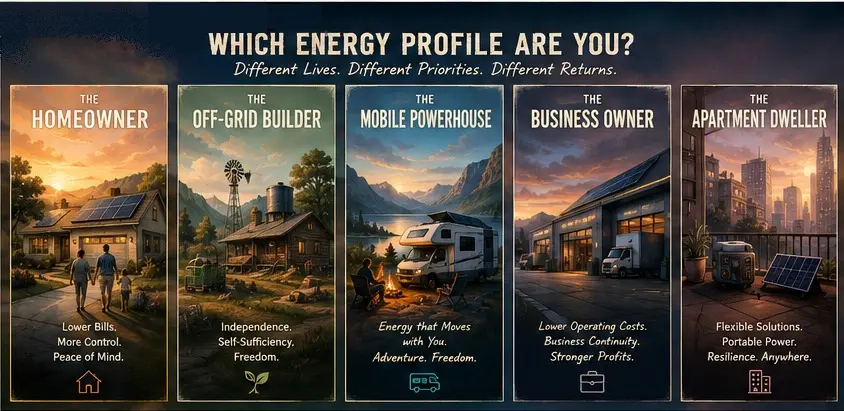
Summary
Understanding Your Energy Profile Puts You in Control
The beauty of solar is that it adapts to you. Whether you're focused on savings, independence, sustainability, or innovation, there's a system designed to meet your needs. Understanding your solar consumer type is the first step toward reclaiming control over your energy future.
Same Tech – Different Returns and Gains
Solar Savings Doesn’t Start With Hardware, It Starts With People’s Needs.
Nobody wakes up wanting solar. People wake up wanting electricity they can trust.
Most of the time the energy conversation for a homeowner starts because there is a pain-point to resolve.
A need to be fulfilled.
Backup solutions, high utility bills, always-on reliable home security.
The last thought to hit is: “my basic needs have a level of ROI to tap into”
Where you are in life, and what return you’re actually looking for from your type of solar or energy system, changes everything that follows.
Commonly we look at panels, batteries, quotes, or installer recommendations and assume the decision is mostly technical.
In reality, the technical part is the easy part.
The harder part is understanding what role energy plays in your life, and what you expect it to give back to you in return.
Because solar or renewable energy isn’t one decision.
It’s a system of decisions stacked on top of each other.
How you live, where you live, how stable your grid is, how much control you want, and what financial return actually means to you – all shape the system you end up with.
Once you look at it that way, most households stop being “unique edge cases” and start falling into a few clear energy realities.
Choosing your Energy Profile: A Decision Layer for Solar ROI
Solar ROI is no longer just money – there’s value beyond
That’s probably the biggest win.
- stability
- resilience
- flexibility
- independence
- mobility
These might all seem like solutions, but in energy terms they are in fact profile characteristics. These help shape decisions and energy systems, and in turn has a set of ROI layers that get revealed.
So let’s look at the 5 general energy profiles
Affiliate Disclaimer:
This article may contain affiliate links. NavigatingSolar independently researches products and selects partners based on how well they fit our educational framework, not simply because they offer commissions.
Learn more about how we choose partners.
 The Suburban Homeowner
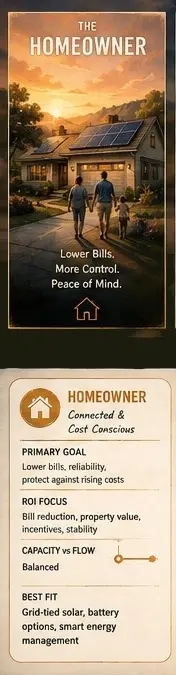
A connected home, access to the grid, a usable roof, and a monthly electricity bill that seems to grow every year.
Life carries on as normal…
…until rising costs, power outages, or the addition of an EV make you question how much control you really have over your energy.
In this profile, solar is usually about reducing monthly cost while adding a layer of protection.
The grid is still there, but it stops being the only source of truth. Some people add batteries for backup.
Others focus purely on offsetting usage during the day.
Some start thinking about smart energy management or wonder about more cost effectively to charge the newly acquired, fuel saving EV.
The return here is layered.
Yes, there’s bill reduction. But there’s also insulation from future tariff increases, more predictable costs over time, and in some cases, a direct increase in property value. Depending on location, incentives and export credits can also play a role, but they are usually part of the equation rather than the entire reason for the system.
Homeowner’s Energy Profile
You’re not trying to leave the grid behind. You’re trying to make it work on your terms.
The goal is lower bills, greater reliability, and protection against an uncertain energy future without changing how you live.
Honing in on Power and Savings
Some homeowners think in capacity. They want enough battery storage to keep the lights on and essential appliances running during outages.
Others think in flow. They’re more interested in producing their own electricity, offsetting daytime usage, exporting excess energy, and using the grid as another part of the system.
Most suburban homes naturally become a balance of both.
The 3 Rs of Solar ROI
Returns – Reliability – Risk Management
Return on investment is more financially focused.
It usually starts with available incentives, maybe rebates, then evolves to lower utility bills – but rarely ends there.
Protection against future tariff increases, smarter energy management and better arbitrage, backup during outages, eliminating EV charging costs, and even sometimes property value, all become part of the long-term return.
When professional skill and support is important
This profile usually leans toward a traditional residential solar installation.
A professional quote and system design often make more sense than buying equipment first, while batteries and portable backup systems can be added later as needs evolve.
 The Off-Grid Builder
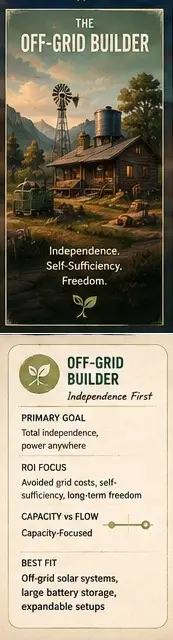
This profile starts with a different assumption. This is a completely different mindset, even if the hardware overlaps.
The grid is unavailable, unreliable, or simply not part of the long-term plan.
Energy is something you design from scratch rather than tap into – it has to be designed rather than supplied.
That usually means rural land, farms, homesteads, cabins, tiny home or rural properties where independence is part of the plan from day one.
The Energy Independence Profile
Your goal isn’t reducing a bill. It’s creating a reliable source of electricity that works every day, regardless of whether a utility company exists. The system design reflects that reality. Batteries aren’t optional. Storage becomes the center of the system, not an add-on. Every decision is about balance between generation, consumption, and reliability.
Planning, Participation and Preparedness
Off-grid users naturally think in capacity. Battery storage becomes the heart of the system, while solar generation, backup charging, and daily consumption all fall into a natural hierarchical order of execution
Flow still matters, because enough stored energy needs to exists to carry you through bad weather and overnight use, and unforeseen incidents without external backup support like a suburban home.
ROI Is Several Things In One
The financial lens is different here too. The return isn’t simply measured by payback years.
It’s found in avoided grid connection and infrastructure costs, eliminating monthly utility bills, long-term self-sufficiency, and the ability to live where traditional infrastructure doesn’t easily reach.
You are effectively buying yourself out of dependency on a service you never fully relied on in the first place.
The return here is less about savings on a bill and more about removing the bill altogether.
Order of Progression
This profile benefits from carefully planned off-grid systems, expandable battery storage, and educational resources that help size systems correctly before investing in equipment.
 The Mobile Powerhouse
Then there’s a completely different category of energy use altogether.
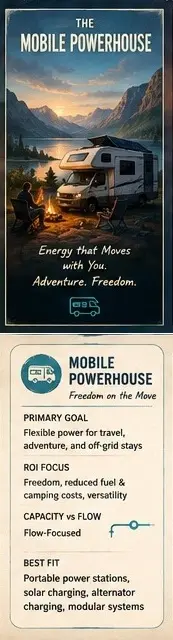
This is the RV lifestyle, van life, boating setups, camping rigs, and portable power environments.
Energy here is not always tied to a fixed location. It moves with you.
That changes everything.
Portable, expandable energy systems is the natural fit, with the added extra quirk of charging speed.
1. The Destination Driven Energy Profile
Energy in this category is mobile. You are not building infrastructure—you are building a self-contained system that travels with you. Instead of optimizing for household consumption, you’re optimizing for flexibility.
Instead of thinking in kilowatt-hours per month, you’re thinking in how long you can stay off-grid, how quietly you can operate, and how much freedom you have to extend a trip without depending on external hookups.
2. Capacity vs Flow thinking
This is where the split becomes obvious:
Some users think in capacity terms. They want to know how big the battery is, how long it lasts, and how much backup they can store before they run out.
Others think in flow terms. They focus on how fast they can recharge from solar, alternator charging while driving, or campsite/grid hookups, and how easily they can switch between those inputs.
Most RV systems sit somewhere between both.
3. ROI on the Road
In this profile, ROI is not just financial, and the financial return is subtle but very real.
ROI shows two sides here:
- It shows up as reduced campground fees, less generator fuel, fewer limitations on where you can go, and the ability to reuse the same equipment in multiple contexts, including emergency backup at home.
- It’s freedom per unit of energy, not just cost recovery. Because the real return is flexibility—being able to extend travel, stay off-grid longer, and reuse the same system across travel and emergency home backup situations.
4. System fit for flight and fight
Here you have choices – professionally fitted systems, modular systems for the daring and inspired DIY traveler, and alternator charging systems that give you that extra boost in power, savings and ROI.
To get into details, product specs, tailored solutions and interesting innovations we need a completely dedicated blog post.
But if this profile caught your fancy somewhere along the line – whether you have that RV or are only dreaming about it – a good place to start doing homework and compare systems are these to companies that stand out for their system quality, range of products and customer support.
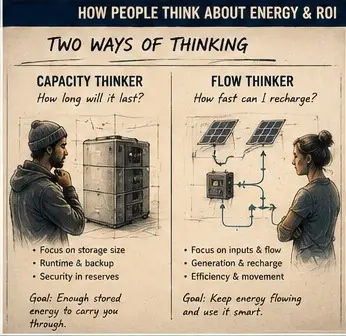 EcoFlow tends to fit users who think in flow terms:
- multi-input charging approach (solar, alternator, AC)
- fast recharge cycles
- “energy wherever I am” mindset
Bluetti tends to fit Capacity-focused users:
- where larger stored reserves matter
- longer off-grid endurance is actively planned for
- “how long can I last without input” mindset
Neither is better—they reflect different mental models of energy use
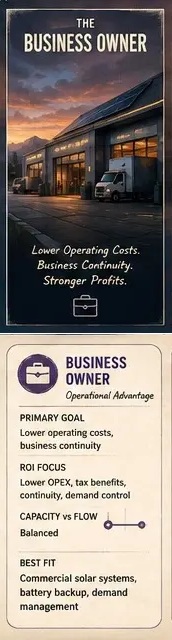
The Business Owner
Commercial energy use introduces a different scale entirely. For businesses, electricity isn’t just another utility bill.
It’s part of controlling operating costs, productivity, customer experience and business continuity. Every outage has the potential to interrupt revenue. It’s not just trying to reduce a bill, but stabilizing long-term expenses, and improve predictability in a system where energy is part of your business overhead.
The loads are larger, the usage is more consistent during the day, and the financial models become more formal. Demand charges, tax incentives, depreciation benefits, and ROI calculations become part of the conversation in a way they usually aren’t in residential solar systems.
The Professional Energy Profile
The goal is controlling operating costs while keeping the business running reliably. Depending on the business, that may mean protecting critical equipment for a few hours or investing in long-term commercial solar infrastructure.
The Operational-first Approach to Energy
Some businesses need capacity only, focusing on backup runtime for equipment, essential to seamlessly continue operations during outages.
Others think in flow, looking at how energy moves through the business each day to reduce operating costs and improve efficiency.
Many businesses require both.
The ROI Drive
Here, solar starts behaving less like a upgrade and more like infrastructure investment.
Return is measured through lower operating costs, improved cash flow, business continuity, tax incentives, depreciation benefits, and protection against rising commercial electricity prices.
Powering Production and Profits
Small businesses may benefit from portable battery backup systems for resilience, and lowered runtime costs. Larger operations usually benefit from professional commercial solar system design and installation, placing solar quotes in a commercial/industrial class – as these often come with a whole different set of governing rules & regulations, billing and crediting systems, paperwork requirements etc.
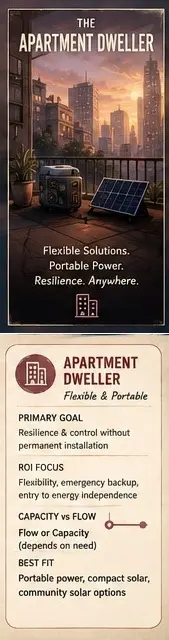 The Apartment or Limited Access Dweller
This is the profile most solar content ignores, but it matters more than people think.
Not everyone owns and controls their roof. Not everyone has permission to install a full system. Renters, apartment owners, and people living in managed communities often have little control over permanent solar installations, but that doesn’t remove the need for reliable energy. Energy use still exists, and so does the need for backup, resilience, and cost control.
So the systems shift. Portable solar, small battery stations, community solar subscriptions, and efficiency-focused setups become the entry point. The scale is smaller, but the intent is the same: reduce dependency and increase control.
The financial return here is not about large savings. It’s about entry-level access to energy independence principles without ownership of infrastructure. It’s flexibility, mobility, and resilience packaged into smaller systems that can move with you.
A Partaking-But-Not-Permanent Energy Profile
The goal is increasing resilience, energy expense control, and reducing dependence on the grid using solutions that don’t require permanent changes to the property. This profile often faces space limitations, which makes for some interesting designs.
Learn more about alternative installation designs for solar.
Smaller Vehicle, but Still in the Race to Renewable Power
These folks are more often divided into 2groups using the same battery-centric system concept:
- Capacity-focused users looking for enough stored energy to ride through outages and keep essential devices running. As communal bill-reduction tool, single-person cost control mechanism, these solutions are giving accessibility a stronger leg to stand on.
- Flow-focused users value flexible charging, portable battery backup systems that can move with them when life changes.
The 3rd group make use of community solar.
A complete different model, that requires no panels or batteries, and operates under a different set of rules. Read the article on Community Solar and VPPs here.
Possible ROI of a Portable Alternative
The return isn’t measured through massive electricity savings. It’s measured through flexibility, emergency preparedness, portability, and access to renewable energy without owning the building itself.
On the flip side, imagine a student for a moment.
If a parent sets them up with an entry-level modular solar system, that’s more than buying a battery or a few panels – that investment could continue paying dividends long after the initial purchase.
It’s giving them a practical head start. As their career, finances, and home evolve, the system can evolve too.
I’d argue that’s a form of ROI we rarely talk about—one that stretches beyond a single purchase and, in some cases, beyond a single generation.
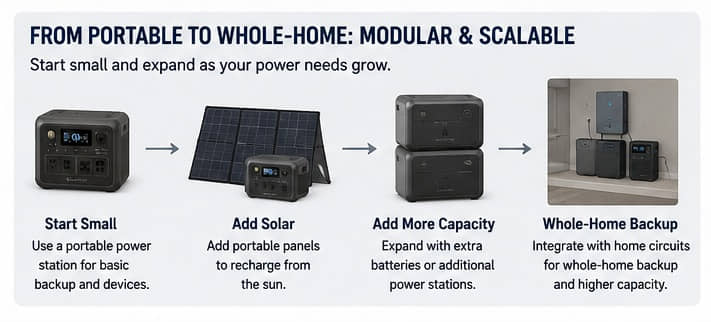
Power, Piece by Piece
Here “modular” solar can mean semi-permanent alternative solar mountings and a portable battery system, or complete mobile unit that moves form the balcony to its compacted stow-away state.
Portable power stations, compact solar solutions, and community solar programs often provide the easiest entry into energy independence while leaving the door open for larger systems in the future.
Pulling it all together
Once you step back from the categories, something becomes clear.
Solar isn’t just a product decision.
It’s a reflection of how your life is structured around energy, and what you expect that energy to give back to you.
Some people want lower bills. Some want independence.
Some want mobility.
For others renewable energy brings better stability in a business environment.
And some are just trying to get started in a system they don’t have to go to debt for to solve anxiety around a medical machine or personal safety while the utility’s power supply goes down.
Regardless of profile or preference, underneath all of that sits the same common thread.
Renewable power is becoming more accessible, the concept less foreign by the month and the demand stems less from “latest revolutionary gadget” and more from a point of “this makes more sense moving forward”. Necessity still remains a strong driver and motivator in current economical climates, but globally the “aha” moment is reaching more people than statistics care to show.
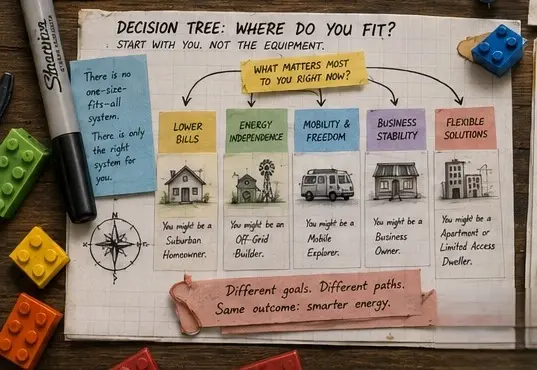
Next Steps in the Energy Decision Tree
Understanding Your Profile Puts You in Control. Choosing the Right System Puts That Control to Work.
The beauty of solar is that it adapts to you.
Understanding your solar consumer type is the first step toward reclaiming control over your energy future.
The next step is choosing a system that reflects why you’re investing in solar in the first place.
That’s often where the growing number of options can create decision paralysis.
Solar Systems Work Best When They Match Your Priorities
Whether you care most about lowering electricity bills, backup protection, energy independence, or long-term ROI, there is no single “perfect” solar setup.
The best system is usually the one that aligns with your actual lifestyle, usage habits, financial goals, and long-term expectations.
By now, you should have a clearer idea of the type of system that suits your lifestyle.
The next step is seeing how those ideas translate into real products, pricing, and installer recommendations for your area.
Which brings us to your next question first: “Okay… which path does my profile naturally lead me down?”
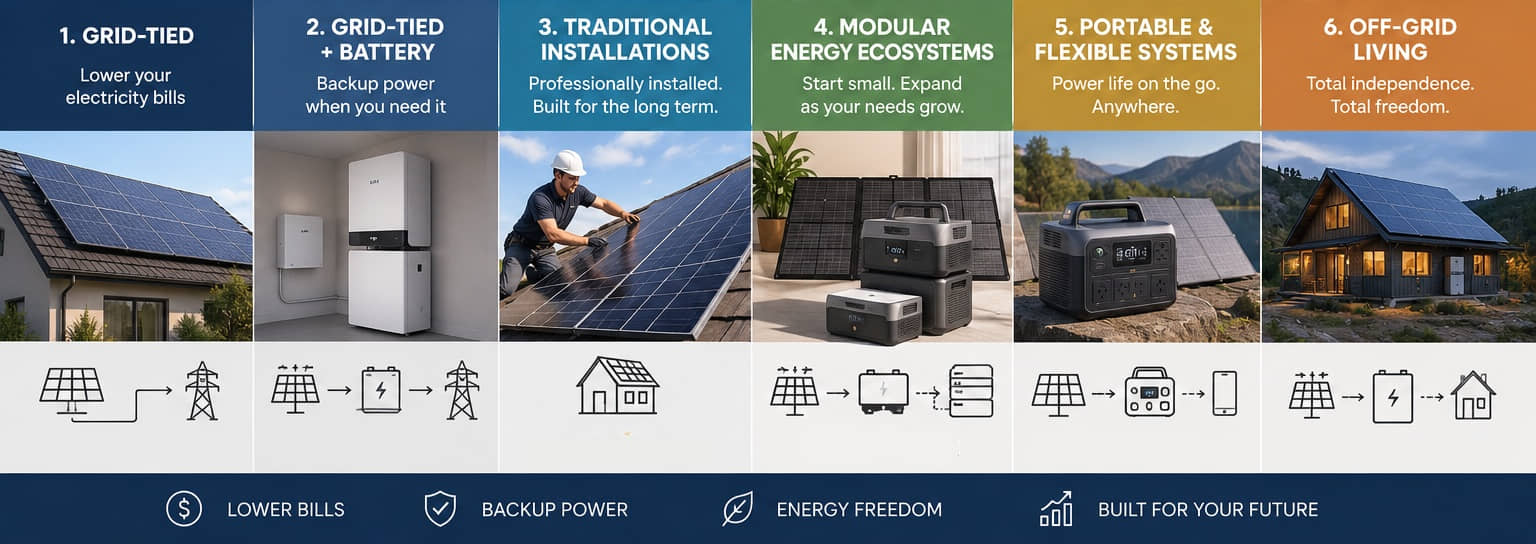
Three Main Energy Pathways
When looking at power systems, there are roughly 3 main options: portable, modular and traditional rooftop solar.
Portable Power
Perfect for renters, apartment living, RV travel, emergency backup, or anyone wanting flexibility without a permanent installation.
➡️ Compare Portable Power Systems
and Battery Backup Solutions
Modular Battery Systems
Ideal for homeowners who want to start with battery backup and expand into solar over time as budgets, needs, or confidence grow.
For excellent diagrams, product layouts and system illustrations, making it one of the easiest places to visualize how different solar systems are assembled before making decisions.
Here’s a visual aid:
Steps: Follow the link below – Choose a system (hybrid, grid-tied or off-grid) – Choose a size (essentials:3-5kW to whole-home: 10kw+) – Hover over the product image and see how it transforms into a home energy system.
➡️ Build-as-you-Grow Modular Energy Systems
➡️ Explore Smart Energy Management Ecosystems
Some homeowners prefer integrated Smart Energy Ecosystems, where batteries, solar generation, EV charging and selected household loads communicate automatically to manage energy throughout the day.
Traditional Solar Installations
Best suited for homeowners looking for long-term savings, professionally designed solar systems, DFY whole-home installation & energy management.
Also known as turnkey or EPC solutions – Evaluation, Procurement and Construction
Speak to Vetted Solar Experts
Quote Request Tool
Connect with Local US Installers trusted by homeowners nationwide — step-by-step, practical, and pressure-free.
Affiliate Disclaimer:
These links above, may connect you with solar providers through our partner network.
NavigatingSolar may earn a commission if you choose to engage — at no extra cost to you.
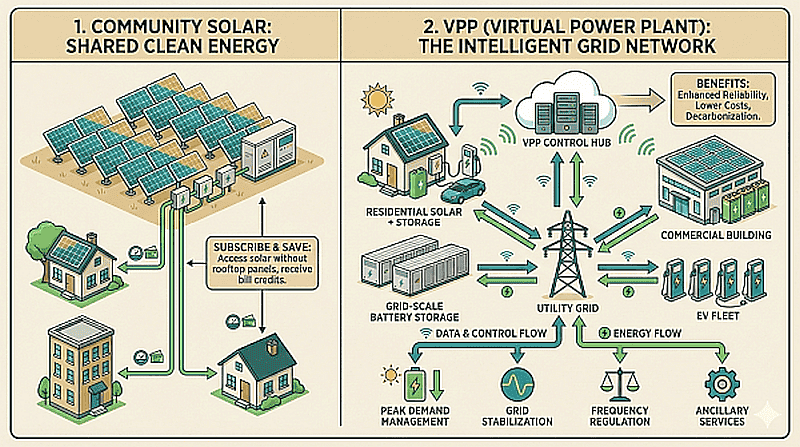
There is another pathway for people who want to join the renewable energy movement but, for various reasons, can’t install solar on their own property.
Community solar programs and Virtual Power Plants (VPPs) allow many households to participate without purchasing or maintaining a private solar installation. For some, this can be the most practical first step into renewable energy.
Ideal for renters, apartment residents, homeowners with unsuitable roofs, or anyone who wants to benefit from solar without installing equipment on their own property.
➡️ Learn About Community Solar Programs
 Helpful Starting Points & Free Online Resources
Visit your NavigatingSolar Toolkit
Independent Solar Planning and Research tools, calculators, checklists and guides
all in one place.
RELATED ARTICLES
➜ Types of solar-powered systems
➜ She went Shopping for Solar!
Solar Battery Backup Power: Value vs Expense
The Homeowner’s Solar Decisions Manual: Built on Choices