 Navigating
 Summary
A Solar Battery is the key to true energy independence, allowing you to capture your solar energy and use it exactly when you need it most. It’s the difference between being a solar generator and becoming your own personal utility.
The BS in Battery Storage You Can Skip and What to Look For Instead
The Financial and Energy Strategy Behind Battery Shopping
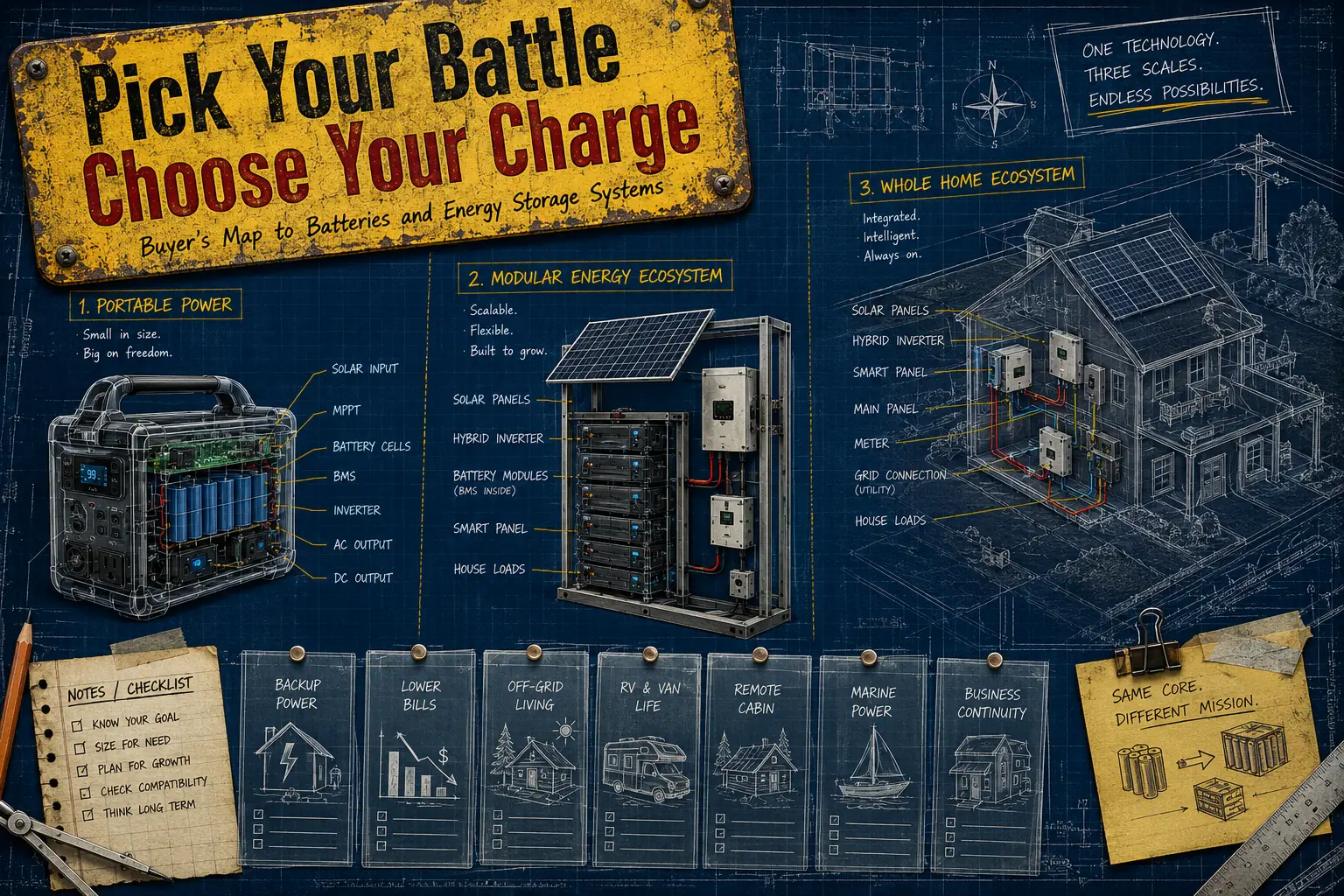
The Battery Marketplace Map is not only a guide to batteries.
It is a guide to understanding today’s energy storage marketplace, where batteries are only one part of a much larger energy system.
Many of today’s available products overlap in function while using completely different terminology.
One of the primary goals of this guide is to translate the marketing language into plain English.
We also look at what’s inside each black box, then decide which product matches your actual needs.
Our approach?
Cut the confusion around battery selection, and
Focus on the steps that come before looking at battery product sheets.
Why?
Different energy paths and lifestyle needs, influence decision-making more than specs on a battery pricing sheet.
That’s where you will hear us refer to energy profiles.
Each profile requires a different approach to energy generation, storage and life cycles.
Battery specs? They’re only one part of the equation.
The part of the equation that is either a costly learning curve or the start of your own type of energy ecosystem.
The goal is to help readers understand the different paths available before we compare brands, prices or specifications.
Affiliate Disclosure:
This article may contain affiliate links. NavigatingSolar independently researches products and selects partners based on how well they fit our educational framework, not simply because they offer commissions. Learn more about how we choose partners.

Purpose of a Battery Marketplace Map
People believe they are choosing a battery.
In reality, they are often choosing an energy platform.
The battery itself may remain useful for 15 years or more, but the surrounding ecosystem—software, monitoring, automation, expansion options and compatibility—often determines the long-term value of the investment.
Choosing an ecosystem can become a more important decision than choosing the battery chemistry.
The modern battery market has evolved beyond standalone batteries.
Today’s buyers may be choosing between:
Traditional Rooftop Installation (EPC)
Modular expandable energy systems and
Whole-home Energy Ecosystems
Think of today’s marketplace mapping as answering three separate questions instead of staring at battery listings and being none the wiser for it.
1. WHY?
What problem are you trying to solve?
- Backup power
- Lower electricity bills
- Storage
- Portable power
- RV travel
- Medical equipment
- Off-grid living
- Business continuity
2. WHAT
What type of solution solves that problem?
Product Categories examples include:
- Portable Power
- Solar Generator
- Battery Bank
- Home Batteries
- ESS vs BESS
- Commercial Energy Storage
3. HOW?
Which technologies are involved?
Examples:
- Types of Batteries
- BMS
- Inverter
- Hybrid Inverter
- Controllers
- Smart integration
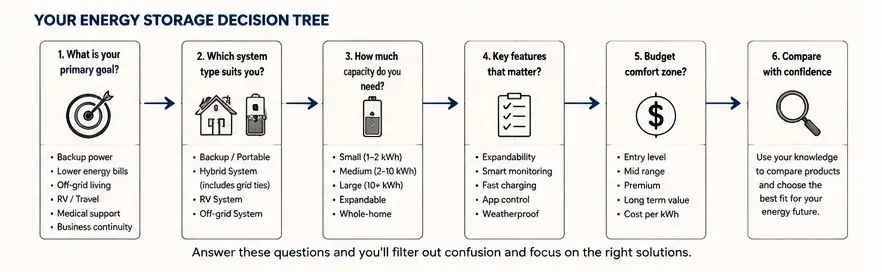
Your Energy Profile is Part of the Map
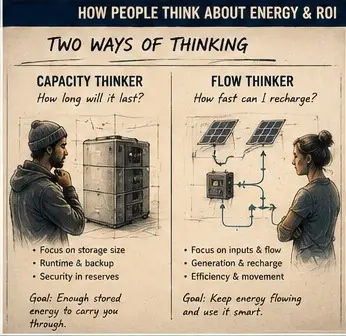
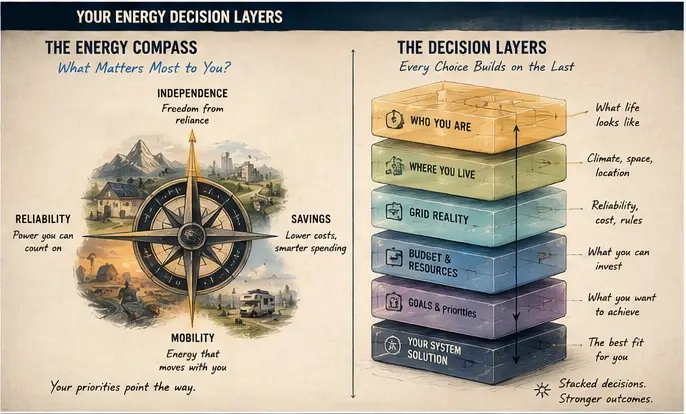
One’s energy profile is not static, it changes with your life.
Families grow, lifestyles and plans change.
This makes choosing a battery less about shopping for hardware, and more about building a strategy first.
Whether it becomes a full ecosystem with all the bells and whistles, depends on your future goals.
When you understand your profile, you can map your energy decisions and future system expansion long before anything is purchased or installed.
Every energy storage solution is designed to solve a particular problem.
It answers the question: “Which one of these do I actually need?
The challenge isn’t finding the “best” battery. It’s understanding which type of system best matches the way you live.
Before comparing brands, capacities or prices, take a moment to decide what you’re actually trying to achieve.
The sections below represent the most common reasons people invest in energy storage.
I Need Backup Power
If your primary concern is keeping the lights on during power outages, you’ll want to focus on backup systems rather than portable convenience.
Questions to consider:
- Which appliances need to keep running?
- How long do outages normally last?
- Do you want to power a few essential circuits or the entire house?
- Is automatic backup important?
Typical solutions include:
- Portable Power Stations
- Home Battery Systems
- Whole-home Backup Systems
I Want To Store My Solar Energy
Without battery storage, most residential solar systems export excess daytime electricity to the grid.
A battery allows you to store that energy for use after sunset, during cloudy weather or during outages.
Questions to consider:
- Is your current solar system battery-ready?
- Are you trying to reduce grid imports?
- Do local electricity tariffs reward self-consumption?
Typical solutions include:
- Home Battery Systems
- ESS
- Hybrid Inverter Systems
I Want Lower Electricity Bills
For many homeowners, batteries are less about outages and more about reducing energy costs.
Some systems can charge when electricity is inexpensive and discharge during expensive peak periods.
Others maximize the use of rooftop solar before drawing power from the grid.
Questions to consider:
- Does your utility use Time-of-Use (TOU) pricing?
- Is battery payback financially worthwhile in your area?
- Would solar panels provide a better return before adding storage?
Typical solutions include:
- Home Battery Systems
- Smart Energy Systems
- Home Energy Ecosystems
I Want Energy Independence
Some homeowners simply want greater control over where their electricity comes from.
Energy independence doesn’t always mean living completely off-grid.
It may simply mean relying less on the utility while increasing resilience during emergencies.
Questions to consider:
- How independent do you want to become?
- Is complete off-grid living realistic?
- Will your system expand over time?
Typical solutions include:
- Modular Battery Systems
- Whole-home Backup
- Home Energy Ecosystems
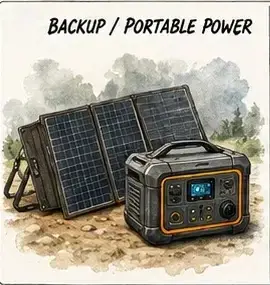 I Need Portable Power
Sometimes mobility matters more than storage capacity.
Portable systems are designed to travel, making them useful for camping, outdoor work, events, emergency response and temporary backup.
Questions to consider:
- How often will you move the system?
- What devices need power?
- Will solar charging be available?
Typical solutions include:
- Portable Power Stations
-
-
-
-
-
-
- Solar Generators
-
-
-
-
-
-
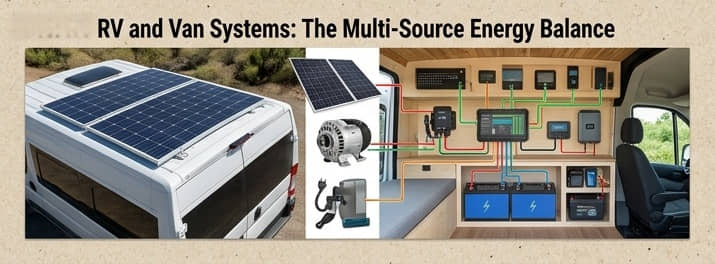
I Travel in an RV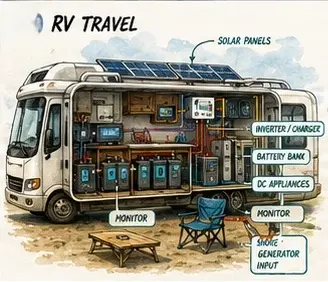
An RV creates very different energy demands than a house.
Weight, available space, charging methods and daily energy use all become important considerations.
Many RV owners begin with portable systems before expanding into permanent battery installations.
Typical solutions include:
- Portable Power Stations
- Deep Cycle Batteries
- Modular Systems
- Alternator Charging
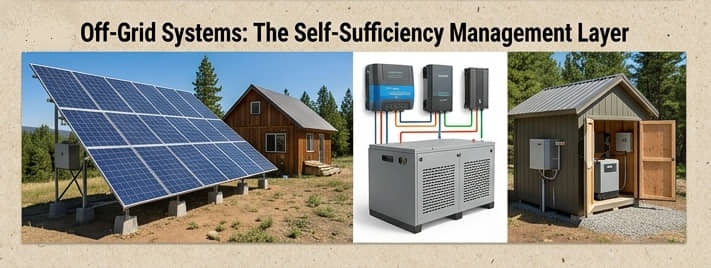
I’m Building Off-Grid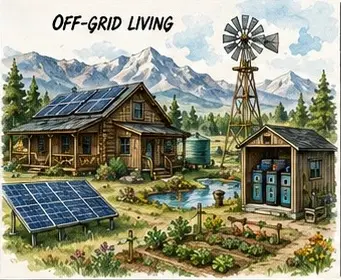
Off-grid systems require a different approach altogether.
Rather than providing occasional backup, the battery becomes the heart of the entire electrical system.
Every component must be carefully sized to meet daily energy demands throughout the year.
Typical solutions include:
- Battery Banks
- ESS
- Modular Battery Systems
I Have Critical Medical Equipment
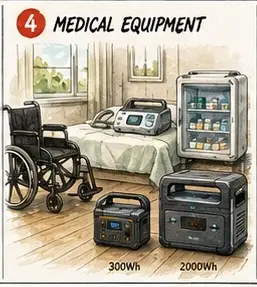
For some households, reliable backup power is more than a convenience—it is essential.
Medical equipment may require continuous operation during unexpected outages, making reliability, redundancy and system monitoring especially important.
In these situations, homeowners should consider professionally designed backup systems rather than relying solely on portable equipment.
Replacement batteries should be bought from a reputable marketplace or battery specialist brands.
Choosing Between Battery Backup, A Modular System or An Energy Ecosystem
This is where many homeowners unknowingly take the wrong path.
Although these products often look similar from the outside, they represent very different levels of investment, capability and long-term commitment.
Think of them as three stages rather than three competing products.
Level 1 → A Battery
You’re buying storage.
The battery becomes one component of a larger system that you either already own or intend to build yourself.
Best suited for:
- DIY projects
- Existing battery systems
- Replacement batteries
- Experienced users
Level 2 → A Modular System
You’re buying a working solution.
The manufacturer has already combined the battery with the necessary electronics, making installation and operation much simpler.
Examples include portable power stations and professionally installed home battery systems.
Best suited for:
- Most homeowners
- Backup power
- Solar storage
- Simplicity
Level 3 → A Whole-home Energy Ecosystem
You’re buying into a platform.
The battery is only one part of a connected family of products that may include solar panels, EV chargers, smart electrical panels, monitoring software and energy management tools.
These systems offer the greatest opportunity for expansion and automation but also create the strongest brand commitment.
Best suited for:
- Long-term home electrification
- Future expansion
- EV ownership
- Smart home integration

The Thing People Actually Need to Understand Before They Spend a Cent
Many compare battery capacity… when they should be comparing expansion paths.
Not chemistry.
Not specifications.
Not even price.
Compatibility.
But first let’s sort out some messy terminology that’s been the root of many confused queries.
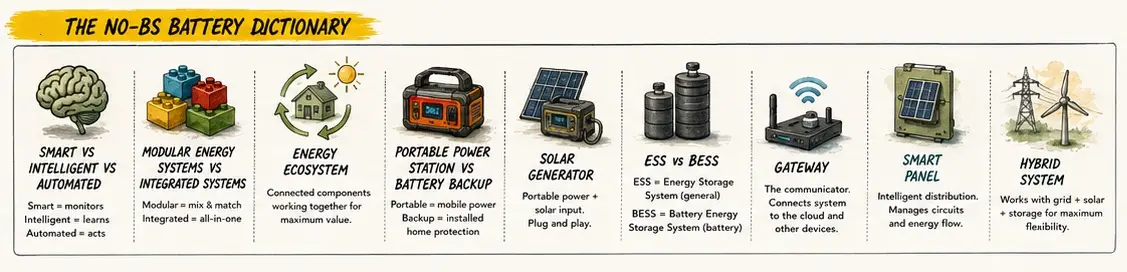
The No-BS Battery Dictionary
Marketing terms translated into English.
This guide decodes marketing language rather than repeats it.
We look at:
- Smart vs Intelligent vs Automated
- Modular Energy Systems vs Integrated Systems
- Energy Ecosystem
- Portable Power Station vs Battery Backup
- Solar Generator
- ESS vs BESS
- Gateway
- Smart Panel
- Hybrid System
⚠️ Smart Systems: Integration vs Automation
Not all “smart” systems are equally intelligent. A guide should distinguish between four levels:
Monitoring: Displays information. The system reports information. You decide what to do.
Control Allows the homeowner to make decisions remotely. You can change settings remotely using an app. The system still waits for your instructions
Automation Carries out predefined actions automatically. The system follows rules that you or the installer have configured. Example: Charge the battery overnight. Discharge during peak tariffs.
Optimization The system analyses multiple inputs, such as electricity tariffs, weather forecasts, battery charge, household consumption and solar production, then automatically adjusts its behavior to maximize savings, backup or efficiency. This is where a battery system becomes a true Home Energy Management System (HEMS).
⚠️ Ecosystems
A very broad term for an energy system that runs the full cycle of generation, storage and management of that energy.
The confusion comes with levels of expansion really, and okay, sometimes the brands’ creative writing skills help that along too…
Again, look at compatibility and future expansion.
Typical ecosystem components include:
- Solar panels
- Battery
- Hybrid inverter
- Gateway
- Monitoring software
- Mobile app
- Smart electrical panel
- Automation
- Future expansion
- EV charger
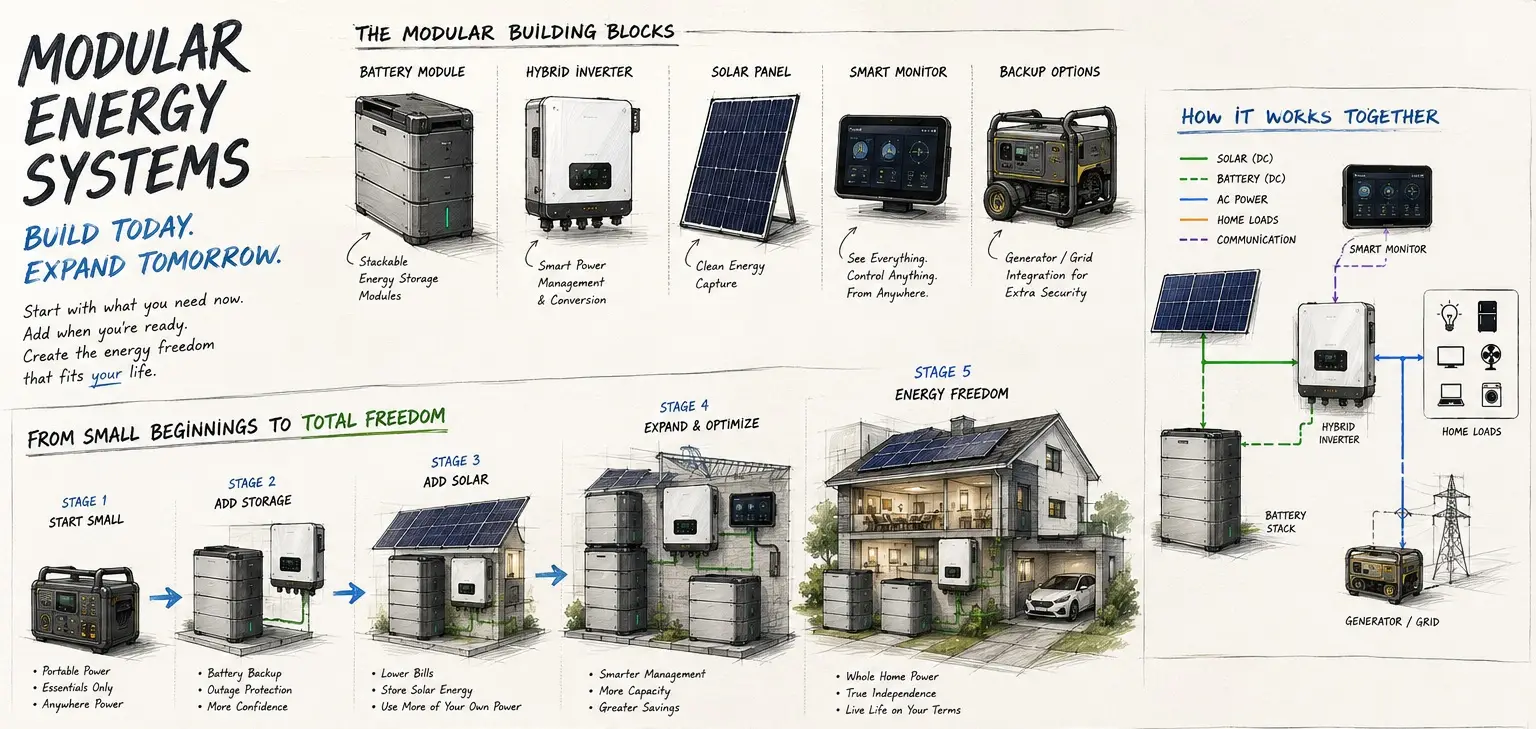
Modular Systems
A modular system allows you to build your energy storage solution over time.
Rather than purchasing everything at once, you can start with the essentials and expand as your needs or budget change.
Typical expansion options include:
- Additional batteries
- More solar panels
- Larger inverter capacity
- EV charging
- Backup circuits
- Smart home integration
For many homeowners, this staged approach makes large projects far more affordable.
Instead of replacing an entire system, you simply add new building blocks when required.
Integrated Systems
Integrated systems arrive as a complete solution.
The manufacturer has already selected and tested the components to work together, reducing installation complexity and simplifying support.
Advantages often include:
- Simpler installation
- Single warranty
- One mobile app
- Optimized communication between components
- Better automation
The trade-off is reduced flexibility.
Future upgrades are often limited to products from the same manufacturer.
Which Approach Is Better?
Neither approach is universally better.
A modular system offers flexibility and gradual expansion.
An integrated system offers simplicity and convenience.
The best choice depends on whether your priority is future flexibility or immediate ease of use.
Open Ecosystems vs Closed Ecosystems
One of the biggest changes in today’s energy storage market is the move from individual products to complete ecosystems.
Manufacturers are no longer just selling batteries.
They’re selling an entire energy platform.
Closed Ecosystems
A closed ecosystem is designed so that most components come from the same manufacturer.
For example, the battery, inverter, monitoring app, gateway and EV charger are all intended to work together as one integrated system.
Advantages include:
- Easier installation
- One support contact
- Consistent software updates
- Better automation
- Simplified monitoring
The downside is reduced flexibility.
Adding third-party equipment may be difficult, unsupported or may limit certain features.
Open Ecosystems
Open systems allow components from different manufacturers to work together.
A homeowner might combine:
- One company’s inverter
- Another company’s batteries
- A different monitoring platform
- Independent automation software
This flexibility can reduce long-term dependence on a single manufacturer and may make future upgrades easier.
However, it often requires greater technical knowledge and more careful planning.
Compatibility should never be assumed.
Ecosystem Lock-In
Every ecosystem involves some degree of commitment.
The more integrated a system becomes, the more likely future upgrades, monitoring software and automation features will depend on that manufacturer’s platform.
This doesn’t necessarily make closed ecosystems a poor choice.
In many cases they deliver the best user experience.
The important point is understanding that you’re investing in an ecosystem, not just a battery.
Now let’s see how manufacturers package these jobs into different products.
When Watts become WHAT
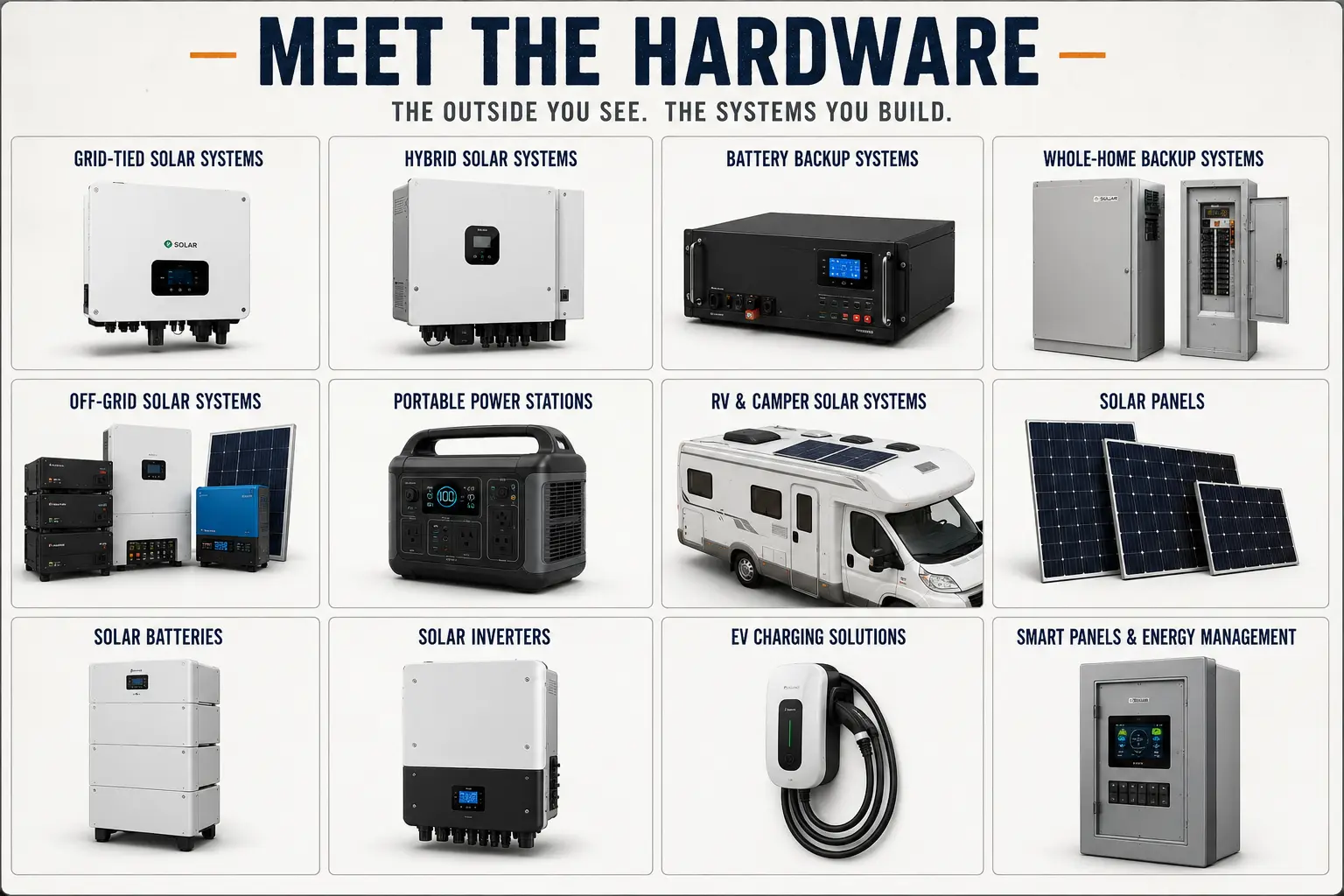
One of the biggest sources of confusion in today’s energy storage market is that manufacturers often sell very similar products under completely different names.
Some names describe the hardware inside the product, while others describe the job it performs or the market it targets.
Before comparing brands, it helps to understand the main product categories and what makes them different, or not.
What type of solution solves that problem?
Examples include:
- Deep Cycle Battery
- Portable Power Station
- Solar Generator
- Battery Bank
- Home Battery
- ESS
- BESS
- Whole-home Backup
- Commercial Energy Storage
Deep Cycle Batteries
A deep cycle battery is simply an energy storage device.
Unlike a car battery, which delivers a large burst of power for a few seconds, a deep cycle battery is designed to discharge and recharge repeatedly over many years.
By itself, a deep cycle battery cannot power most household appliances.
It normally requires additional equipment such as an inverter and charge controller before it becomes part of a usable energy storage system.
Typical uses:
- DIY solar systems
- RVs
- Marine applications
- Battery banks
- Off-grid installations
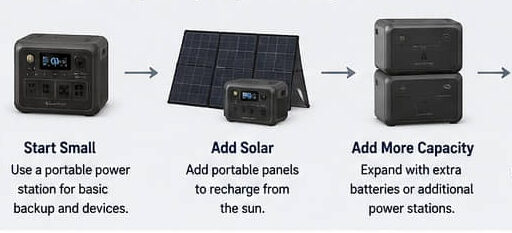
Portable Power Stations
A portable power station combines several components into one enclosure.
Typical internal components include:
- Battery
- Battery Management System (BMS)
- Inverter
- MPPT charge controller
- AC charger
- Monitoring software
Instead of buying each component separately, everything is supplied as a single portable unit.
These systems are designed for convenience rather than permanent installation.
Typical uses:
Solar Generators
Despite the name, a solar generator does not resemble a fuel generator.
It is simply a larger, more industrial portable power station paired with portable solar panels – not the type to take camping, but similar concept.
The solar panels recharge the battery, while the power station stores and supplies electricity when required.
The term “solar generator” is largely a marketing description rather than a separate category of product.
Battery Banks
A battery bank is created when multiple batteries are connected together to increase storage capacity.
Battery banks are commonly found in:
The batteries themselves may be lead-acid, AGM or lithium, LiFePO₄ depending on the application.
Home Battery Systems
A home battery system expands beyond the battery itself.
In addition to energy storage, it normally includes equipment that allows the battery to interact safely with the home, solar panels and the electrical grid.
Depending on the design, this may include:
- Hybrid inverter
- Gateway
- Transfer switch
- Monitoring
- Electrical protection
Unlike portable power stations, these systems are intended for permanent installation.
Energy Storage Systems (ESS)
An Energy Storage System (ESS) is a broader term.
Rather than referring to a specific product, ESS describes a complete system designed to store and manage electrical energy.
An ESS may include batteries, inverters, software, monitoring, gateways and other supporting equipment.
Many manufacturers use ESS to describe complete residential or commercial storage solutions.
Battery Energy Storage Systems (BESS)
Battery Energy Storage System (BESS) is simply a more specific version of ESS.
It emphasizes that the stored energy comes from batteries rather than another storage technology.
In everyday residential use, ESS and BESS are often used interchangeably.
Home Energy Ecosystems
This is where the industry is heading.
Rather than selling individual products, manufacturers increasingly offer complete energy ecosystems where batteries, solar panels, inverters, EV chargers, monitoring software and home energy management all work together.
These ecosystems are designed to simplify installation, improve automation and make future expansion easier.
The trade-off is that they can also increase dependence on a single manufacturer’s hardware and software.
Understand how each system links to your home and utility, before settling on product choice.
Explore what these systems look like, how they work and what the modules are for each.
Here’s a visual aid:
Steps: Follow the link below – Choose a system (hybrid, grid-tied or off-grid) – Choose a size – Hover over the product image and see how it transforms into a home energy system.
➡️ Take a Look, Compare Systems
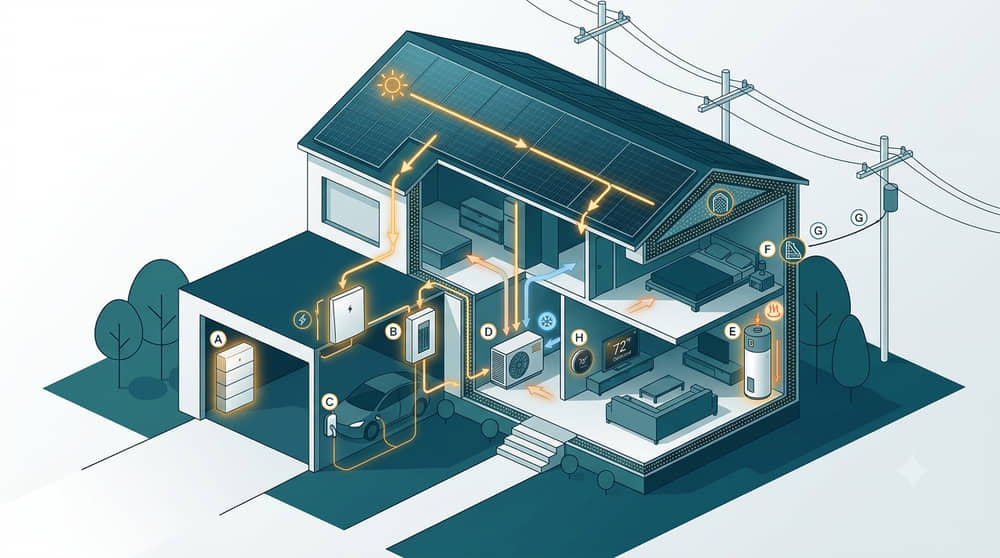
Whole-Home Backup Systems
Whole-home backup systems are designed to power an entire house during an outage.
Unlike portable backup systems, they integrate directly with the home’s electrical system and automatically manage the transition between grid power, solar generation and battery storage.
These systems usually require professional installation and often form part of a larger energy management solution.
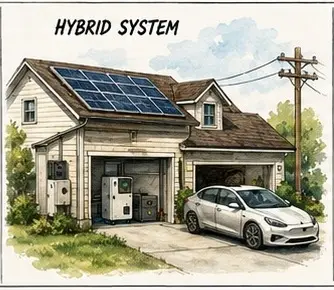
Hybrid Systems
A hybrid solar system combines the best features of grid-tied and battery-backed solar.
Unlike a standard grid-tied system, a hybrid system is designed to work with battery storage, allowing you to store excess solar energy for later use while still remaining connected to the utility grid.
Typical reasons for choosing a hybrid system include:
- Backup power during outages.
- Greater energy independence.
- Lower reliance on peak electricity tariffs.
- The ability to expand into a larger energy ecosystem over time.
Hybrid systems usually require a hybrid inverter, which is designed to manage power flowing between the solar panels, battery, household and utility grid.
If battery storage is part of your long-term plan, choosing a hybrid-ready system from the beginning can be easier and less expensive than upgrading a standard grid-tied system later.
➡️ For a deeper look at hybrid inverters and system design, see this Hybrid Solar Systems guide.
Steps: Follow the link – Choose hybrid system – Choose a size – Hover over the product image and see how it transforms into a home energy system.
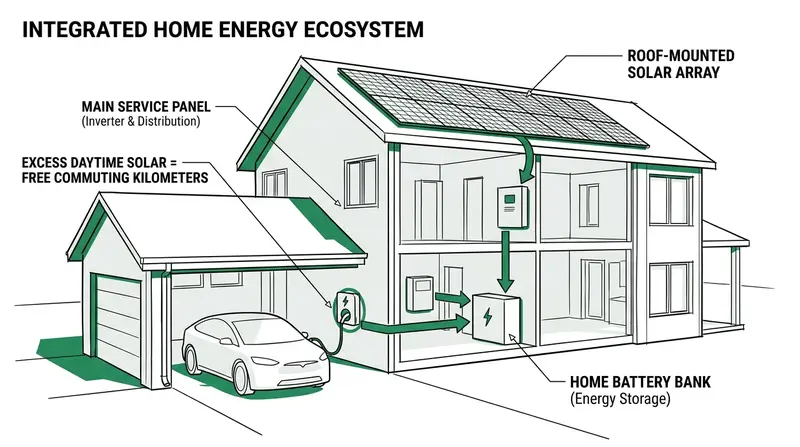 Vehicle-to-Home (V2H) Integration
Electric vehicles are beginning to evolve beyond transportation into mobile energy storage.
That’s not hype anymore.
That’s the direction the major ecosystem companies are actively building toward.
And because this guide is about choosing a path, not just choosing a battery, a short V2H section is called for.
Some EVs can also become part of your home’s energy system through Vehicle-to-Home (V2H) technology, allowing the vehicle battery to help power your home during outages or reduce electricity costs.
Biggest catch? V2H is NOT → Buy EV → Plug into house.
It needs:
✔ compatible EV
✔ bidirectional charger
✔ compatible inverter / gateway
✔ transfer equipment
✔ utility approval in some regions
✔ ecosystem compatibility
If an EV is part of your long-term plans, check whether your chosen battery system or energy ecosystem supports:
- EV charging
- Bidirectional charging
- Vehicle-to-Home (V2H)
- Future software compatibility
Not every battery system is ready for this yet—but more manufacturers are moving in that direction.
You will come across these three terms, that often get mixed together:
Vehicle-to-Load (V2L) Your car powers appliances. Usually extension leads. Camping, Emergency use.
Vehicle-to-Home (V2H) Your car powers your house. Requires proper equipment.
Vehicle-to-Grid (V2G) Your car powers the utility grid. Completely different conversation.
This isn’t a side feature anymore
The Home Energy Ecosystem is increasingly built around the idea that your EV becomes another battery in the system, alongside the stationary battery.
Explore examples of complete home energy ecosystems, EV integration and V2H-ready solutions:
- EcoFlow Home Energy Ecosystem
- EcoFlow Ocean EV Charger- They openly compare V2H with a dedicated BESS and even discuss combining both.
- Bluetti Home Battery Backup
The Jobs Every Energy Storage System Must Perform
Every energy storage system, whether it’s a portable power station or a whole-home backup installation, performs the same basic jobs.
The difference lies in how manufacturers package those jobs together.
Some systems combine everything into a single unit.
Others spread those functions across several components that work together.
Understanding these jobs makes it much easier to compare products without getting lost in the marketing.
System Components
Every component performs a specific job.
| Job | Component |
|---|---|
| Store energy | Battery |
| Protect battery | BMS |
| Harvest solar | MPPT / Charge Controller |
| Convert electricity | Inverter |
| Route electricity | Gateway / Smart Panel |
| Manage energy | EMS / HEMS |
| Monitor the system | Mobile App |
Readers should understand functions first, then product names.
1. Store Energy
Primary Component: Battery
This is the easiest part to understand.
The battery stores electricity for use later.
Whether the energy comes from solar panels, the electrical grid, a generator, or another charging source, the battery simply acts as the storage tank.
It doesn’t decide when electricity should be used or where it should go.
Its job is simply to store energy safely until another component requests it.
2. Protect the Battery
Primary Component: Battery Management System (BMS)
Modern lithium batteries contain a Battery Management System (BMS).
Think of it as the battery’s safety officer.
The BMS constantly monitors cell voltage, temperature, charging and discharge rates, ensuring the battery operates safely and remains within its design limits.
Without a BMS, lithium batteries would suffer reduced lifespan and could become unsafe.
In most modern batteries the BMS is built into the battery and requires no user intervention.
3. Harvest Solar Energy
Primary Components: MPPT / Charge Controller
Solar panels don’t connect directly to a battery.
The electricity they produce must first be regulated.
A charge controller manages the flow of electricity from the solar panels into the battery, preventing overcharging and protecting the battery from damage.
Most modern systems use an MPPT (Maximum Power Point Tracking) charge controller, which continually adjusts to harvest as much power as possible from the solar panels under changing sunlight conditions.
Many portable power stations and hybrid inverters already have an MPPT charge controller built in.
4. Convert Electricity
Primary Component: Inverter
Solar panels and batteries store electricity as Direct Current (DC).
Most household appliances use Alternating Current (AC).
An inverter converts DC electricity into the AC power used by lights, televisions, refrigerators and other household appliances.
Hybrid inverters go a step further by managing electricity from multiple sources, including solar panels, batteries and the electrical grid.
5. Direct Power Where It Needs to Go
Primary Components: Gateway, Transfer Switch, Smart Panel
During normal operation, electricity flows between the grid, solar panels, batteries and household circuits.
When the grid fails, the system must safely disconnect from the utility network while continuing to power the home.
Depending on the system, this job may be performed by a gateway, transfer switch or smart electrical panel.
Although manufacturers use different names, they all perform variations of the same core function: directing electricity safely where it is needed.
6. Manage Energy
Primary Component: EMS / HEMS
As systems become more advanced, software begins making energy decisions.
An Energy Management System (EMS),
or Home Energy Management System (HEMS),
can coordinate solar production, battery charging, electricity tariffs, weather forecasts, EV charging and household energy consumption.
Some systems simply provide information, while others can automate many of these decisions without user intervention.
7. Keep You Informed
Primary Component: Monitoring App
Nearly every modern energy storage system includes a mobile app.
These apps allow homeowners to monitor battery charge, solar production, electricity usage and system health.
Some apps simply display information, while others also provide remote control and automation features.
Understanding the difference between monitoring, control and automation is one of the most important concepts in today’s energy storage market.
How this all stacks up financially
Cost Ladder (Working Figures)
Battery only ≈ $100–2,000
↓
Portable Power Station ≈ $300–5,000
↓
Expandable Portable System ≈ $3,000–10,000
↓
Installed Home Battery ≈ $10,000–18,000
↓
Whole-home Battery Backup ≈ $15,000–35,000+
↓
Complete Home Energy Ecosystem ≈ $25,000–60,000+
The cost increase is driven less by the battery itself than by the surrounding infrastructure: inverters, gateways, electrical upgrades, installation, software and integration.
Now that you have a better idea of how energy storage systems work, it’s time to look inside the battery itself.
While chemistry isn’t the first buying decision, it still influences lifespan, safety, charging speed and long-term value.

Choosing the Right Battery Chemistry
The chemistry inside a battery influences its lifespan, weight, charging speed, operating temperature and cost.
While battery chemistry is an important specification, it should only be considered after you’ve decided what type of energy storage system you actually need.
The good news is that for most homeowners, the choice has become much simpler than it was a decade ago.
Flooded Lead-Acid
The veteran.
Cheap.
Reliable.
Heavy.
Requires maintenance.
Still common in older off-grid installations and budget battery banks.
Best suited for:
- Budget systems
- Off-grid cabins
- Agricultural applications
- DIY installations
AGM (Absorbent Glass Mat)
An improved lead-acid battery that requires little or no maintenance.
AGM batteries are sealed, safer than flooded batteries and perform well in backup applications, although they remain heavier and have a shorter lifespan than modern lithium batteries.
Best suited for:
- Backup power
- RVs
- Marine
- Budget upgrades
Gel Batteries
Gel batteries are another sealed lead-acid technology designed for deep cycling.
They tolerate deep discharge well but generally charge more slowly than AGM batteries and are gradually being replaced by lithium technologies.
Still found in:
- Marine systems
- Mobility equipment
- Certain off-grid applications
Lithium-Ion (NMC)
Lithium-ion batteries cover several different chemistries. One of the most common is Nickel Manganese Cobalt (NMC).
These batteries offer high energy density, making them popular where weight and size matter.
Typical applications include:
- Electric vehicles
- Portable electronics
- Some portable power stations
Lithium Iron Phosphate (LiFePO₄)
LiFePO₄ has become the dominant chemistry for residential energy storage.
Compared with older battery technologies it generally offers:
- Longer service life
- More charge cycles
- Faster charging
- Lower maintenance
- Improved thermal stability
- Better suitability for daily cycling
As a result, most modern residential battery systems, portable power stations and modular storage solutions now use LiFePO₄ batteries.
Which is the Better Battery?
There is not one ‘better battery”.
Every battery chemistry involves trade-offs between cost, lifespan, weight, performance and intended use.
For most new residential installations, LiFePO₄ has become the preferred choice because it balances safety, longevity and performance.
However, AGM and other lead-acid technologies still remain practical solutions for certain applications where budget, simplicity or compatibility are the primary concern.
Battery Specifications That Matter Most
These are the specifications most homeowners should compare first because they directly affect day-to-day performance and long-term value.
Capacity (kWh)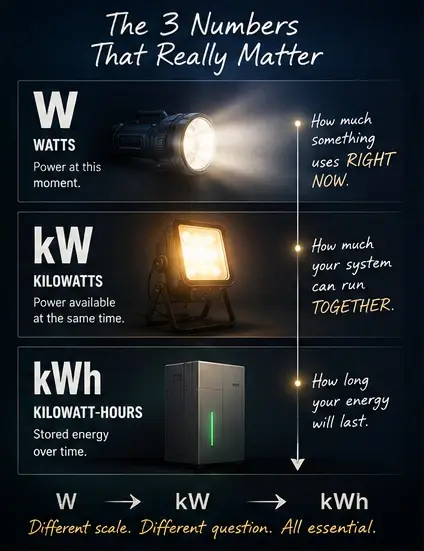
Capacity tells you how much electricity the battery can store.
The larger the capacity, the longer the battery can power your appliances before it needs to recharge.
Capacity is usually measured in kilowatt-hours (kWh), making it one of the easiest ways to compare systems.
Power Output (kW)
Capacity tells you how long a battery can supply electricity.
Power output tells you how much electricity it can deliver at one time.
A battery may store enough energy to run your home for several hours, but if its maximum power output is too low it may struggle to start large appliances such as air conditioners or well pumps.
Depth of Discharge (DoD)
Depth of Discharge describes how much of the battery’s stored energy can be used before it should be recharged.
For example, a 10 kWh battery with a 90% DoD allows approximately 9 kWh of usable energy.
Higher DoD generally means more usable storage.
Cycle Life
A cycle represents one complete charge and discharge.
Cycle life estimates how many times the battery can repeat this process before its capacity begins to decline significantly.
Although not a guarantee of lifespan, cycle life provides a useful comparison between different battery technologies.
Round-Trip Efficiency
Not every unit of electricity placed into a battery can be recovered.
Round-trip efficiency measures how much energy is returned after charging and discharging.
Higher efficiency means less energy is lost during storage.
Warranty
A battery warranty often reveals more than the advertised specifications.
Pay attention to:
- Years of coverage
- Guaranteed remaining capacity
- Maximum energy throughput
- Cycle limitations
Scalability
Some batteries are designed to grow with your needs.
Others remain fixed for their entire lifespan.
If future expansion is part of your long-term plan, always check how additional batteries can be added and whether there are practical limits.
Advanced Battery Specifications
Most homeowners don’t need these figures to choose a system, but understanding them can make specification sheets much easier to interpret.
Voltage (V)
Voltage describes the electrical pressure within a battery system.
Residential batteries may operate at different voltages depending on their design and intended application.
Higher-voltage systems generally improve efficiency in larger installations, but voltage alone should never be used to judge battery quality.
Amp-hours (Ah)
Amp-hours measure electrical charge rather than stored energy.
Because batteries operate at different voltages, comparing amp-hours alone can be misleading.
For residential systems, kilowatt-hours (kWh) usually provide a more meaningful comparison.
Continuous Power
Some batteries can continuously deliver their maximum rated output.
Others can only sustain high loads for short periods before reducing power to protect themselves.
This specification becomes important when running multiple large appliances simultaneously.
Peak or Surge Power
Many household appliances require extra power for a few seconds when starting.
Surge power indicates how much temporary output the battery or inverter can provide during these brief startup periods.
Charge Rate
Charge rate determines how quickly a battery can safely recharge.
Higher charging rates can be particularly useful when making the most of short winter days or limited generator runtime.
Operating Temperature
Every battery performs best within a specified temperature range.
Extreme heat or cold may reduce performance, charging speed or battery lifespan.
Some batteries include built-in heating systems for cold climates.
Communication Protocols
Modern batteries exchange information with inverters, gateways and energy management systems.
These communication protocols allow different components to coordinate charging, monitoring and protection.
Compatibility between communication protocols becomes increasingly important in modular systems and integrated ecosystems.
Ingress Protection (IP Rating)
The IP rating indicates how well a battery enclosure resists dust and water.
This specification is particularly important for equipment installed outdoors or in harsh environments.
Cell Format (Optional Advanced Reading)
Battery cells come in several physical designs, including cylindrical, prismatic and pouch cells.
While manufacturers often promote one format over another, the overall quality of the battery management system, thermal design and manufacturing standards generally have a greater impact on real-world performance than cell shape alone.
Remember What Matters Most
Specification sheets can contain dozens of numbers.
Don’t let them distract you from the bigger picture.
The best battery isn’t the one with the highest capacity, the fastest charging speed or the longest specification sheet.
It’s the one that fits your needs, works with your existing or planned system, and still leaves room to grow as your energy requirements change.

FAQ Checklists for Practical Decisions.
By now you understand the technology.
Now it’s time to apply it.
These quick checklists answer the practical questions many homeowners actually ask before buying battery storage.
Before comparing products, ask yourself these questions.
Should You Buy A Battery At All?
For some homeowners it’s one of the best investments they’ll make.
For others, it adds cost without solving a real problem.
If none of these apply, your budget may be better spent elsewhere—for now.
A battery is likely worth considering if you answer yes to one or more of these:
Discuss:
- When batteries make sense.
✔ You experience frequent power outages.
✔ You want to store excess solar energy.
✔ Your electricity tariff rewards energy shifting.
✔ You’re working toward greater energy independence.
✔ You expect your energy needs to grow over time. - When solar panels alone make more sense.
- When net metering changes the equation.
- When frequent outages justify backup.
- When TOU tariffs improve payback.
- When it’s smarter to wait.
Are you buying peace of mind?
Sometimes the value of a battery isn’t measured in dollars.
Only you can decide what that peace of mind is worth.
For many homeowners, knowing the security system, the fridge and a few lights stay on during an outage is reason enough.
For others the purpose is to protect against rising electricity costs and future price hikes and having more control over energy expenses.
Each choice has it’s own strategy. What’s yours?
What are my plans for a system with a 15+ year lifespan?
- More battery capacity
- Additional solar panels
- An EV charger
- Smart energy management
- Whole-home backup
If expansion is part of your long-term plan, compatibility becomes just as important as battery size.
How Much Battery Storage Do You Actually Need?
A battery needs a strict job description.
What do you expect it to do?
So, the first question is not “how many kWh?”, but what do I need it for?
- Essential loads
- Whole-home backup
- Overnight storage
- Multi-day resilience
BECAUSE Lifestyle affects sizing far more than your electricity bill.
This is where your Energy Profile becomes far more useful than simply comparing battery capacities.
Can You Add More Batteries Later?
Again, understand a system’s compatibility before you buy.
Questions include:
- Expansion limits – batteries, inverters, panels
- Matching old and new batteries
- Same chemistry?
- Same brand?
- Same firmware?
- Mixing capacities?
This is where we reinforce the importance of expansion paths again.
Not because we like harping on about it, but because once the time comes for crunching numbers, it usually gets pushed onto the back burner…
…and that’s where it starts a fire of regrets later.
AC Coupling vs DC Coupling
Boring? Maybe, but people search for this constantly.
We won’t explain it like engineers do either:
DC coupling keeps solar energy in DC for longer before converting it to AC.
AC coupling converts energy sooner, making it easier to add batteries to existing solar systems.
Advantages of DC Coupling
✔ Higher efficiency.
✔ Excellent for new solar installations.
✔ Fewer conversion losses.
✔ Often integrated into hybrid inverter systems.
Advantages of AC Coupling
✔ Easier to add batteries to existing solar systems.
✔ Greater flexibility when upgrading.
✔ Ideal for retrofitting many grid-tied installations.
Disadvantages DC Coupling
• Less flexible for existing systems.
• Usually requires planning from the start.
AC Coupling
• Additional energy conversion can reduce efficiency slightly.
• May require additional hardware.
Typical use cases DC Coupling
• New solar installations.
• New home builds.
• Integrated energy ecosystems.
AC Coupling
• Existing solar systems.
• Battery retrofits.
• Gradual system expansion.
What Happens During A Power Outage?
This is actually a really important practical section.
People assume: Solar = power.
Nope.
Things to understand before buying:
- Grid-tied solar systems normally shut down during a power outage. This protects utility workers repairing damaged power lines.
- What is islanding? Islanding is when your home safely disconnects from the grid and continues operating using its own power source.
- What does a Gateway or Transfer Switch do? It automatically disconnects your home from the grid and manages the safe flow of electricity between your battery, solar panels and household circuits.
- What are backup circuits? Many battery systems are designed to power selected appliances rather than the entire house. Decide in advance what you want to keep running.
- What is whole-home backup? Whole-home systems are designed to power most or all of your home’s electrical circuits during an outage. They usually require larger batteries, more equipment and a higher budget.
Not every battery system provides the same level of backup. Understand what stays on… and what doesn’t.
Indoor Or Outdoor Installation?
Not every battery can be installed just anywhere.
Before choosing a system, check the manufacturer’s installation requirements.
Things to consider:
- Weather exposure Is the battery designed for outdoor installation?
- Operating temperature Extreme heat and freezing temperatures can affect battery performance and lifespan.
- Ventilation Follow the manufacturer’s recommendations to prevent overheating and allow adequate airflow.
- Flood risk Avoid installing batteries where water could collect during heavy rain or storms.
- Location Garage, utility room, basement or outside wall? Each has advantages and limitations.
- Access Leave enough space for maintenance, servicing and possible future expansion.
- Local regulations Building codes, fire regulations and utility requirements may influence where a battery can be installed.
The best location isn’t always the most convenient one—it’s the one that balances safety, performance and future accessibility.
Energy Storage System Maintenance
Here we’re talking about the system, not just the battery.
Most of these apply whether it’s AGM, lead-acid, LiFePO₄ or lithium—the amount of attention just differs.
Firmware
What is it? The operating software inside devices like the battery, inverter, gateway and smart panel. Why update it?
- Fixes bugs.
- Improves compatibility.
- Adds new features.
- Occasionally improves charging or battery management.How do I know? Usually the manufacturer’s app notifies you.
How do I do it? Often through the app with a single tap, although some systems require the installer to perform the update.
App Updates
Usually these update only the app on your phone.
Sometimes they also enable new system features or support newer firmware versions.
Updating the app doesn’t normally change your battery settings, although major firmware updates may introduce new options or require confirmation.
Physical Inspection
DIY: Every 6–12 months is usually enough. Look for:
- Loose cables
- Damage
- Corrosion
- Water ingress
- Animal nests
- Warning lights
Professional: During scheduled servicing, or if the manufacturer recommends inspections.
Ventilation
Pretty much common sense.
Don’t block airflow.
Don’t store boxes against the battery.
Don’t build cupboards around equipment unless the manufacturer specifically allows it.
Keeping Vents Clear
Yep. This is 100% a DIY task…
Check them whenever you’re in the area.
Brush away dust, leaves, cobwebs or pet hair if applicable.
No need to make it a monthly ritual—just don’t let them become blocked.
Warranty Requirements
Follow the manufacturer’s maintenance requirements to protect your warranty.
Some warranties may require approved installers, software updates or minimum maintenance procedures.
Visit the NavigatingSolar Warranty & Permits Vault to see the full checklist.
⚠️ Emergency Shutdown
I think it’s a worthwhile addition.
It’s one of those things nobody wants to learn during the emergency.
Not a maintenance item, but a homeowner should know:
□ Do I know how to safely shut the system down in an emergency?
- Where is the emergency shutdown?
- How do I isolate the battery?
- Who do I call if there’s a fault?
Right… you’re about to enter the marketplace.
Here’s your map.

Your Battery Marketplace Decision Tree
Before opening hundreds of products, narrow down what you’re actually looking for.
Step 1 — What problem are you solving?
☐ Backup power
☐ Lower electricity bills
☐ Energy independence
☐ Off-grid living
☐ RV or Van Life
☐ Emergency preparedness
☐ Medical equipment
Step 2 — What type of solution do you need?
☐ Battery only
☐ Portable Power Station
☐ Expandable Portable System
☐ Home Battery System
☐ Whole-home Backup
☐ Complete Energy Ecosystem
Step 3 — Is this a new installation?
☐ Yes
☐ No — I’m upgrading an existing system.
Step 4 — Which installation best describes you?
☐ Grid-tied
☐ Hybrid
☐ Off-grid
Step 5 — Will you expand later?
☐ More batteries
☐ More solar panels
☐ EV charger
☐ Smart home integration
☐ Unsure
Step 6 — What’s most important?
☐ Lowest price
☐ Best long-term value
☐ Backup performance
☐ Expandability
☐ Automation
☐ Brand ecosystem
Step 7 — Now start filtering products.
Use marketplace filters such as:
- Brand
- Battery capacity
- Power output
- System type
- Indoor / Outdoor
- Mounting options
- Budget
See what’s happened?
Now the specifications actually mean something because you’ve already narrowed your search.
Instead of arriving at the solar marketplace and going:
😳 “Holy sh#t… 487 products…”
Your reaction will be: “I need a hybrid, expandable home battery around 10–15 kWh. Let’s see what they have.”
That’s a completely different shopping experience.
→ Ready to Give the Marketplace a Go?
Continue Building Your Solar Knowledge
Choosing the right battery is only one step in building a smarter energy system.
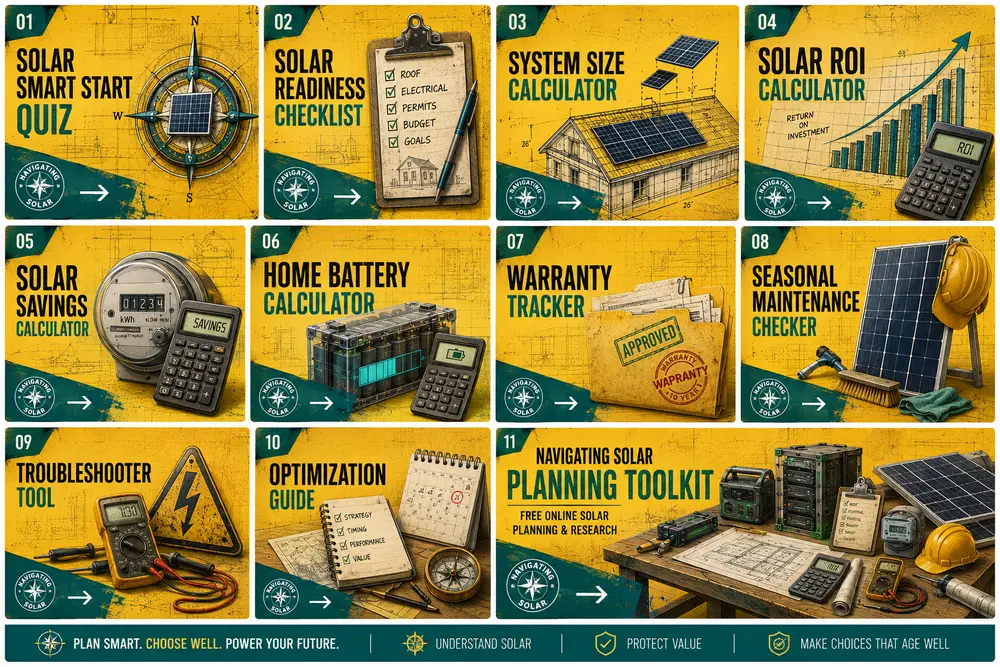
The NavigatingSolar Toolkit brings together
our collection of solar calculators, checklists, decision maps and practical guides to help you plan with confidence—not guesswork.
⚡ Ready to Turn Battery Planning Into Action?
Follow these simple steps:
✓ Visit the NavigatingSolar Maximization Phase webpage
✓ Work through the guided battery sizing calculator
✓ Compare storage options based on your usage patterns
✓ Speak with a verified solar installer for personalized recommendations
Quote Request Tool
Connect with Local US Installers trusted by homeowners nationwide — step-by-step, practical, and pressure-free.
For Solar Installation and Battery Quotes
Affiliate Disclaimer:
This link may connect you with solar providers through our partner network.
We may earn a commission if you choose to engage — at no extra cost to you.
 Recommended Reading:
Solar Battery Storage: Value vs Expense
Solar Inverters : The Brain of Your System
How to Monitor Solar Production: 3 Best Ways
References
[1] Clean Energy Reviews. “The 2025 Guide to Solar Home Batteries.” Clean Energy Reviews.
[2] Sinovoltaics. “Understanding BESS Specifications: Key Factors to Consider.” Sinovoltaics.
[3] Anern Store. “A Comprehensive Guide to Round Trip Efficiency in Batteries.” Anern Store Blog.
[4] Anern Store. “LFP vs. NMC Safety: A Deep Dive Into Battery Chemistries.” Anern Store Blog.
[5] EV Lithium. “LFP vs. NMC Batteries: Which is the Best Choice?” EV Lithium Blog.