 Navigating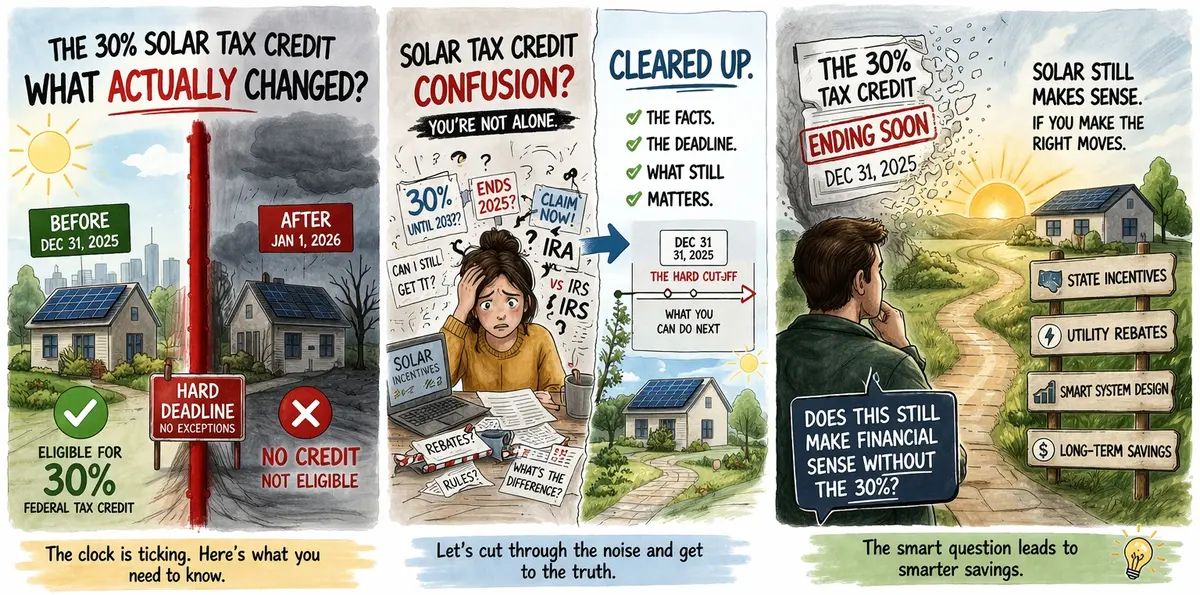
The US Solar Tax Credit Confusion — Cleared up
Who can claim what, and how much?
If you’ve been researching solar incentives and US Solar Tax Credits lately, you’ve probably run into a wall of conflicting information.
Some sources say the 30% federal tax credit runs until 2032.
 Others say it’s ending in 2025. Some say you can still claim credits.
Others say you can’t.
So what’s actually going on?
The truth is, both statements are coming from legitimate sources — but they’re referencing different laws, timelines, and guidance documents. This confusion has left homeowners frustrated, unsure if they can still claim the credit, and wary of installer claims. .
Let’s clear this up properly — based on current filing guidance and legislation — so you know exactly where you stand, what it means for you in 2026, and how you can still maximize your solar savings without the Federal ITC.
And what the Smart Question is to ask yourself in 2026.
The Simple Truth: The 30% Solar Tax Credit Has a Hard Deadline
Under current guidance tied to the One Big Beautiful Bill Act:
-
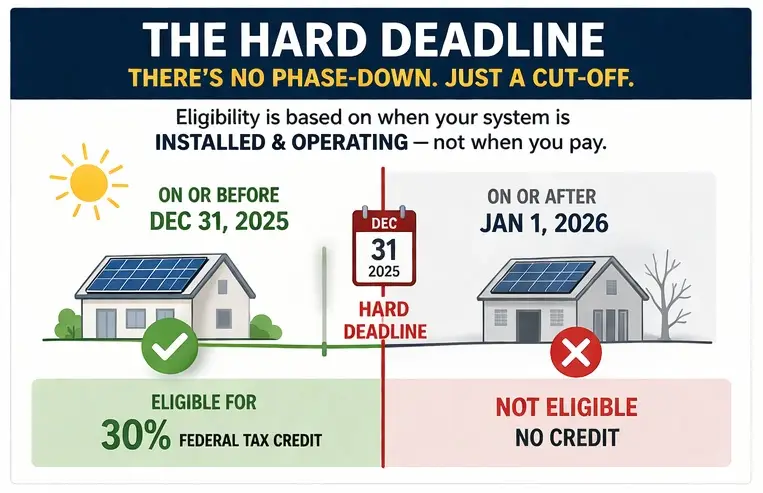
Will not apply to systems installed after December 31, 2025
That means:
-
✅ Install completed by Dec 31, 2025 → Eligible for 30%
-
❌ Install completed after Jan 1, 2026 → Not eligible
There is no phase-down anymore. There is no gradual reduction.
➜ It’s a hard cutoff.
You may still hear homeowners claiming the 30% credit in 2026 — but those are systems installed before the 2025 deadline and only now being reported to the IRS.
Why You’re Seeing Conflicting Information Everywhere
This isn’t your fault — the confusion is real, and it comes from a few specific places.
Two Different Laws Are Being Referenced
The Inflation Reduction Act originally extended the 30% Residential Clean Energy Credit through 2032.
But newer policy changes under the One Big Beautiful Bill Act shorten that timeline significantly.
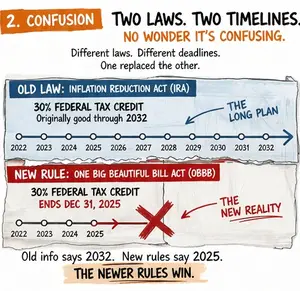
➜ Many websites still reference the older 2032 timeline
➜ Updated IRS guidance reflects the newer cutoff
That’s why you’re seeing two completely different answers online — not to even speak of all the noise on social media and pushy sales tactics.
And these abbreviations?! IRS and IRA — with one letter difference, a small reading mistake turns into a huge gap in understanding…
The IRS Controls What You Can Actually Claim
At the end of the day, the only entity that matters when you file taxes is the Internal Revenue Service
Their current filing instructions regarding Residential Clean Energy Credit clearly state:
-
No credit for expenditures after Dec 31, 2025
-
Eligibility is based on when the system is installed and operational
➜ Not when you sign a contract
➜ Not when you pay a deposit
This detail alone causes a huge amount of misunderstanding.
The “Payment vs Installation” Trap
 This is one of the biggest mistakes homeowners make:
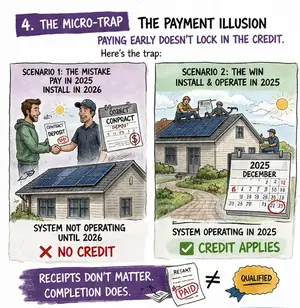
➜ You cannot lock in the credit by paying early
What matters is:
-
When installation is completed
-
When the system is placed in service
So:
-
❌ Pay in 2025, install in 2026 → No credit
-
✅ Install completed in 2025 → Eligible
Tax Timing Creates a False Signal
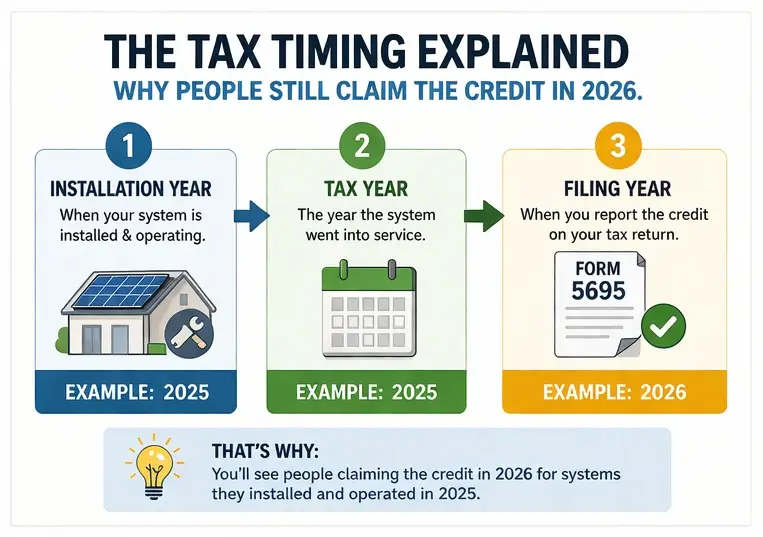
There’s a lag effect that confuses everyone: You may still hear homeowners claiming the 30% credit in 2026
— but those are systems installed before the 2025 deadline and only now being reported to the IRS.
Right now, most people confirming they “got the credit”:
-
Installed systems in 2025 or before
-
Claimed during 2026 tax filing
➡️ So:
People will still be “getting the credit” in 2026, even though the eligibility ended Dec 31, 2025
What About Other Credits? (Appliances, EVs, and More)
It’s not just solar — several other energy incentives are also ending earlier than expected.
Home Efficiency & Appliance Credits (Section 25C)
✅ Available through Dec 31,2025 ❌ Not available after that. These include:
-
Heat pumps
-
Insulation
-
Windows and doors
-
Electrical upgrades
-
HVAC systems
Electric Vehicle Credits
❌ Ending earlier — September 30, 2025: Credits for
-
New EVs
-
Used EVs
What This Means Overall
These are no longer long-term incentives you can “get to later.”
➜ They are time-sensitive opportunities with hard deadlines
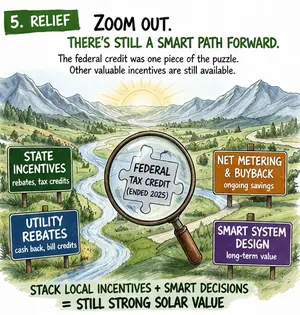
What’s important now though, is to change the your focus: from Federal Incentives to State/Local Incentives. Some states and local utilities offer equal if not better incentives to that lost 30%. In the next article we dig deeper into why that is.
Does This Mean You’ve Missed Out?
Solar Smart Start Quiz
Not necessarily — but it does change how you should think about solar.
If you’re just getting started with solar: Planning and preparation are key
➡️ Go to the Solar Smart Start Quiz and follow the steps after.
If you already have a system: Look for ways to optimize and improve performance
➡️ See the Optimization Strategies
Either way, at it’s core, solar is a game of timing:
🟡 State/Local Solar Incentives timing and timelines: get it right, and you can lower costs
🟡 Optimization Strategy Timing: you nurture short- and long-term savings
🟡 TOU Arbitrage Timing: you control your usage vs expense vs timing
Get the timing right — and solar can still deliver strong value.
Tax Credits & Incentives Reduce Cost — But They Don’t Guarantee Good ROI
A federal tax credit or State/Local Incentive can improve affordability, but long-term solar value still depends on:
- local electricity prices
- system sizing
- installation quality
- self-consumption
- utility structures
- battery strategy
Incentives lower the barrier to entry.
Optimization determines long-term returns.
🔴 The Smarter Way to Look at Solar (With or Without the Credit)
Yes — losing the 30% credit matters.
But it’s not the whole story.
Incentives Were Never the Real Profit Driver
Most homeowners lose more money from:
-
Poor system sizing
-
Bad financing terms
-
Misaligned usage assumptions
Than they ever gain from tax credits.
➜ A well-designed system can outperform a poorly designed one — even with incentives.
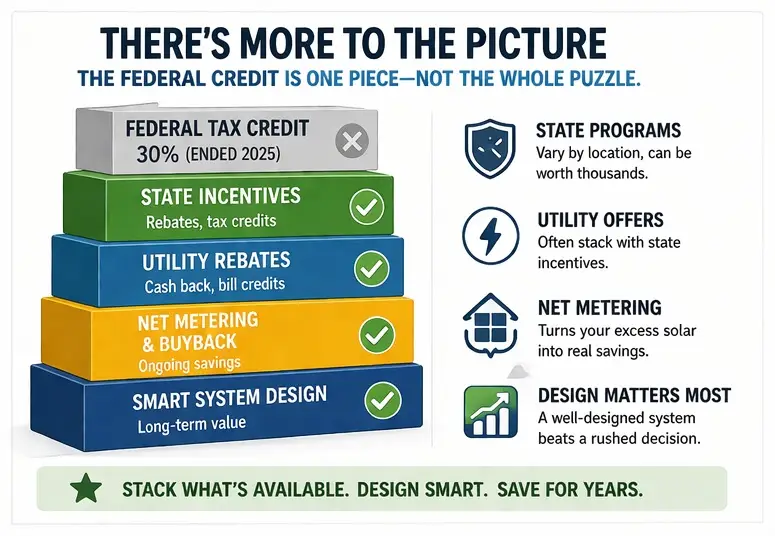
You Can Still Stack Local Incentives
Even without federal credits, many homeowners can still benefit from:
-
State-level solar incentives
-
Utility rebates
-
Net metering or energy buyback programs
➜ In some cases, these can offset a significant portion of system cost.
Timing Still Matters (If You Want the 30%)
If your system was installed before 2026 and you qualify for the Federal ITC, timing still plays an important role.
➜ Make sure your tax filings, incentive documentation, and insurance paperwork are complete and up to date.
For full details and official guidance, you’ll find a link to the relevant Inflation Reduction Act resource at the bottom of this page.
🟢 The Bottom Line
Energy Independence Still Has Value
Even without tax incentives, solar still offers:
-
Protection against rising electricity costs
-
More predictable monthly expenses
-
Backup power options when paired with batteries
➜ That value doesn’t disappear when incentives do.
Yes — the federal solar tax credit is ending sooner than many expected.
And yes — the information online is confusing because multiple policies and timelines are being mixed together.
But the key takeaway is simple:
➜ If your system wasn’t fully installed and approved by the end of 2025, you should assume the 30% federal credit won’t apply.
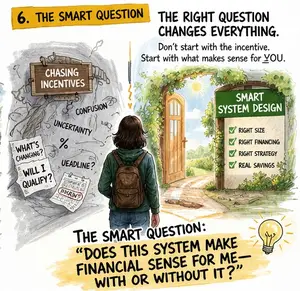
So remember the Smart Question?
A Step-by-Step Checklist to Map Solar Value
From here, the question shifts from:
“Do I get the incentive?”
To:
➜ “Does this system make financial sense for me — with or without it?”
🟢 What You Should Do Next
-
If you’re considering solar → understand your timeline clearly
-
If you’re unsure → focus on system design and real ROI
-
If you’re already planning → avoid delays that push installation into 2026
Because in the end:
➜ Solar Incentives can help
➜ But clarity — and good decisions — are what actually save you money
…and that’s why NavigatingSolar exists.
To help you find clarity.
Estimate What Incentives Could Mean for Your System
Before requesting quotes, it helps to understand how incentives interact with your actual electricity usage and long-term savings potential.
These tools can help you build a clearer financial baseline first.
Visit our website for free-to-use independent Solar calculators, Tools, Guides and Resources on:
- System Sizing,
- calculating Annual Savings,
- ROI and the Payback period, and
- Solar Installations in your area
- . Visit www.navigatingsolar.com
When you have checked your solar readiness and want to explore how this could work for your home, you can use this tool
Quote Request Tool
Connect with Local US Installers trusted by homeowners nationwide — step-by-step, practical, and pressure-free.
Affiliate Disclaimer:
This link may connect you with solar providers through our partner network.
We may earn a commission if you choose to engage — at no extra cost to you.
Why Use This Service?
Choosing the right installer can feel overwhelming — especially when options vary by location.
Instead of guessing, you can start by seeing which providers are actually available in your area.
✔️ Fast connection to available solar providers
✔️ No obligation to move forward
✔️ Simple, guided process
✔️ Options based on your location
✔️ Explore your options at your own pace
What Happens Next?
Once you submit your details, your request is securely shared with a solar provider from our partner network who can assist you based on your location and energy needs.
They may contact you to discuss system options, pricing, and next steps — so you can decide what works best for you.
You may be contacted fairly quickly after submitting, so it helps to keep your phone nearby.
This service works best for
homeowners who are looking to explore solar options for their property.
✔️ You own your home
✔️ Your average electricity bill is around $100/month or more
✔️ You’re 18 or older
✔️ You’re open to reviewing solar options if it makes sense
Some providers may consider credit as part of their evaluation, but options can vary.
🔗 Partner Disclosure
We’re an independent resource and don’t provide solar installation or quotes directly.
By continuing, you agree to be contacted by a provider from our partner network.
For further info on US Incentives, Credit systems, and Solar ROI visit our blog category Solar Finance & Incentives
References:
For full details and official guidance:
Energy credits and deductions expiring under OBBB, and their termination dates
and here for:
IRS : Instructions for Form 5695 (2025) Residential Energy Credits
In the Next Article:
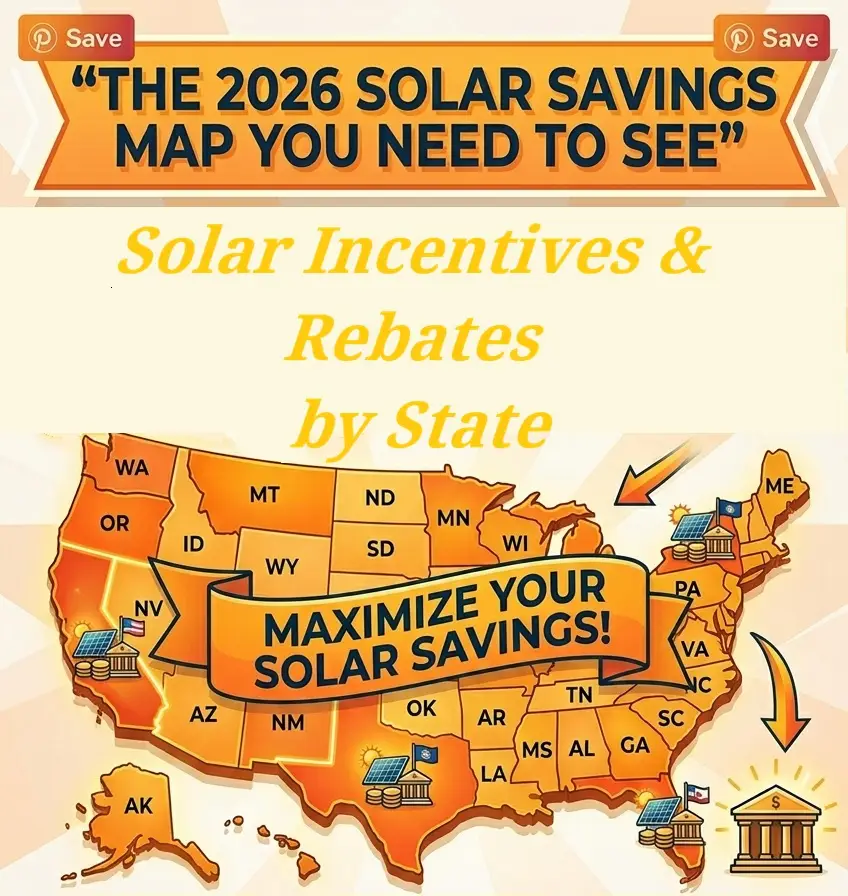
Solar Incentives by State in 2026
We Explore Solar Incentives by State,
and dig deeper into the facts of WHY SOME STATES PAY MORE
Other Related Articles
UNDERSTANDING INCENTIVES (Bonus Cheat Sheet)
Solar ROI Leverage : Strategy, Sequence and Timing