Navigating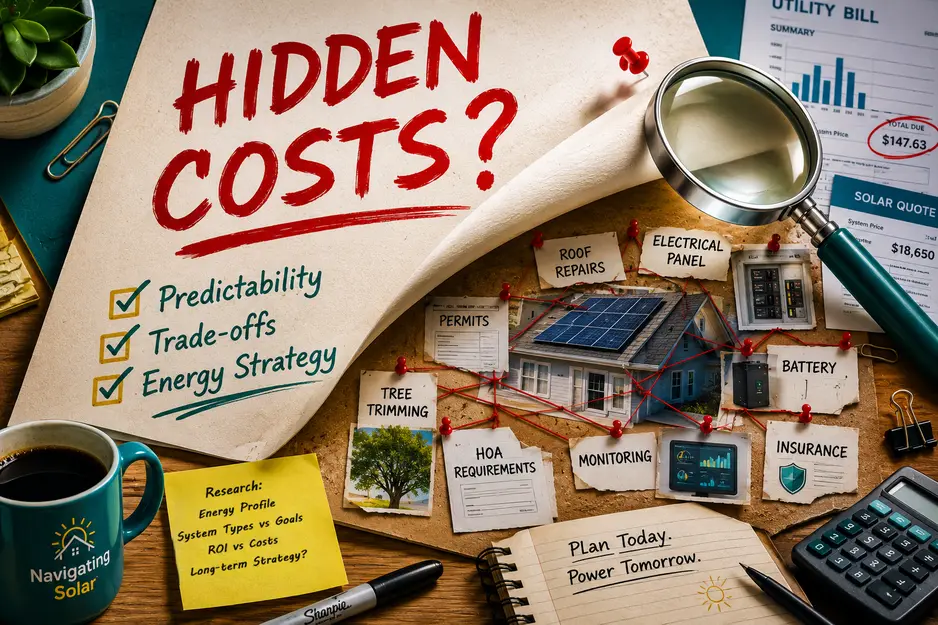
Summary
Common solar installation mistakes and hidden costs that can affect performance and savings are not explained when the hardware goes up — because it's at planning and operational level, that the gaps occur. In this article we look at what causes those gaps.
The costs compare to the questions you ask
and Uninformed Trade-offs don’t stem from Installation Quotes
What you don’t know about solar, is what we call a surprise at best.
People often talk about the “hidden costs” of solar.
The funny thing is, most of them aren’t actually hidden – just rarely discussed upfront.
Because they’re simply outside the installer’s quote.
Some of those costs belong to your home.
Some belong to your utility.
Some depend on local regulations.
Others only appear because nobody asked the right questions before the design began.
None of them are mysterious, or necessarily shoddy customer service.
They’re just rarely collected into one place before you make a decision.
Predictability has economic value
…because uncertainty is expensive.
You don’t budget for surprises.
You budget for known costs.
They hurt because they arrive after you’ve mentally committed to a project.
You’ve already imagined lower bills.
You’ve already accepted the quoted price.
You’ve already started picturing the finished system on your roof.
Then suddenly someone says:
“Your electrical panel needs replacing.”
Or:
“The roof should really be repaired first.”
Or:
“Your utility requires an upgraded meter.”
None of those costs are new. They were always there.
What changed is when you discovered them (and maybe how…)
That’s what creates the feeling of being misled.
Not the cost itself— but the loss of predictability.
This is exactly why so many people walk away believing solar is full of hidden surprises, when in reality most of those surprises were simply outside the original quotation.
Or expectation of what a solar quote entails…
You expect to have a solution to high energy costs, only to be told your home infrastructure needs money first.
Sounds utterly miserable for a start!
But look at it this way: The more of those costs you identify before signing a contract, the easier it becomes to compare proposals, budget realistically and decide whether the investment still makes sense for your goals.
Maybe you realize Traditional Rooftop Solar is not the be all and end all of solar and discover that a modular ecosystem approach would suit the infrastructure limitations better.
Predictability doesn’t eliminate costs.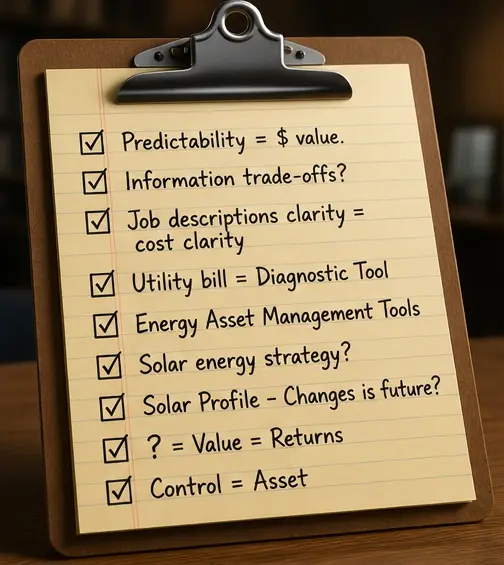
It eliminates nasty surprises.
People didn’t “make a mistake” buying a 10 kW system. Maybe they:
- didn’t know the roof needed repairs first.
- didn’t know the main panel needed upgrading.
- didn’t know trenching would cost another small fortune
- didn’t know the HOA required a different mounting system.
- didn’t know about permit fees, or that permitting in their county takes months.
- didn’t know batteries require additional equipment.
- didn’t consider an inverter replacement in 12–15 years,
Those aren’t mistakes, and those aren’t “hidden costs” either. Those are costs that were not considered during the shopping phase.
And that’s maybe the whole reason – you are focused on hardware.
These costs are more like ” home improvement services”, not so much “solar hardware” that you are looking to make sense of!
So they go unnoticed, UNQUESTIONED, until it’s an inconvenient time.
That’s where predictability creates economic value.
Once these costs are expected, they stop being financial shocks.
They’re expected investments.
Not because it makes the project cheaper.
Because it makes the financial outcome more reliable, and the solar investment more stable.
Every energy system has costs
Grid power isn’t free.
Generators aren’t free.
Batteries aren’t free.
Solar isn’t free.
Heck, is some places fire isn’t free anymore either!
The only question is:
Which costs do you choose, and which level of control are you willing to live with?
With the grid, you’re paying for convenience and letting someone else manage generation, maintenance and pricing.
With a generator, you’re paying for gas (or the price of forgetting to do so…), servicing and backup when things go wrong.
With solar, you’re buying something different.
Solar buys control.
Because that’s what the money actually purchases.
You’re buying the ability to influence your own energy future.
How much dependence on the grid you’re comfortable with – who produces your energy, when and at what cost it gets used.
That means deciding how much backup you want – you become your own ‘customer support’ helpline
Whether future price increases become your problem – or less of one.
How resilient your home should be in its actual production : costs : consumption ratio
How much flexibility you want as your household changes over time.
With that purchase of control, comes a responsibility.
Which is best managed with a long-term energy strategy.
You wanted to take power into your own hands.
Exactly. Then act like it.
Learn enough to ask better questions.
Understand enough to compare proposals properly.
Plan far enough ahead that today’s installation still makes sense ten years from now.
Manage it. Optimize it. Own it.
Because once you decide to generate your own electricity, you’re no longer just paying an electricity bill.
You’ve taken on a different role.
You’re no longer just a customer; you’re making decisions that affect your costs, resilience, and flexibility for years to come.
You’re managing an energy asset.
And energy assets reward people who think ahead.
If someone wants total convenience, they can stay on the grid and pay whatever arrives on the monthly bill.
There’s nothing inherently wrong with that choice of energy profile either.
Again: Manage it. Optimize it. Own the choice.
You’re asking a question that’s too small…
…if your only question is “How much will I save?”
The bigger questions are:
- What am I trying to protect?
- What level of reliability do I want?
- What trade-offs am I willing to accept?
- Which future costs can I make predictable today?
“Solar is not about cutting costs. It’s about choosing what you’re willing to pay for.”
That’s harder to dismiss because it’s true. That doesn’t mean savings aren’t important — why else go solar — but savings are only one dimension of a much larger decision.
Solar is an energy strategy with financial consequences, not a magic discount on electricity.
That’s a message people can disagree with, but they can’t easily brush aside because it reflects how these systems actually work.
The Decision Is Yours. Now Make It Predictable
None of the costs we’ve covered mean solar is a bad investment.
They simply remind us that the purchase price is only one layer of the investment.
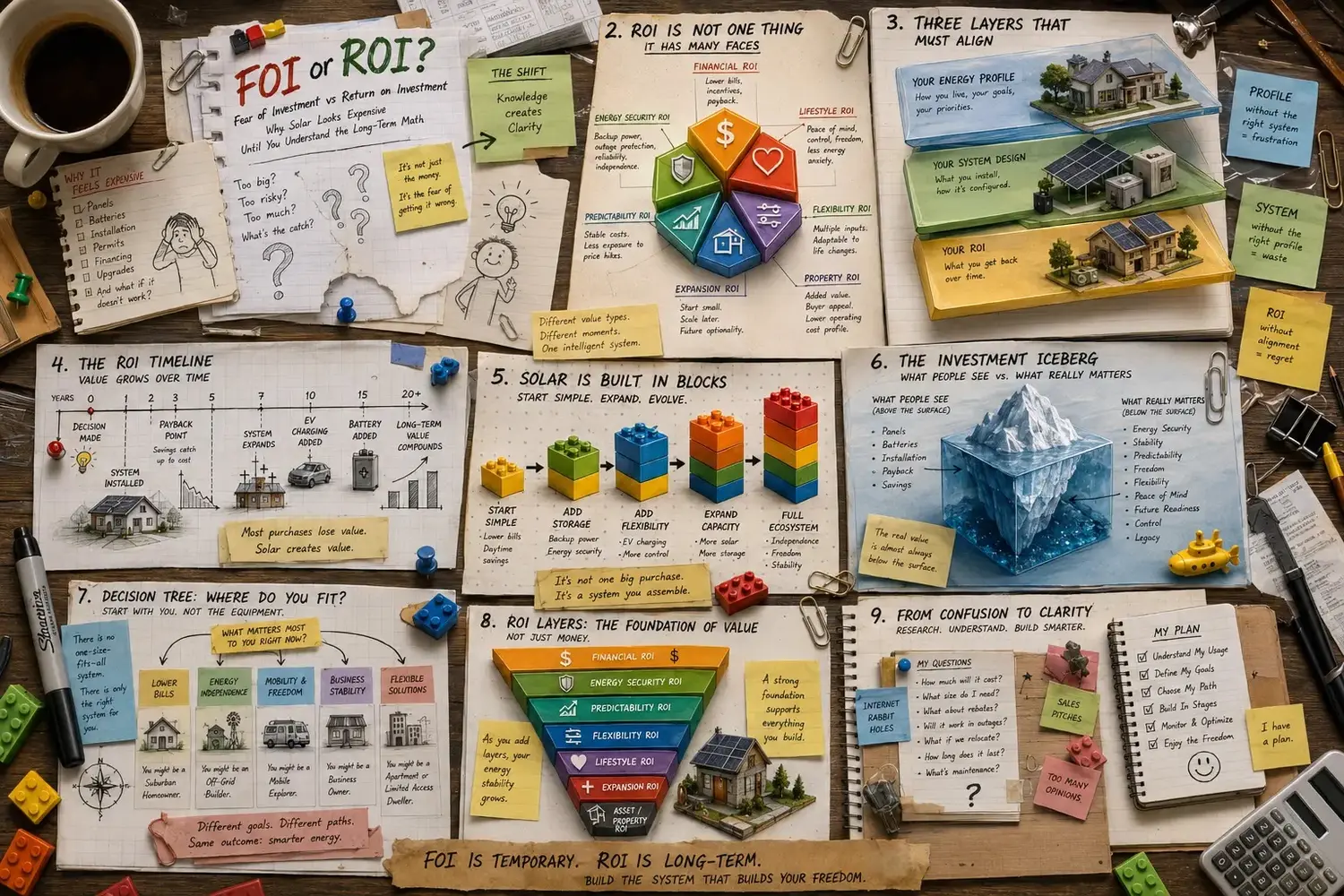
Return on investment isn’t the same for everyone.
For one homeowner, ROI means the shortest financial payback.
For another, it’s protection against rising electricity prices and the predictability they can have over costs for the next 20 years.
Some value stability and reliable backup more then complete energy independence and a lower environmental footprint.
Each of those goals changes what “good value” looks like.
The question isn’t always “Which system has the highest ROI?”
It’s “Which return matters most to me?”
➡️ Explore the different layers of solar ROI and how they influence system design
The more predictable your costs become before you sign a contract, the easier it is to compare proposals, budget realistically, and decide whether a system genuinely delivers value for your priorities—not someone else’s.
The goal isn’t to eliminate every unknown.
It’s to make sure the unknowns don’t make the decision for you.
Just as good solar decisions aren’t about avoiding mistakes.
They’re about reducing uncertainty before you commit.
Because predictability has value.
Control has value.
And systems have value if the decision frameworks around them are solid.
And includes truly understanding what all the costs of the investment entails – before, during and after installation.
A Solar Cost Check Checklist
You can’t eliminate uncertainty.
You can only decide whether you’ll discover it before you buy—or pay for it afterwards
So let’s create predictability before we create misconceptions over which contractor had to do which job.
(Be sure to bookmark this page, whether you are considering your first solar options or seeing how best to upgrade and expand your existing system.)
Costs your house can create
- roof repairs
- roof Reinforcement
- roof replacement due to age
- electrical panel upgrades
- electric rewiring
- conduit runs
- trenching
- structural reinforcement
- Tree trimming or felling
Costs your utility can create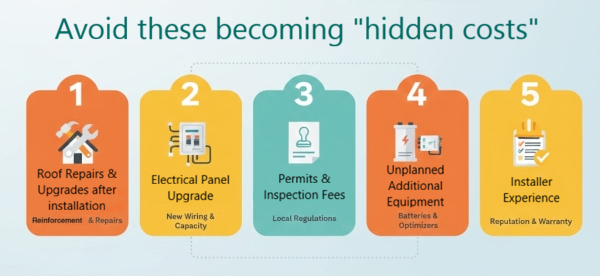
- Permit & HOA Requirements
- Utility Interconnection Requirements
- Inspection fees
- meter changes
- application fees
- TOU implications
Costs your choices create
- batteries
- EV Charger Installation
- future expansion
- backup circuits
- monitoring
- optimization strategy
- TOU arbitrage
- Home-appliances – how energy efficient are they?
Costs time creates
- Expansion to suit future growing needs
- inverter replacement
- battery replacement
- Technology upgrades
- cleaning
- maintenance
- component warranty differences
Subscription costs
There are actually quite a few that people never think about. Monitoring, just like optimization strategies, is only a phase two thought.
These are worth considering if/where applicable.
Ongoing Services might include:
- Monitoring platform subscription (some manufacturers charge for advanced features)
- Cellular communication plans (for systems using built-in cellular gateways)
- Extended warranties
- Software or premium monitoring services
- Utility fixed monthly connection charges (these often remain even if you import almost no electricity)
- Community solar participation fees (where applicable)
- Virtual power plant (VPP) participation terms (not always a cost, but worth understanding)
I actually like to label these Fixed Energy Charges, because it ties directly into the “my bill didn’t disappear” theme many folks experience.
People think: “I produced all my electricity.”
Then they still see:
Grid Access Charge $28
and think something is broken.
Nope. That’s just how the tariff works.
🛠 Home Improvements That Can Affect Solar Costs
Many of the so-called “hidden costs” of solar have nothing to do with the solar equipment itself.
They come from preparing the home for a system that can operate safely and efficiently.
Depending on your property, you may also need to consider:
➡️ Tree Trimming & Removal (shade management)
➡️ Insulation & Air Sealing
➡️ Heat Pumps & Electrification
➡️ HVAC Efficiency Improvements
➡️ Generator Integration
➡️ Internet / Wi-Fi Improvements (for monitoring systems)
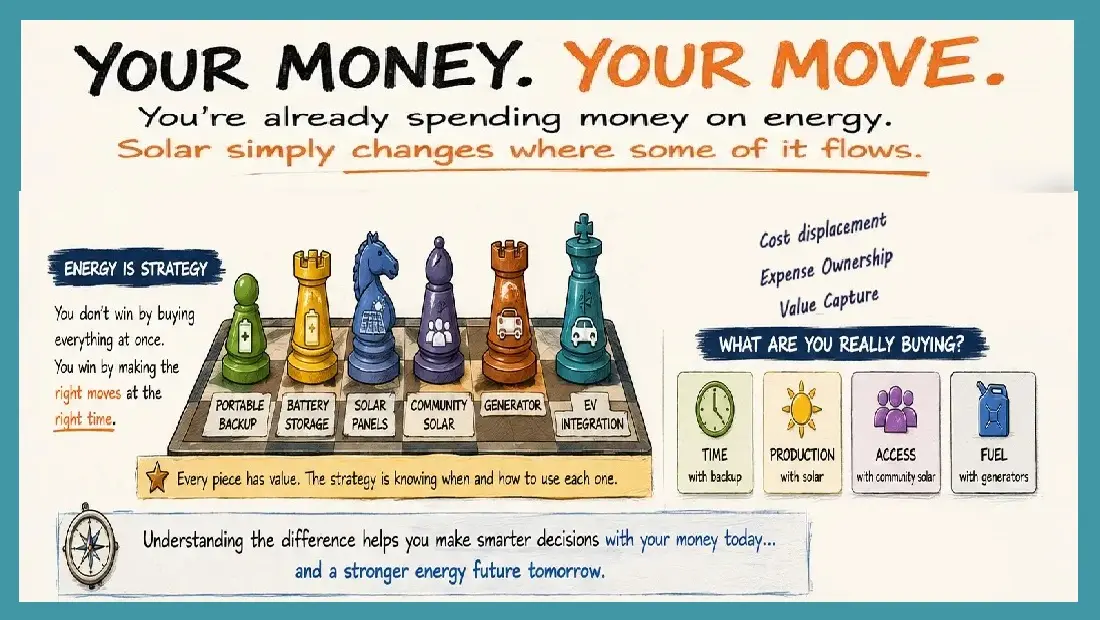
Choose the Right Building Blocks
After seeing what the costs involve, it’s easier to start looking at solar systems and components.
And to choose an energy strategy that will make the choices around your system, work.
The next step is understanding which type of solar system
Just remember the 3 things to align: energy goals, your budget, and the level of control you want.
From there, you can start exploring the hardware, batteries, inverters, monitoring systems, and expansion options that support that strategy—not because they’re the most expensive or the most popular, but because they’re the right tools for what you’re trying to achieve.
That’s how predictable decisions become valuable investments.
Different goals lead to different solutions.
The best solar system isn’t the one with the most hardware.
It’s the one that supports your energy goals, your property, your budget, and the level of control you’re looking for.
Start with the type of solution you’re trying to build.
Please note: Affiliate Disclosure
This article contains affiliate links. NavigatingSolar independently researches products and selects partners based on how well they fit our educational framework, not simply because they offer commissions. Learn more about how we choose partners.
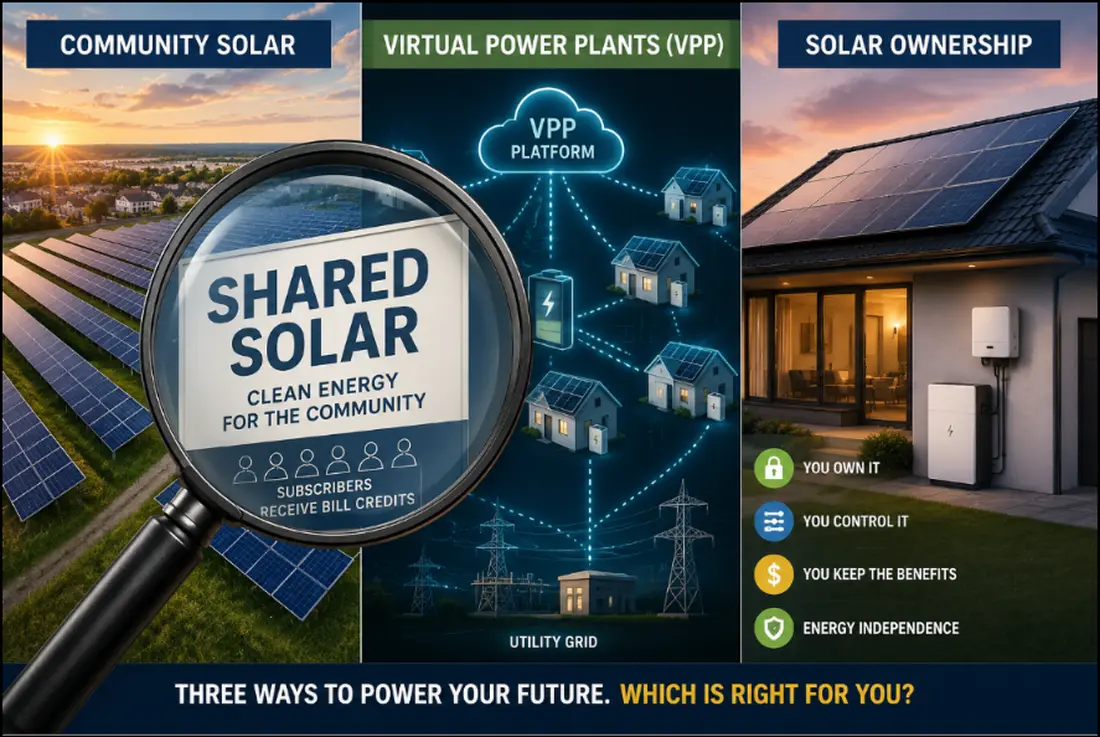 Traditional Solar Installations
Whether you’re comparing installers or exploring system types, understanding the different installation approaches helps you ask better questions before signing a contract.
➡️ Explore Alternative Solar Mounting Options
➡️ Read up about Community Solar – Who is it for and how does it work?
➡️ Learn about Virtual Power Plants (VPP)
➡️ Wondering Which Questions to Ask Before Choosing an Installer
➡️ Compare Solar Quotes for Traditional EPC Installations
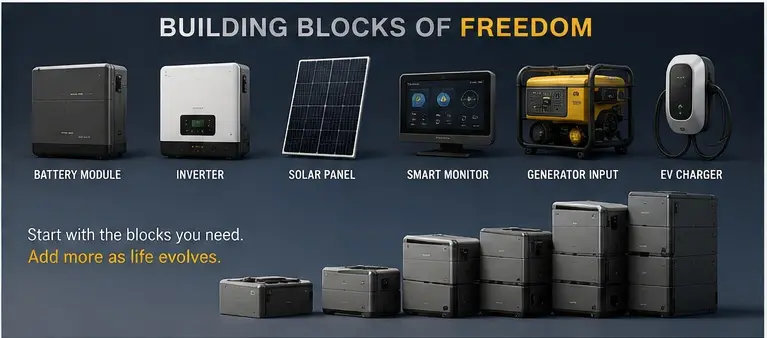 Backup Power & Battery Solutions
Not every battery serves the same purpose.
Some simply shift energy into the evening.
Others are designed to keep your entire home running during extended outages.
Look at the following Home Battery Options:
➡️ Essentials-only Automated Backup
➡️Modular Hybrid Solar Systems
➡️ Whole-home Off-Grid Solar Systems
🏠 Whole-Home Smart Energy Management Ecosystems
A modern solar installation is becoming more than panels and batteries.
Think of it as your own Department of Transport & Energy Distribution.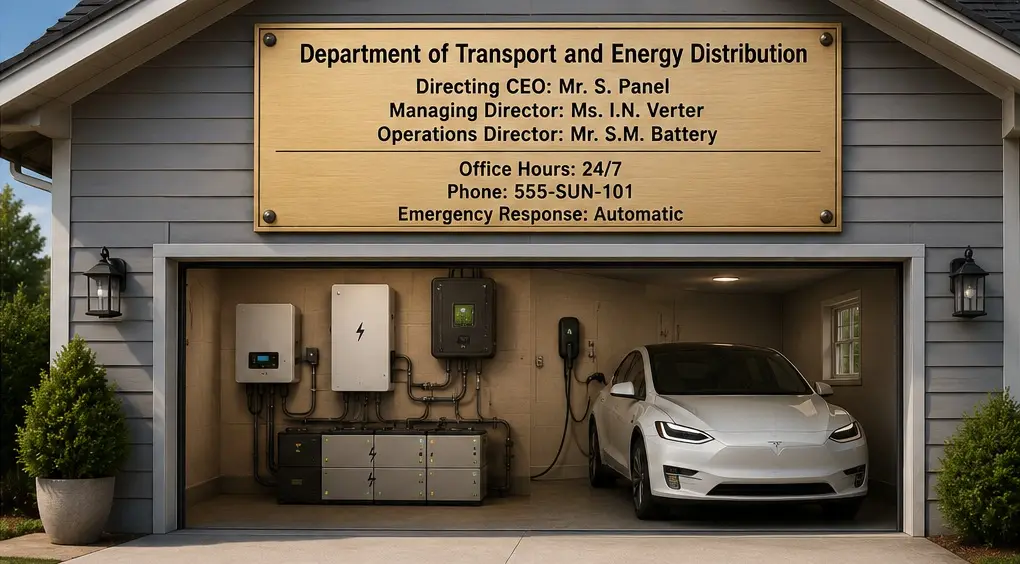
As your household grows, so does the system that manages it.
Learn how the different building blocks work together.
➡️ See what a Whole-home Smart Energy Ecosystem looks like
What to look for:
Battery Management Systems
Smart Load Management
Energy Automation
Future Expansion Possibilities
EV Charging stations and connection
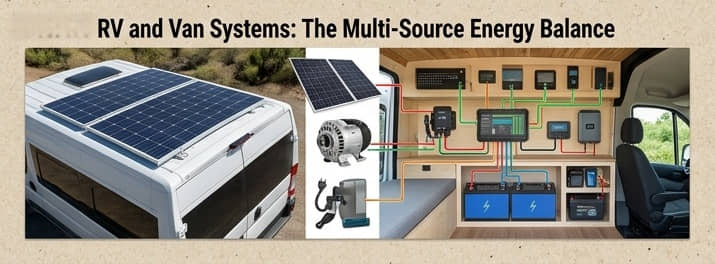 🚐 Mobile Energy & Portable Power
Energy independence doesn’t stop at your driveway.
Portable systems make it possible to take electricity wherever life takes you.
➡️ Discover RV Solar Systems for life on the road
➡️ Alternator Fast-Charging Solutions for charging while you drive
➡️ Portable Solar Panels and Heat-guard Solar Films
The best solar decisions rarely start with shopping.
They start with understanding your home, your energy usage, your goals, and the trade-offs you’re willing to make.
That’s exactly why we built the NavigatingSolar Toolkit.
Our collection of free, independent calculators, worksheets, checklists, planning guides, and eGuides helps you answer the questions that matter before you compare products, request quotes, or commit to a system.
The more informed your decisions become, the more predictable your investment becomes.
Explore our free planning resources:
➡️ Solar Production Optimization Guides
➡️ Downloadable Research & Planning Guides & Checklists
Recommended Guides for You
Which Type of Solar Consumer Are You?
The Homeowner’s Solar Decisions Manual: Built on Choices
The Homeowner’s Guide to Solar Optimization
Solar ROI Leverage : Strategy, Sequence and Timing
Solar Battery Storage: Value vs Expense
Solarize • Monetize • Optimize
Educational transparency.
NavigatingSolar is an Independent Educational Resource. We are not solar manufacturers or installers – we research them.
Why these suggestions?
Navigating Solar doesn’t recommend companies simply because they offer affiliate programs. We believe readers should always understand why something is being recommended. We begin with the homeowner’s decision—not the product. We identify where people struggle to make informed choices, then evaluate products, services and partners that genuinely solve those problems.
Not every recommendation earns us a commission. Partnerships are selected to fit the educational framework—not forcing the educational framework to fit whatever affiliate programs happened to exist. If a company doesn’t fit the decision framework and ethos, we don’t include it—whether it has an affiliate program or not. If we believe a better solution exists, we’ll recommend it regardless of whether it generates a commission.
➡️ Our goal is to help you make the right decision—not the fastest purchase.
Learn more here