 Navigating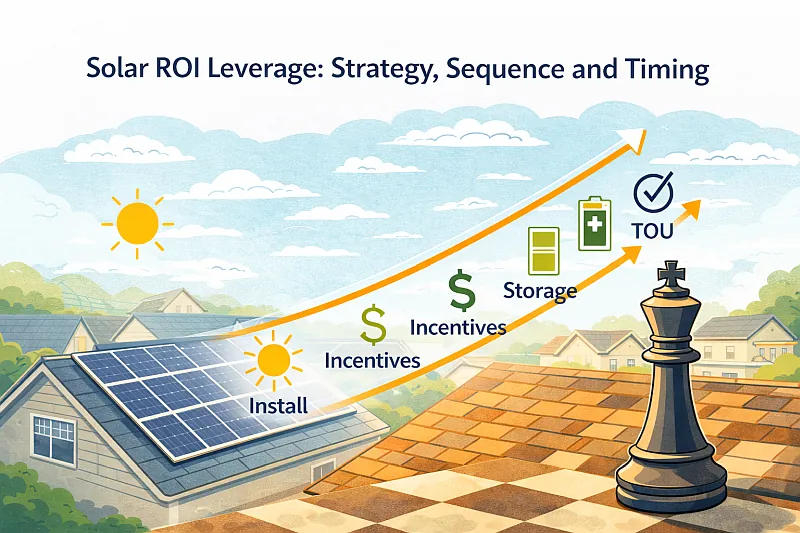
Why Strategic Solar Planning Creates Better Outcomes
How Solar Success Starts Before Installation
Most people think solar success comes down to panels, inverters, and installation day.
That’s not where the real advantage is.
It’s how you Leverage Solar ROI through Strategy, Sequence and Timing
The biggest difference between a solar system that feels ‘expensive’ and one that feels smart comes down to planning — not in a calendar sense, but in preparation.
Solar is a long-term asset. Planning affects more than installation day — it shapes system performance, long-term savings, flexibility, and the financial value your solar setup delivers over time.
The decisions that shape its value – happen before anything is installed.
This article breaks down every strategic lever — habits, timing logic, financial framing, and planning behaviors — that consistently lead to better outcomes. Whether you’re just starting or already solar-curious, this is the layer most people skip.
⏱️The Timing Myth That Confuses Homeowners
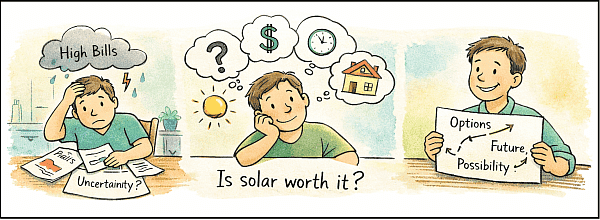
There’s a persistent belief that solar has a “perfect moment”:
➜ a perfect season ➜ a perfect price ➜ a perfect incentive window
In reality, solar performance doesn’t care about timing myths.
What does care about timing is:
➡️ pricing leverage
➡️ installer availability
➡️ incentive eligibility
➡️ financing terms
➡️ your stress levels
Rushed decisions don’t break solar systems — they break outcomes.
Strategic solar planning removes urgency from the equation. And urgency is where people overpay, under-spec, or lock themselves into systems that don’t age well.

Strategic solar planning
🧭 Strategic Solar Planning vs Reactive Solar Decisions
Here’s the real divide:
Reactive solar decisions look like:
❌ “We need to decide quickly”
❌ “Let’s just get a quote”
❌ “This installer seems fine”
❌ “We’ll figure upgrades out later”
=====🆚====
Strategic solar planning looks like:
✅ “What problem am I actually solving?”
✅ “How does this system evolve over time?”
✅ “What assumptions am I making about future usage?”
✅ “How does this affect cash flow, not just price?”
The difference isn’t intelligence.
It’s sequence.

The Solar Buyer’s Survival Guide
Homeowner to homeowner insights on how to optimize and maximize your solar investment.
7 Solar Strategies for Better Long-Term Outcomes
🧭 Strategy #1: Separate Learning from Buying
This is the most important habit.
Learning and buying are two different phases — and mixing them creates pressure.
When homeowners learn before speaking to installers:
🟢 conversations are shorter
🟢 quotes are clearer
🟢 upsells lose power
🟢 numbers make sense faster
Strategic planning means:
🟢 understanding system components before they’re pitched
🟢 knowing basic terminology
🟢 having rough expectations for cost, output, and savings
This doesn’t slow things down — it speeds them up later.
Want to know more? On NavigatingSolar’s Resources page you can learn more about
Choosing Solar Installers, Insurance & System Protection
Find clear strategies and practical next steps to going solar— without the pressure.
🧭 Strategy #2: Model Before You Commit
Solar works best when it’s treated like a financial model, not a purchase.
Before committing, strategic planners:
✔️ estimate baseline energy usage
✔️ model system size ranges
✔️ explore self-consumption vs export
✔️ test scenarios with and without batteries
✔️ look at cash vs finance outcomes
This isn’t about precision — it’s about directional clarity.
Even rough models reveal:
➜ where oversizing happens
➜ where batteries actually make sense
➜ how small habit changes shift ROI
➜ what “good” looks like for your home
Planning turns guesswork into ranges — and ranges create confidence.
Solar ROI Leverage : Strategy, Sequence and Timing make solar work better.
🧭 Strategy #3: Design for Future Energy Use, too.
Most systems are designed for today’s habits. Strategic systems are designed for future behavior.
That includes:
➜ EV charging
➜ heat pumps or electric heating
➜ home offices
➜ growing households
➜ battery add-ons
➜ load shifting over time
You don’t need to install everything now — but you do need to plan for it.
A system that can’t scale is rarely “cheaper” in the long run.
🧭 Strategy #4: Incentives Are Solar Planning Tools, Not Discounts
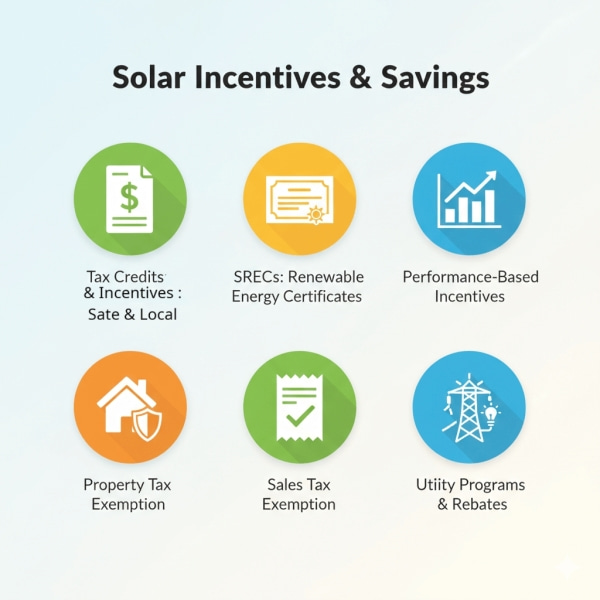
One of the biggest planning mistakes is treating incentives like coupons. They’re not.
Incentives, credits, and structured utility programs are cash-flow tools:
➜ they affect payback timing
➜ they affect financing structures
➜ they influence system sizing decisions
Strategic planners ask:
✔️ how incentives interact with financing
✔️ how credits apply over time
✔️ how assumptions change if incentives shift
The goal isn’t to “get the biggest incentive” — it’s to optimize long-term returns.
🧭 Strategy #5: Solar Is an Operational System, Not Just an Installation
Solar doesn’t stop working on install day — but many people stop thinking about it there.
Strategic solar planning includes:
✔️ monitoring setup
✔️ load-shifting habits
✔️ TOU awareness
✔️ maintenance planning
✔️ performance reviews
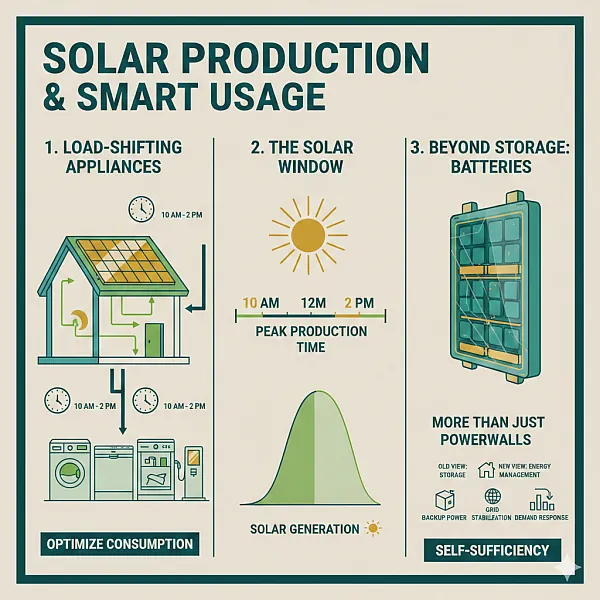
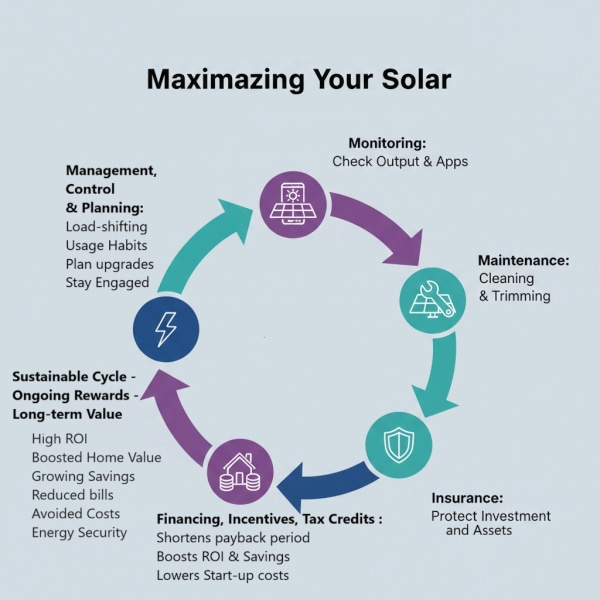
Solar Production & Smart Solar Usage: Strategy is a tool – affecting your performance outcomes and savings directly.
Small operational habits:
✔️ running heavy loads during solar hours
✔️ tracking anomalies early
✔️ adjusting usage seasonally
…can outperform hardware upgrades.
Planning turns solar into a system you manage, not a box on the garage wall.
And managing is where the value ( both energy and money ) is made or lost.
🧭 Strategy #6: Give Yourself Time to Compare, Calmly
Preparation gives you something invaluable:
choice without pressure.
When you’re not rushed:
🟢 you can compare installers properly
🟢 quotes make sense
🟢 red flags stand out
🟢 negotiations feel normal
This doesn’t mean dragging things out — it means choosing the pace, not being forced into one.
Calm decisions age better.
🧭 Strategy #7: Think in Assets, Not Appliances
Strategic planners frame solar as:
✔️ an income-offsetting asset
✔️ a hedge against price volatility
✔️ a system with a lifecycle
✔️ something that integrates with other assets (EVs, batteries, smart homes)
This mindset changes:
➜ how you evaluate price
➜ how you approach financing
➜ how you value monitoring and upgrades
➜ how you protect the system (insurance, maintenance)
Assets deserve planning. Appliances don’t.
Strategic Planning Reduces Expensive Regret
Most solar problems do not come from solar technology itself.
They come from rushed assumptions, poor sequencing, unclear expectations, or systems designed without long-term thinking.
Strategic planning helps homeowners slow the process down just enough to:
- understand trade-offs
- compare options properly
- identify future needs
- and make decisions with clearer expectations
That does not guarantee perfection.
But it dramatically improves the odds of building a system that continues making sense years after installation.
🏆 The Long-Term Payoff of Strategic Planning
Here’s what strategic planning actually buys you:
🟢 fewer surprises
🟢 clearer numbers
🟢 better installer conversations
🟢 stronger long-term returns
🟢 less regret
Not because solar is complicated — but because good decisions compound.
Solar performance is measured in decades. Planning for a few weeks or months doesn’t change output — it changes everything else.
Where to Go Next
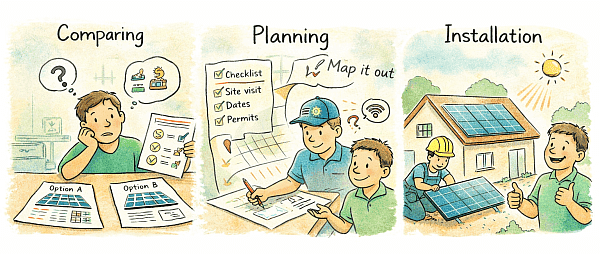
NavigatingSolar – Free Online Solar Planning & Research Toolkit for Homeowners
If you’re still exploring costs and incentives, visit the Blog category 🟡Solar Finance & Incentives
If you want to model scenarios and run numbers: 🟡 Explore the Solar Toolkit and calculators.
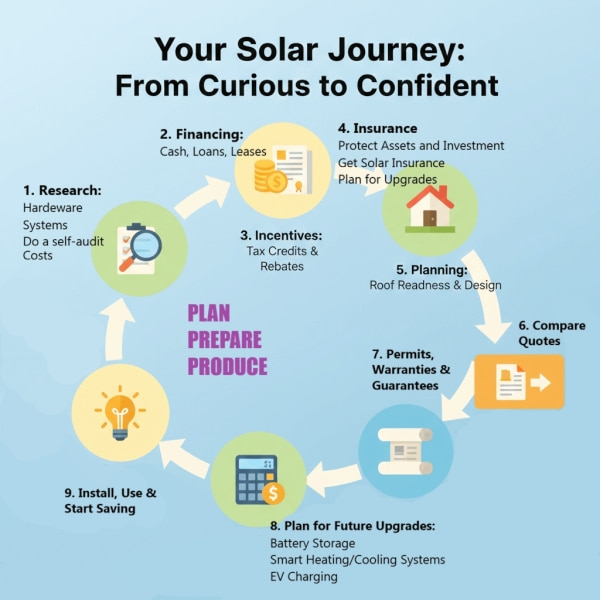
And if you’re not sure where you stand yet: 🟡 Start with your Solar Phase — there are step-by-step guides, calculators and tools for every part of your solar journey
Preparation isn’t delay.
It’s leverage.
And in solar, leverage is what turns a good system into a great one.
The Solar Buyer’s Survival Guide
Homeowner to homeowner insights on how to optimize and maximize your solar investment.
Recommended Reads
Solar ROI, IRR & Payback Explained
Solar Incentives by State in 2026
US Solar Tax Credits : 2026 Updated Facts
Solar Battery Storage: Value vs Expense
7 Solar Installation Mistakes to Avoid (Including Hidden Costs Most People Miss)
Extra Sources
Here are some handy links to follow for deeper dives into incentives and TOU Rates:
Government / Policy Sources
-
U.S. Department of Energy – Solar Energy Technologies Office
https://www.energy.gov/eere/solar
→ Official data, funding programs, and incentive info -
Energy Information Administration (EIA) – Electricity Data
https://www.eia.gov/
→ Electricity costs, rate schedules, TOU data.