 Navigating
 Building a Whole-Home Energy Ecosystem
From Energy Generation and Storage to an Intelligent Ecosystem

What is a Whole-Home Energy Ecosystem?
1 System – All bases covered
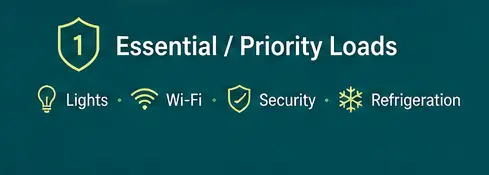
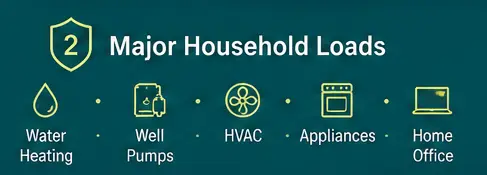
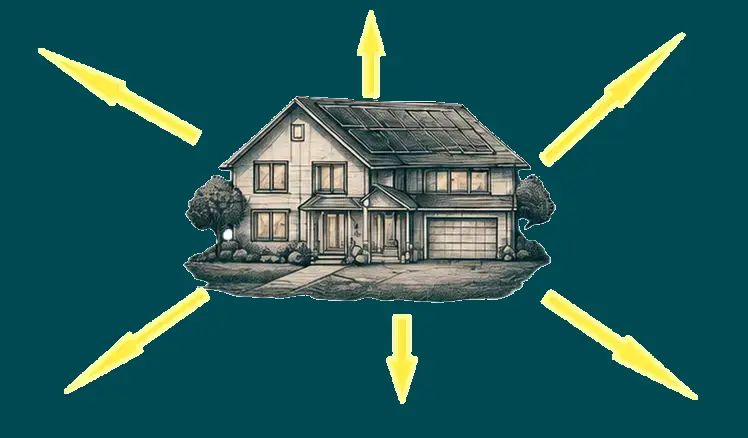
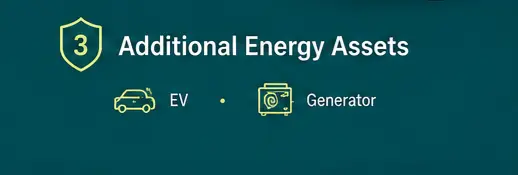
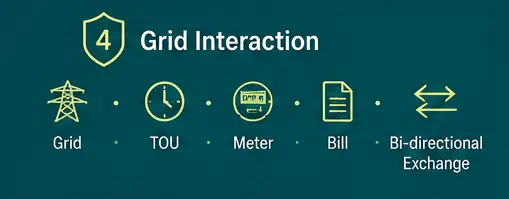
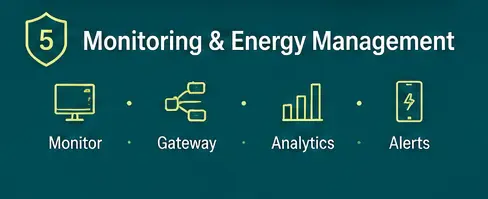
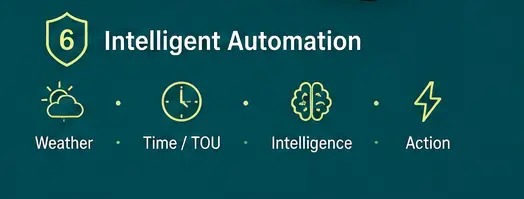
What do you think?
Build Progressively or
Install as an Integrated System?
MODULAR
Start with what you need
→ solar panel array
→ add capacity
→ add backup
→ add control
→ expand.
WHOLE-HOME
Complete the system designed around generation, storage, and backup flow.
→ Add monitoring and management
→ Energy efficient appliance upgrades and home-improvements
→ Add energy assets: extra battery storage, backup generator, and EV charging.
INTELLIGENT AUTOMATION
Add intelligent management between the system, home and grid.
Explore automated load management and distribution.
→ Add energy assets: extra battery storage, backup generator, and EV charging.
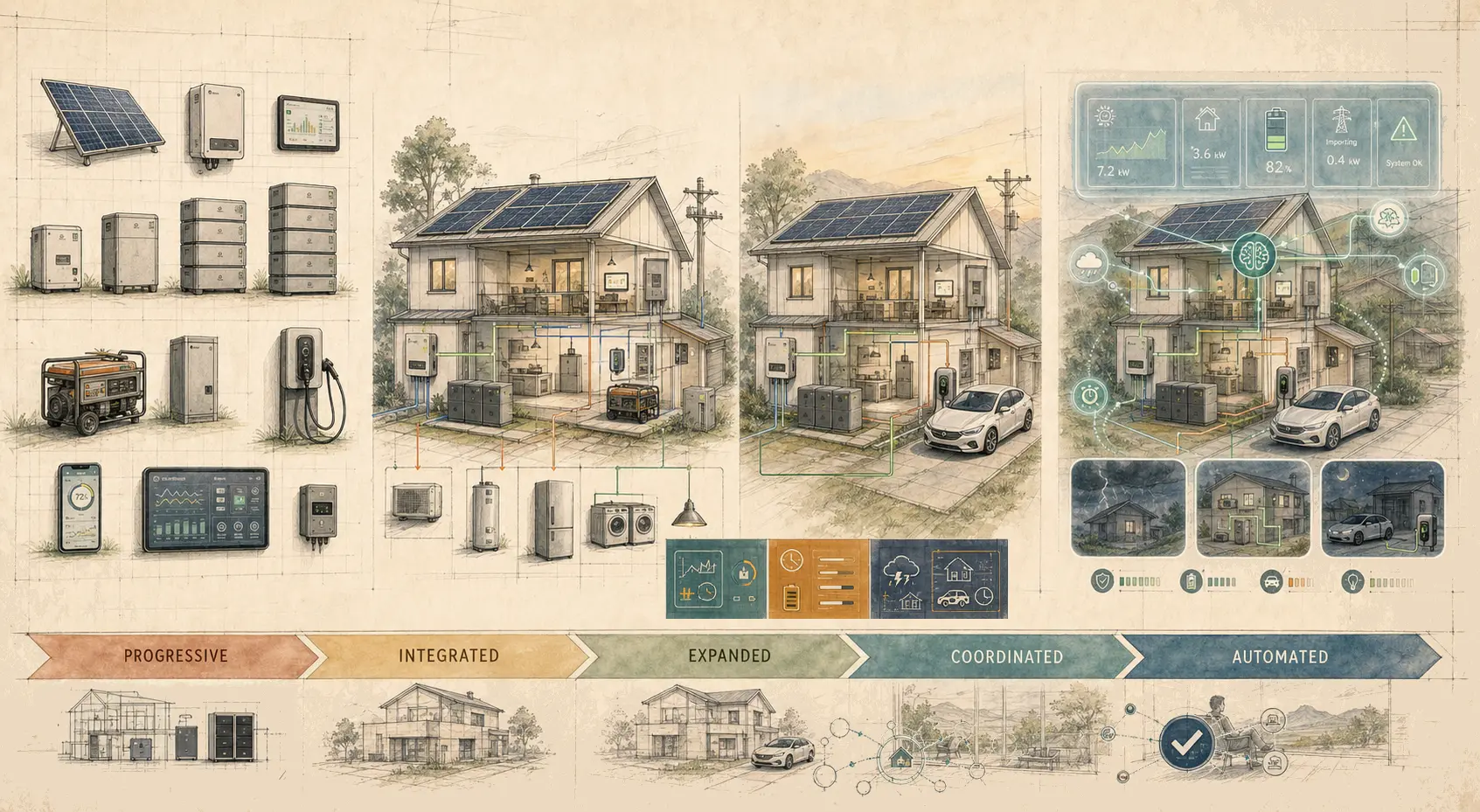
This page tells the story of evolution:
Where energy systems begin
solar
backup
storage
How they can grow
modular expansion
compatibility
manufacturer ecosystem
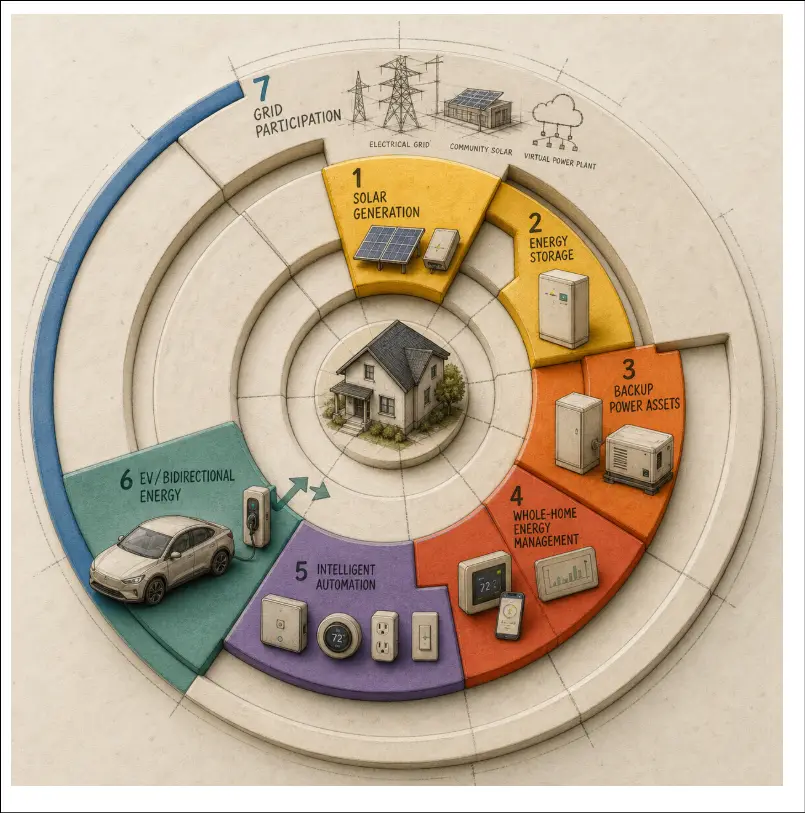
When intelligent management enters
automation
load management
EV integration
bidirectional charging
How far you take it
depends on your property,
energy needs,
budget,
future plans and
appetite for integrating your energy assets.
and the secret to it all
Plan the energy ecosystem, not just the first purchase.
You’re planning asset growth alongside energy flow, rather than buying isolated power components.
The question isn’t only “What do I need today?”
It’s “What do I want this system to do in the next few years?”
THE BIG DECISION: Where to Start?
A homeowner starts with a need.
For backup power, resilience or simply a desire to control energy costs.
BUT
you’re not necessarily just buying a solar system.
You’re building your own energy ecosystem.
Planning how energy assets develop, interact, create value, reduce costs
and potentially become a larger household asset over time,
matters.

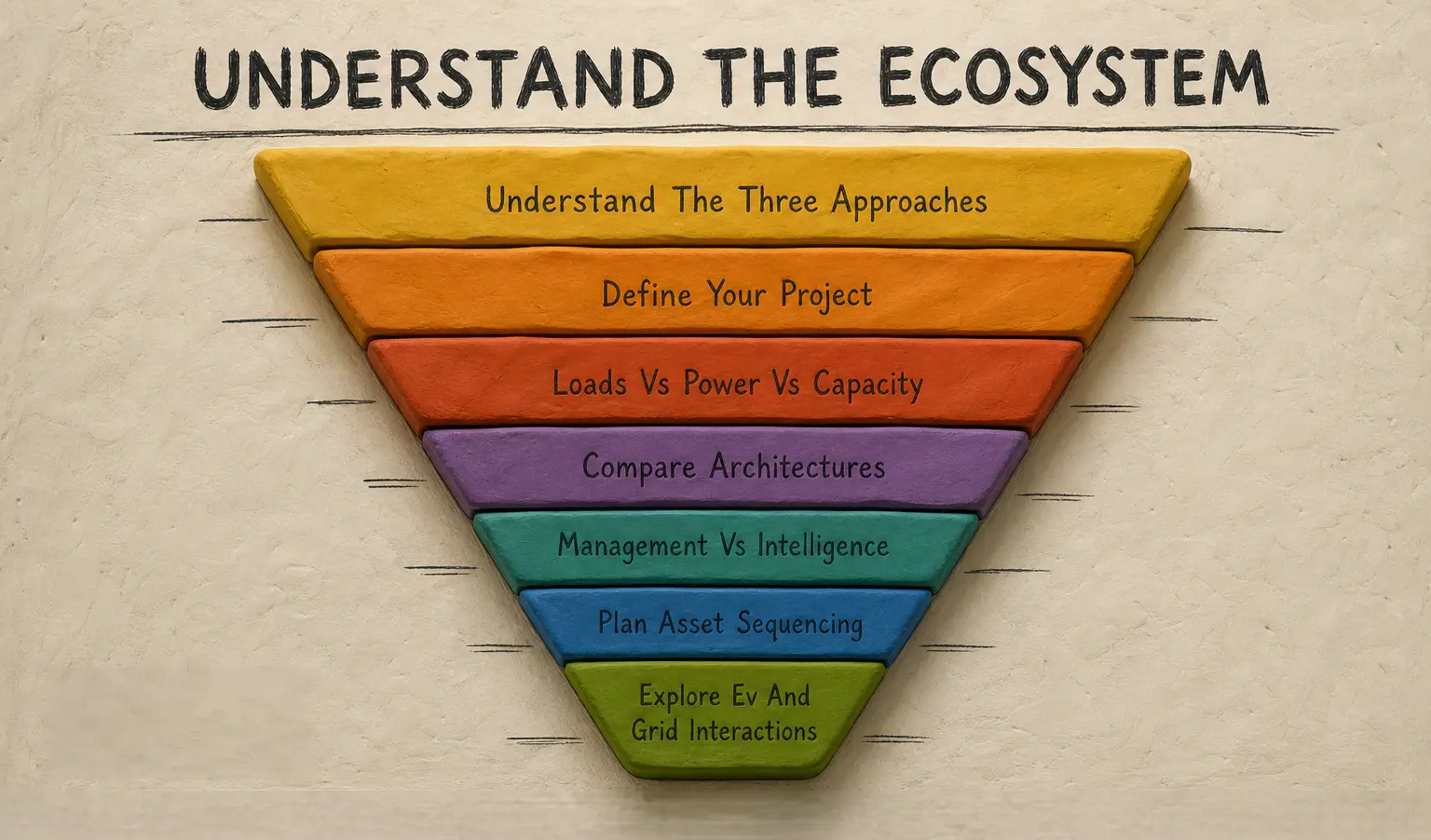
Step 1.
Energy Profiles and Decisions
FIRST: DEFINE THE PROJECT
Energy Profile → Energy Asset Goals → Existing Equipment → Budget → Installation → Energy Asset Expansion
↓
THEN: DESIGN THE PATH
combining
Power Generation:
Solar / Grid
Energy Storage:
Capacity → Loads → Backup requirement →
Asset Growth:
Expansion → Upgrades → EV → Automation/Intelligence
What is your Energy Goal – where are you going with this?
Identify your Energy Profile: What type of consumer are you?
Determine your Energy Needs: Immediate and future
Set your Energy Goal: What does your energy asset evolve to?
Step 2.
How far can the energy ecosystem evolve?
How far do you want to take it?
For every ecosystem, this means something different.
Something personal.
The order in which it starts and grows depends on the problem it’s solving at the time.
Fortunately, you don’t necessarily have to buy the final destination on day one.
That’s where a modular pathway becomes incredibly powerful.
You can build toward it.
The problem
…only appears when there is no future plan.
But we do need to investigate the boundaries of that modularity, before purchasing.
Compatibility → voltage → communications → inverter architecture →
battery architecture → manufacturer ecosystem → expansion → EV integration
all matter for future growth, system performance, and avoiding costly mistakes.
And suddenly one understands
why planning the destination before buying the first component matters.
But, how do I plan for growth before I buy?
Step 3:
How much power do you need?
Define Your Energy Needs:
Your home
Your energy use
Your outage / backup needs
Your budget
Your existing equipment
Your future plans
“What does my house actually require?”

Backup Power
“What keeps running when the grid fails?”
VS
Whole-Home Energy Storage
“How does the system manage energy under normal and abnormal conditions?”
because Whole-Home energy storage is a management and prioritized distribution question,
while the Backup question is a capacity/continuity question.
kW determines how much power the system can deliver at a given moment.
kWh determines how much energy it can store and deliver over time.
But “whole-home” doesn’t mean Every appliance can run simultaneously forever.
It’s understanding the difference between
whole-home backup capability
and
unlimited whole-home power.
kW
power determines what can run
VS
kWh
capacity determines how long energy lasts.
Need a Solar Battery Capacity Calculator?
See how much battery capacity your home might need
Step 4 :
Compare the architecture
Affiliate Disclaimer:
Navigating Solar is an independent educational resource. We don’t manufacture or install solar systems—we research technologies, compare solutions, and help homeowners make informed decisions.
Some of the followinghttps://navigatingsolar.com/disclaimer/ links may connect you with solar providers through our partner network.
We may earn a commission if you choose to engage — at no extra cost to you.
Learn more about how we choose partners.
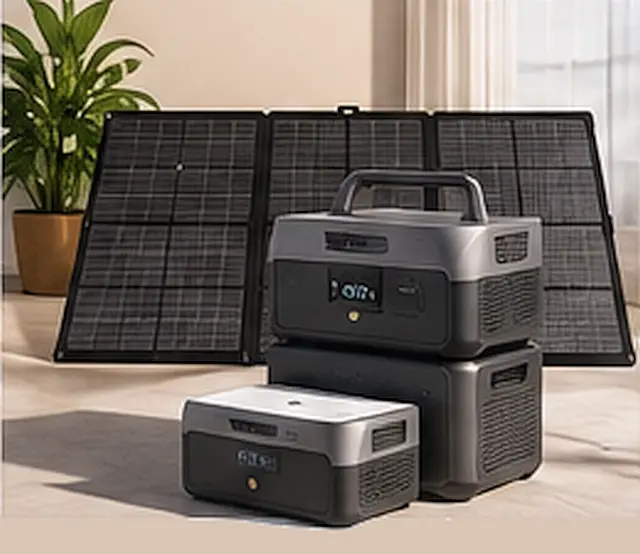
PORTABLE BACKUP POWER
portable architecture,
one battery/inverter unit
+ add extra battery
WHOLE-HOME ECOSYSTEM
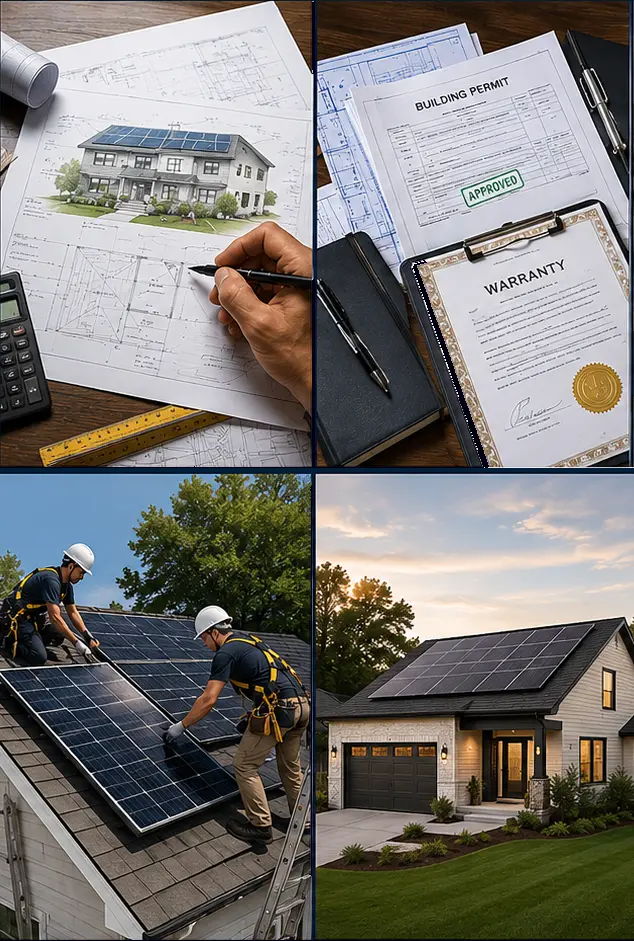
Professional system design and installation
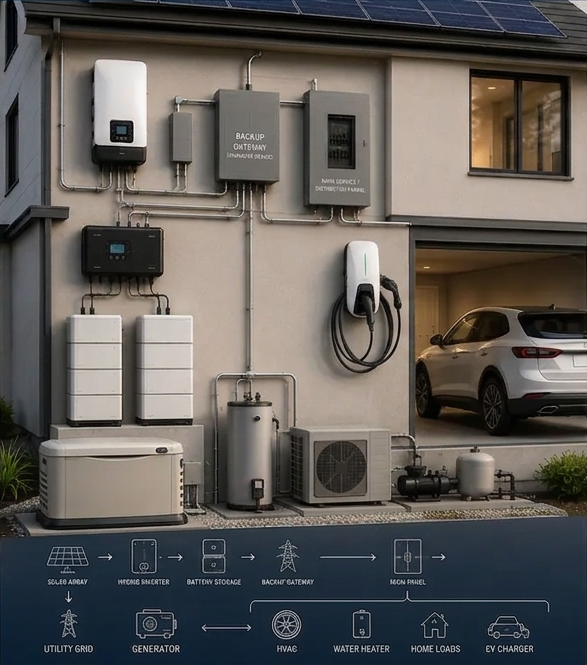
Solar →
Hybrid Inverter→ Battery → Distribution → Loads → Backup
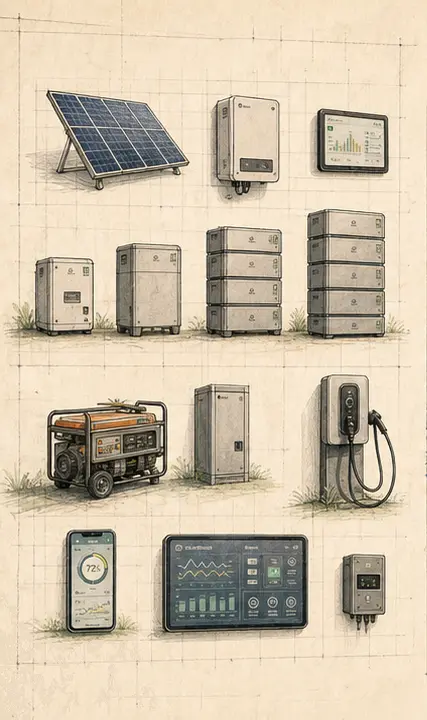
MODULAR SOLAR COMPONENTS
Build your system piece by piece.
Solar → Inverter → Battery → Backup → Expansion
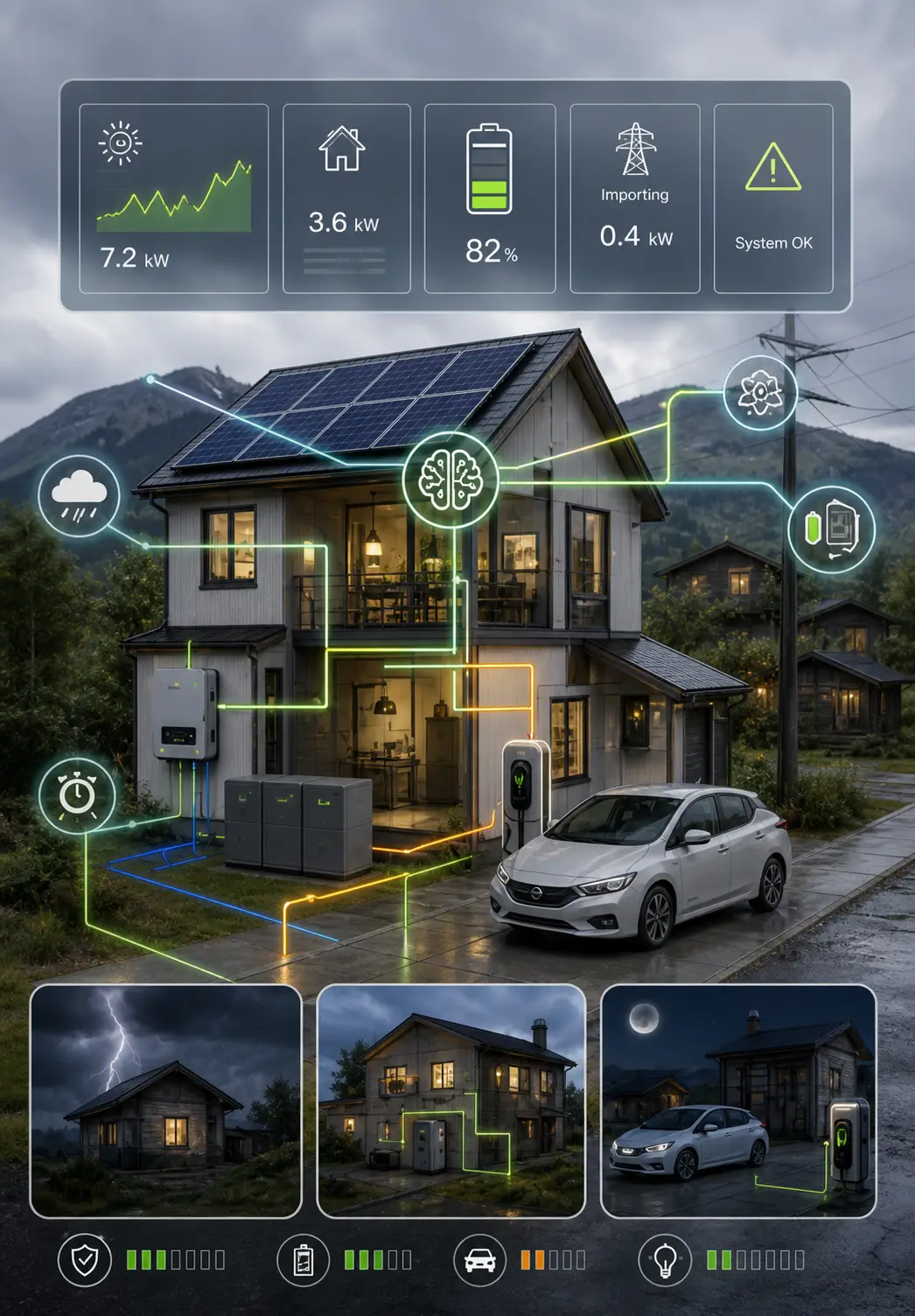
INTELLIGENT SYSTEMS
Automated Energy Management
Solar ↔ Home ↔ Battery ↔ Grid ↔ EV

Step 5:
Consider Future Expansion
What can change?
Besides a growing household, rising electricity costs, and future technological advancements
there are a few things to consider around system expansion:
Capacity
How much energy can be generated or stored?
Compatibility
Will new equipment communicate with what you already own?
Architecture
Can the inverter, battery and controls support the next stage?
Manufacturer ecosystem
Are you staying within one ecosystem, or combining equipment?
Installation
Will future expansion require electrical or structural changes?
Energy efficient improvements
Can you system support things like climate control, water heating systems and EV charging for example.
Remember the Golden Rule:
A residential energy system means:
system design → equipment selection → electrical compatibility → permitting/code → installation → monitoring → future expansion.
You can start a system modularly to resolve certain short-term issues like power outages or high utility bills, but once an energy ecosystem reaches a certain point of expansion, its time to bring in professional help.
Installation requirements vary by system and jurisdiction.
Whole-home systems should be designed and installed by appropriately qualified professionals, with permitting and electrical-code requirements checked before installation.
To contact professional installers in your area
Step 6:
Choose your Direction of Evolution
An energy ecosystem can be modular, whole-home, intelligent, or a combination of all three.
These are not three competing system types.
They describe three different ways an energy ecosystem can evolve:
how you build it,
how broadly it serves the home,
and how intelligently it manages energy.
A system can combine elements of all three.

1. Modular Evolution:
THE PROGRESSIVE ROUTE
This is fundamentally about building in stages.
Build progressively from individual modules, adding modules as budget and energy goals allow.
Modular systems can range from relatively simple, homeowner-managed equipment to professionally designed and installed systems built in stages.
Modularity gives you a pathway to build toward a larger system, but it does not remove the need for professional design and installation as the system expands into the home’s electrical infrastructure.
Build It in Stages
Generate energy → store it → monitor the system → add capabilities → optimize energy use → expand the ecosystem.
The advantage
You don’t have to fund the entire ecosystem on day one.
For homeowners who want flexibility,
staged investment,
more component choice,
and the ability to expand.
The catch:
Every stage has to work with the next one.
Planning around compatibility + system design + manufacturer choices + future expansion is crucial.
What to Consider:
Module and Manufacturer Compatibility
Voltage
Inverter architecture
Battery chemistry
Communication protocols
Expansion limits
Manufacturer ecosystem
Future equipment
Installation requirements
Professional services
Visit the Solar Marketplace
to compare component selections

2. Whole-home Energy Ecosystem Installation
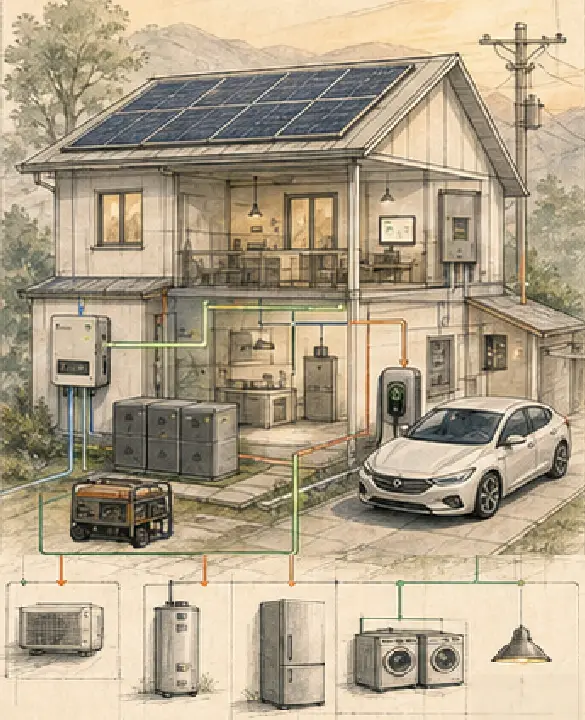
A whole-home system is designed as a coordinated system rather than assembled component by component. Professionally evaluated, designed and installed systems, built around the home’s total energy requirements, electrical infrastructure and intended loads.
Best suited to homeowners ready to build a more comprehensive system from the start.
Advantage:
The major components are selected and sized as one system, reducing the need to make each new addition work with an existing collection of equipment.
The system can be designed around the home’s actual loads, backup requirements, electrical infrastructure and future expansion plans from the beginning.
The catch:
A whole-home system requires more planning and a larger commitment at the outset.
System sizing, electrical infrastructure, installation requirements, permitting, equipment selection and future expansion all need to be considered before installation. Changing the system later may be more involved than adding another modular component.
What to consider:
Home energy use and load profile
Required backup loads
System capacity and sizing
Electrical infrastructure and service capacity
Equipment compatibility
Installation requirements
Permitting and code requirements
Property readiness and pre-installation work
Future expansion plans
Level of Energy Management
A whole-home system can be highly integrated without being highly automated.
Monitoring, energy management and automation are additional capabilities that depend on the equipment, controls and system configuration.
Request multiple quote from trusted installers near you.
Learn how you can, Here

3. Intelligent Ecosystem:
Energy Management & Automation
Choose an integrated manufacturer ecosystem designed to bring these capabilities together.
MONITOR → UNDERSTAND → MANAGE → PRIORITIZE → RESPOND
What is intelligent energy management?
Intelligent energy management means the system can actively manage energy flows and priorities across the home, rather than simply storing electricity and supplying it when requested.
Depending on the equipment and configuration, the system can manage how energy is generated, stored, used, redirected or reserved in response to changing conditions, operating priorities and user settings.
The layers of energy intelligence
Not every “smart” energy system does the same thing. The level of control depends on the equipment, software and how the components are configured to work together.
These are different capabilities, and they can exist independently or be combined.
3 Levels of Energy Management
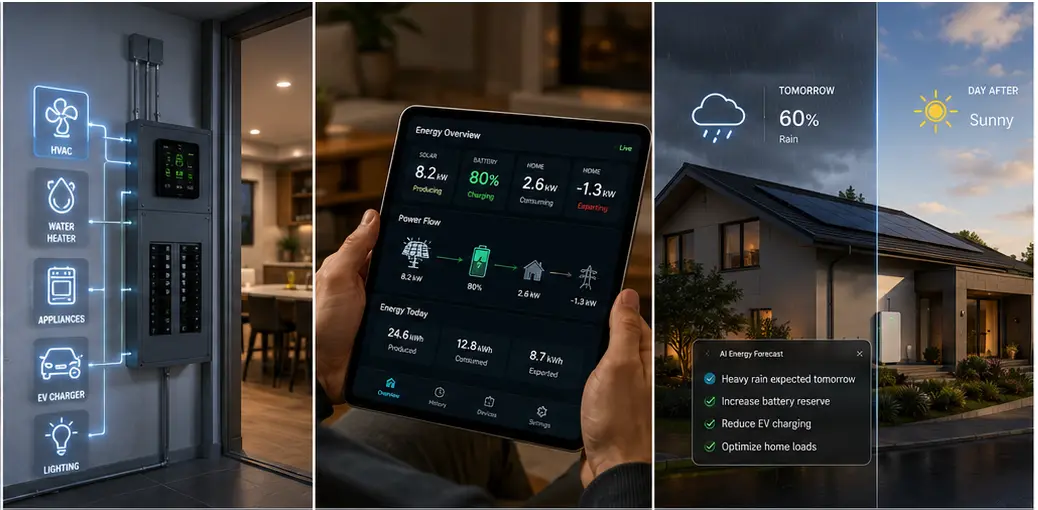
ENERGY MANAGEMENT
The system and/or user controls how energy is allocated and when it is used.
Self-consumption
Time-of-use
Charging/discharging
Backup reserve
Load priorities
MONITORING
The system reports what is happening.
Solar production
Home consumption
Battery state
Grid status
System alerts
AUTOMATION
The system acts on defined conditions without the homeowner having to manually intervene.
Storm response
Automatic load shedding
Automatic charging
Scheduled energy operation
Automatic transitions between operating states
But importantly:
A system can have monitoring without sophisticated energy management.
A system can have energy management without all the automation capabilities.
A system can have automation in some areas and not others.
And some integrated ecosystems combine all three.
The advantage:
Energy management and automation can coordinate multiple parts of the energy ecosystem instead of leaving the homeowner to manage each component separately
Depending on the system, this can help coordinate solar generation, battery storage, home loads, grid interaction, backup reserves, EV charging and other connected equipment according to defined priorities and operating conditions.
The catch:
The more tightly the components are integrated, the more important the manufacturer’s ecosystem, communications and compatibility become. Equipment, software and control systems may have to work within the same ecosystem or meet specific compatibility requirements.
Choosing an intelligent ecosystem can therefore influence which batteries, inverters, chargers, controls and other equipment can be added later.
What to consider:
Manufacturer ecosystem
Equipment compatibility
Communication protocols
Software and control platform
Monitoring capabilities
Energy management capabilities
Automation capabilities
EV and bidirectional charging compatibility
Generator integration
Future expansion
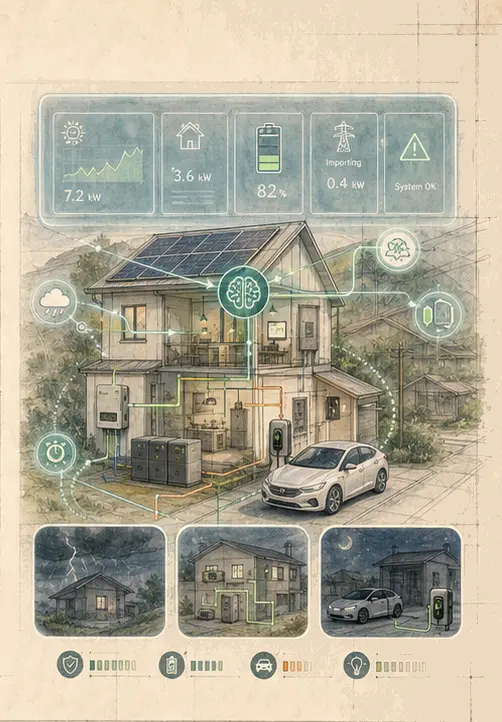
Compare the 3 Approaches
See what the Real Systems look like
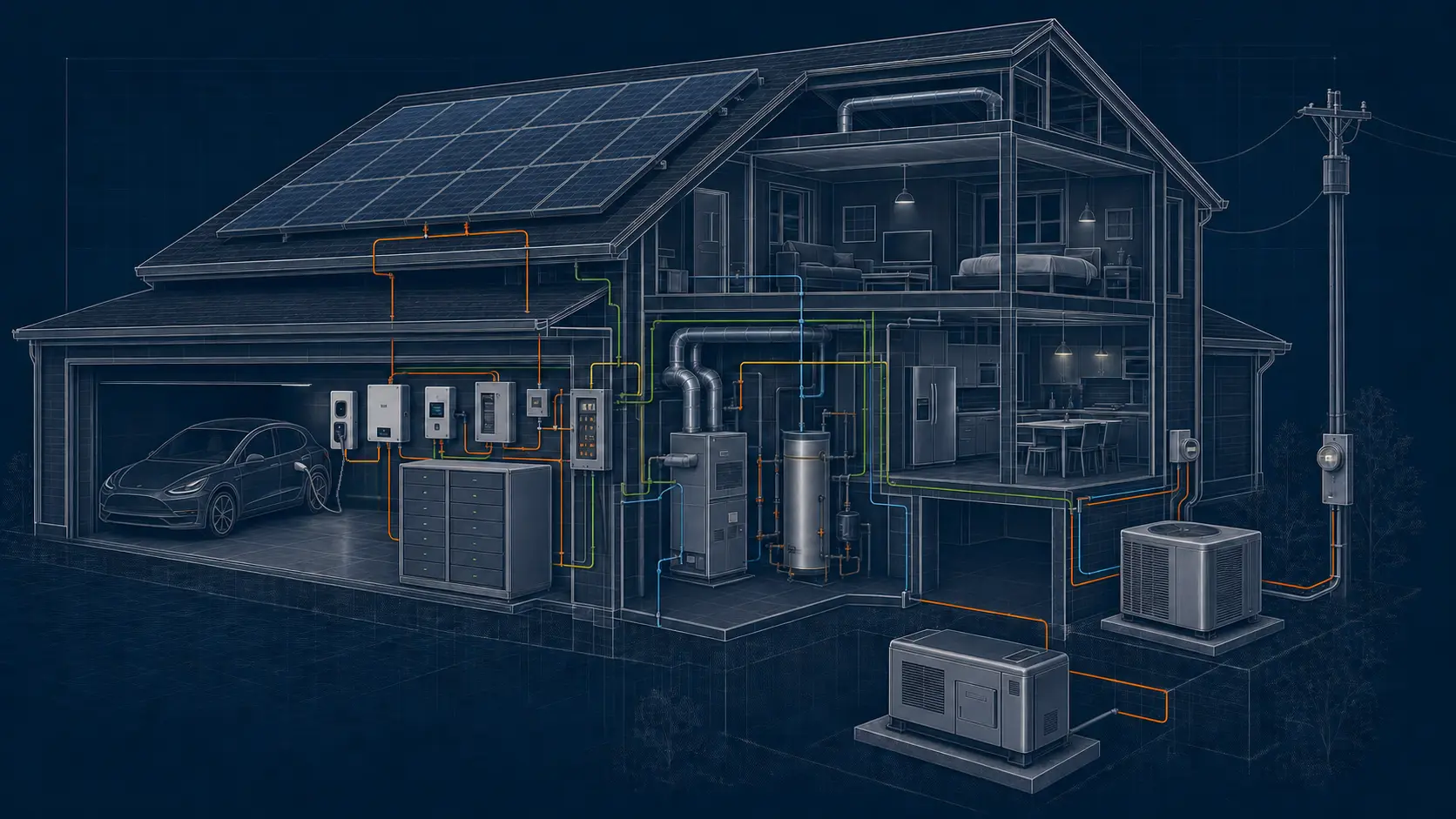
Energy Assets
These include energy efficient home improvements like climate control, backup power, water heating systems
that reduce running costs and energy usage.
Energy assets like the EV, that reduces fuel costs, are evolving to have the potential to do more.
Bidirectional charging changes the role of the EV
Instead of being only a vehicle that consumes electricity, a compatible EV can become another source of stored energy within the home’s energy architecture.
Not every solar system or EV is capable of bi-directional charging.
That is vital to remember when planning your energy ecosystem’s future expansion goals.
vehicle compatibility + charger compatibility + system compatibility
matter.
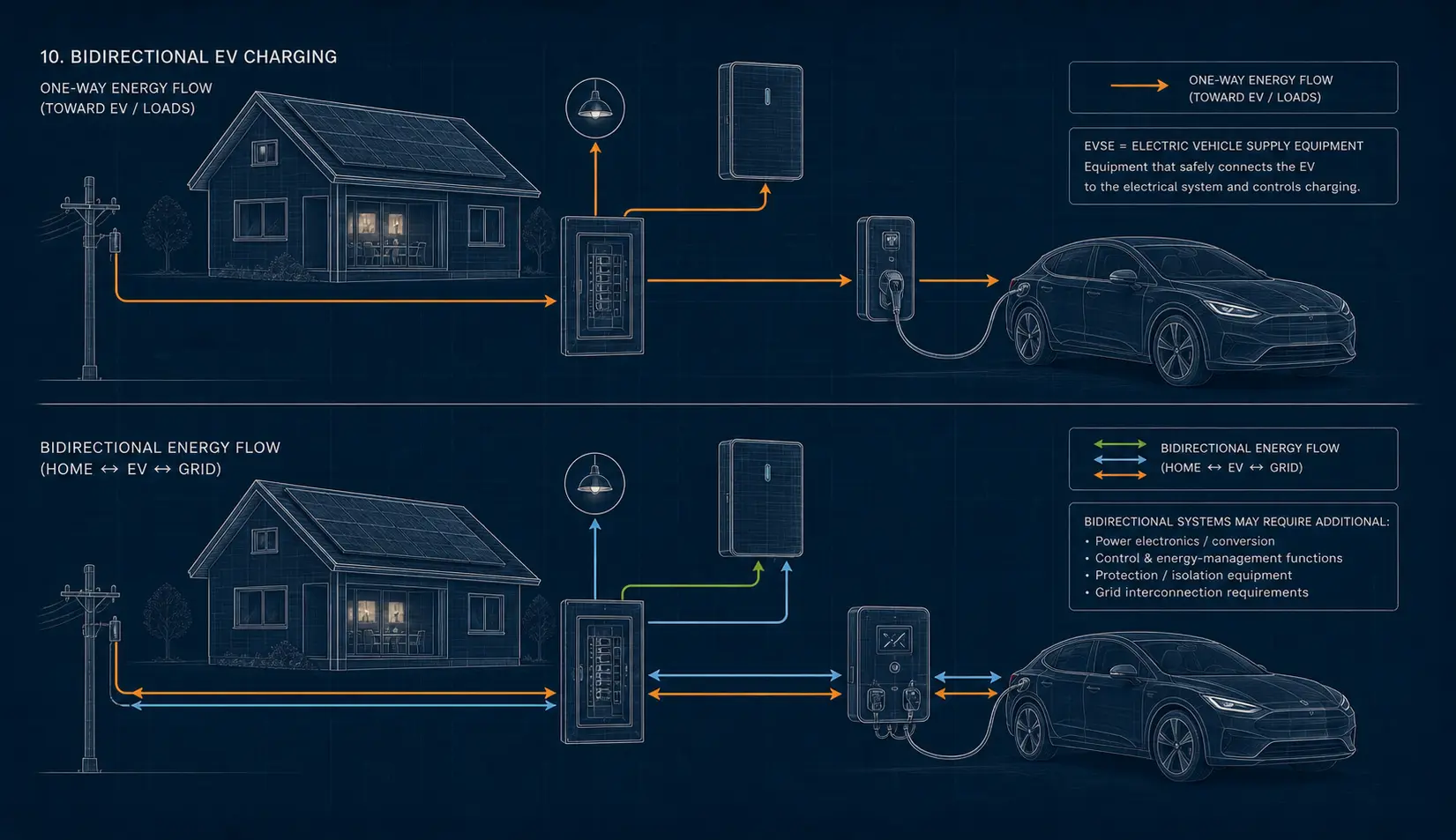
Depending on the vehicle, charger, home energy system and applicable utility program,
that stored energy may be used to support the home,
provide backup power
or participate in other forms of managed energy exchange.
The important point is that the capability has to exist across the entire system.
An EV being capable of bidirectional charging does not, by itself, make a home capable of using that energy.
Vehicle → Charger → Energy system → Home/Grid
Every part of that chain has to be compatible.
This is still an emerging part of the US residential energy ecosystem.
Availability, vehicle support, compatible charging equipment, utility programs and local requirements vary, so bidirectional capability should be treated as a future-planning consideration rather than an assumed feature of every solar-plus-storage system.
Energy Asset Sequencing
PLAN THE SEQUENCE, NOT JUST THE SYSTEM
This is not about a “smart home” or adding automation for convenience.
Asset sequencing is a financial planning decision.
A solar system is not necessarily one purchase. It can become a collection of energy-producing, energy-storing and energy-consuming assets built over time.
The financial question is not simply what can I afford today?
It is which asset should come next, and what does that decision do to the value, usefulness and cost of everything already in the system?
The order matters because some choices constrain what can be added later, while others make the next stage easier, cheaper or more useful.
That is asset sequencing.
Plan the sequence.
Understand what each addition changes.
Build toward the system you actually want.
Questions to ask before buying
A homeowner checklist to understanding the long-term ownership proposition
Before you buy, here are the questions that determine whether the system you are considering can actually become the system you want.
THE COMPATIBILITY QUESTION
“Can this work with the solar system I already have?”
Existing solar
→ AC-coupled or DC-coupled?
→ What role will the existing system play?
Existing inverter
→ Is it compatible?
→ Can it be expanded, paralleled or does it need replacing?
Microinverters → Are they compatible with the proposed system? → Would they change how additional solar or storage needs to be configured?
Existing battery
→ Is it compatible with the inverter and other batteries?
→ Does the system require a separate charge controller?
Adding new solar
→ What system architecture is required?
→ Can the new generation connect to the existing system, or does it need its own inverter, controller or other equipment?
Replacing existing equipment
→ What else changes when one component is replaced?
→ Will the replacement affect existing solar, storage, backup or controls?
External energy sources
→ How will the system work with the grid, solar, generator or EV?
CAN YOU BUILD TOWARD IT MODULARLY?
Yes, but only if the original system is designed with future expansion in mind.
- Can you add more batteries or panels?
- Is there a maximum?
- Can configuration change later?
- Can multiple units be combined?
- Can the inverter be upgraded/replaced?
- What wiring or distribution changes are required?
- When does professional installation become necessary?
THE "What Changes" QUESTION
Every time you add something, you discover another set of decisions.
System requirements, capabilities and compatibility matter when building modularly.
What to consider when adding to the system
Add |
You need to consider |
| Solar Panels | generation + inverter (grid-tied / hybrid + export/import or off-grid requirements) |
| Battery | capacity + compatibility |
| Backup | critical loads + output + transfer |
| More storage | expansion architecture + charging capacity |
| EV | charging capacity + load impact |
| Bidirectional charging | vehicle + charger + system compatibility |
| Intelligent control | communications + load management + automation |
WHAT MUST BE PLANNED BEFORE BUYING?
Home infrastructure
Is the property ready, or will upgrades add cost?
Energy requirements
What loads need to run, and for how long?
Power vs. capacity
How much power must the system deliver, and how much energy must it store?
System architecture
How will solar, inverter, storage, loads and backup work together?
Expansion
What do you want to add later?
EV plans
Does the system need to accommodate future EV charging or bidirectional charging?
Installation
What electrical, permitting and installation requirements apply?
Manufacturer ecosystem
What equipment, software and future products need to remain compatible?
For any specific installation, compatibility must be confirmed with the manufacturer and qualified installer.
WHAT DOES “INTELLIGENT ENERGY MANAGEMENT” ACTUALLY MEAN?
The system actively and automatically manages the movement, storage, use and prioritization of energy across those connected assets.
It determines the appropriate action from changing conditions, system state, priorities and available energy.
Monitoring tells you: What is happening?
Management allows: What should happen?
Automation allows: Make it happen without me having to intervene.
Depending on the system, intelligent management may include:
Storm response
Smart load control
Remote monitoring
Real-time energy information
OTA updates
Backup / self-consumption / TOU / custom modes EMS controller
What decisions does the system actually make automatically?
versus:
What does the homeowner have to configure or control?
WHERE DOES EV CHARGING FIT?
NOTE: This is an emerging extension of the ecosystem, not a universal capability.
Before buying, establish:
- Solar system and component compatibility
- Which EVs are actually supported?
- Ask about bidirectional standard
- V2H specifically?
- V2L?
- V2G?
- Is a specific charger required?
- Is the functionality available now or dependent on future products/software?
- Is it available in the U.S.?
- What happens to warranty?
Can I buy an EV and EV charger today and reasonably plan around this capability?
Next step
Ready to explore an integrated home energy system?
MODULAR → WHOLE-HOME → INTELLIGENT AUTOMATION
Choose Your Level of Energy Independence
Affiliate Disclaimer:
Navigating Solar is an independent educational resource. We don’t manufacture or install solar systems—we research technologies, compare solutions, and help homeowners make informed decisions.
Some of the following links may connect you with solar providers through our partner network.
We may earn a commission if you choose to engage — at no extra cost to you.
Learn more about how we choose partners.
MODULAR
Build in stages.
Start with the energy asset you need now and build toward more capacity, backup and energy management as your needs and budget evolve.
Best for: staged investment, flexibility and expansion.
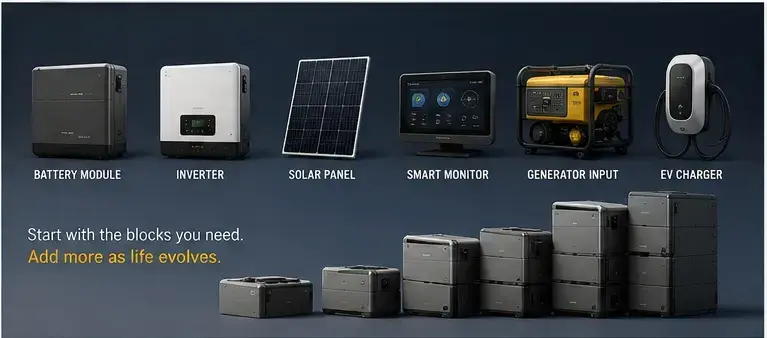
WHOLE-HOME
Build the system around your home.
A professionally designed and installed energy system brings generation, storage, distribution and backup together around the home’s energy requirements.
Best for: homeowners ready to build a coordinated whole-home system.
INTELLIGENT AUTOMATION
Make the system work smarter.
Add energy management and automation to coordinate generation, storage, loads, grid interaction and connected energy assets.
Best for: homeowners looking beyond backup toward a more connected energy ecosystem.
The whole-home energy ecosystem is not a single product.
It is an energy system that can evolve as your needs, assets and technology evolve.
That’s the whole-home energy ecosystem story.
Start your story
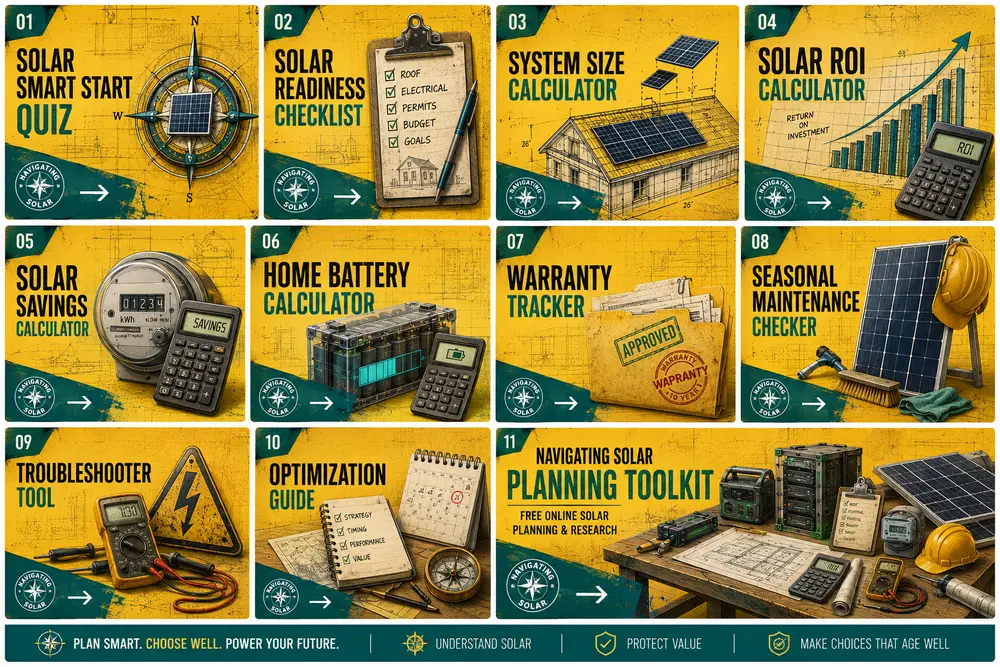
Need to understand your energy usage vs solar generation first?
Explore the NavigatingSolar Toolkit
Calculators · Planning Tools · Decision Guides · Resources

Decision Maps & Guides:
🟢🟡The Homeowner’s Solar Decisions Manual: Built on Choices
🟢🟡Which Type of Solar Consumer Are You?
🟢🟡Types of Solar-powered Systems
🟢🟡An Unbiased Comparison : Community Solar, Virtual Power Plants, and Solar Ownership
🟢🟡3 Alternative Solar Installation Solutions
🟢🟡Electric Vehicles and EV Chargers
Hardware Guides
3 Top Guides on Solar Equipment and more
🟢🟡Find them all here
Educational transparency.
NavigatingSolar is an Independent Educational Resource. We are not solar manufacturers or installers – we research them
Why these suggestions?
Navigating Solar doesn’t recommend companies simply because they offer affiliate programs. We believe readers should always understand why something is being recommended. We begin with the homeowner’s decision—not the product. We identify where people struggle to make informed choices, then evaluate products, services and partners that genuinely solve those problems.
Not every recommendation earns us a commission. Partnerships are selected to fit the educational framework—not forcing the educational framework to fit whatever affiliate programs happened to exist. If a company doesn’t fit the decision framework and ethos, we don’t include it—whether it has an affiliate program or not. If we believe a better solution exists, we’ll recommend it regardless of whether it generates a commission.
➡️ Our goal is to help you make the right decision—not the fastest purchase.