 Navigating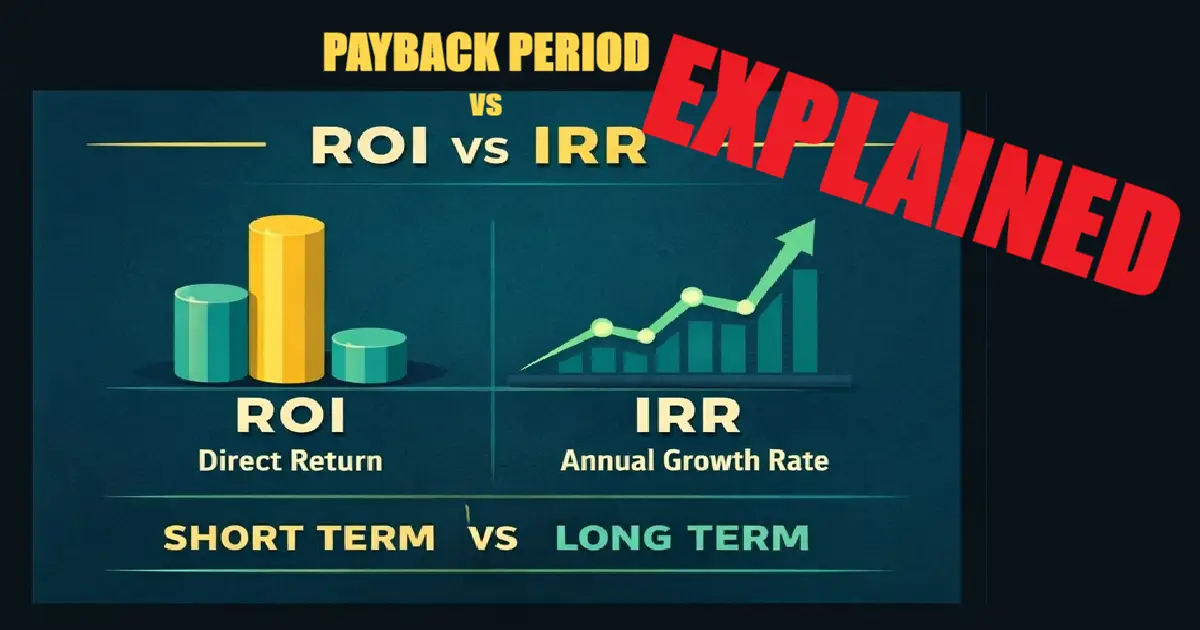
How You Measure Solar Investment Value
ROI, IRR… What Are These Things and Why Should You Care?
Because It’s How Your Solar Investment Really Works!
If you’ve ever wondered whether solar panels are truly worth the upfront cost, you’re not alone.
Most people look at a monthly electric bill and think, “Sure, I’ll save some money,” without realizing that solar is also a real, measurable investment — one that grows in value over time.
Most people see terms like ROI, payback period, and IRR when looking at solar and quietly skip past them.
Not because they’re stupid or uninterested — but because it feels like finance language that doesn’t connect to real life.
But here’s the problem:
These aren’t just technical terms. They are actually the difference between:
- guessing if solar is “worth it” and
- understanding what it actually does for your money over time
Understanding ROI and payback is part of the Initialization phase where homeowners evaluate long-term solar value.
In this guide, we’ll break down exactly how solar ROI, IRR, and payback work — in plain English.
By the end, you’ll understand why solar isn’t just about saving money on electricity; it’s a hands-on way to see your investment grow, all while powering your home every day.
And why it’s important for you to calculate your personal solar ROI.

Today’s Takeaway
If anything, timing and order matter with solar. So does preparation.
We’re here to help.
NavigatingSolar Toolkit
offers indepentent calculators and guides for you to work out your solar ROI, payback, and Annual Savings.
That’s the first and most important step
BEFORE you use a tool like this:
Quote Requesting Tool
Connect with Local US Installers trusted by homeowners nationwide — step-by-step, practical, and pressure-free.
Affiliate Disclaimer:
This link may connect you with solar providers through our partner network.
We may earn a commission if you choose to engage — at no extra cost to you.
Here’s why:
First: what people usually look at (and why it’s incomplete)
When people first explore solar, they usually ask:
- “How long until it pays itself off?”
- “How much do I save per month?”
- “Is it worth it?”
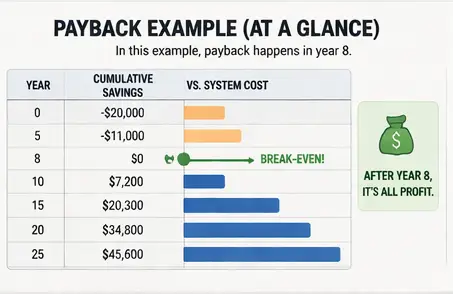
That’s where payback period comes in.
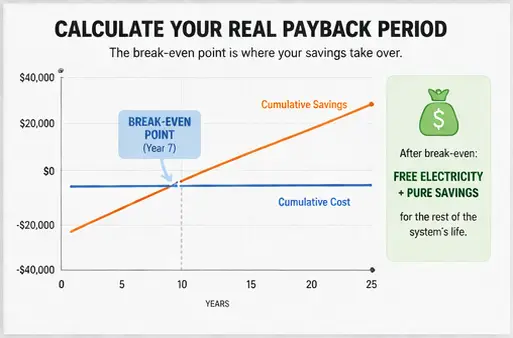
Payback Period: The break-even point and after
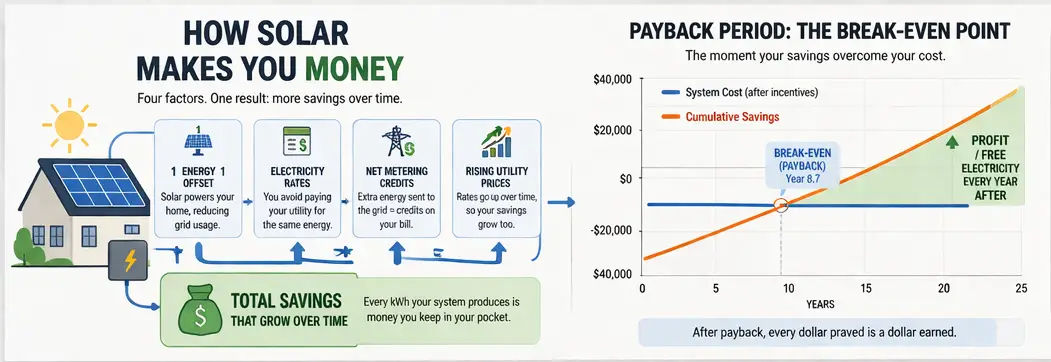
The payback period is simply how long it takes for your solar system to pay for itself through savings on your electric bill.
So if say, your system costs $10,000 and saves you $2,000 per year, your payback is about 5 years.
It feels clean. Simple. Easy.
But it’s also incomplete.
Because after that 5 years, the system doesn’t stop saving you money — it keeps going.
And that’s where ROI starts to matter more.
Example:
- Upfront cost: $20,000
- Incentives/credits: $5,000
- Net cost: $15,000
- Annual energy savings: $2,500
Payback = $15,000 ÷ $2,500 = 6 years
After year six, every kilowatt-hour your system produces is essentially “free energy.”
That’s when solar stops being an expense and starts being pure gain.
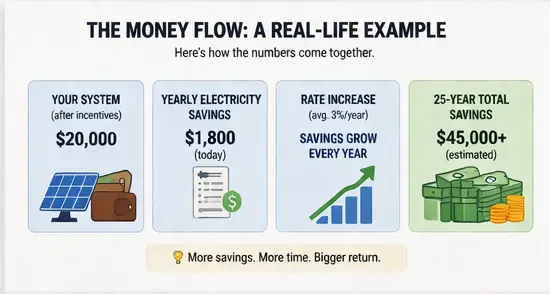
Understanding Solar ROI: What You’re Really Measuring
Cost vs Return vs Time
“What did I actually get back compared to what I put in?” This is what ROI, or Return on Investment, tells you.
For solar, it’s the total value of the energy your system produces over time compared to your upfront cost.
Example:
- System cost: $20,000
- Annual savings: $2,500
- ROI after 10 years = ($2,500 × 10) ÷ $20,000 = 125%
That means by year 10, you’ve earned back your original investment and 25% extra. ROI gives you a clear picture of your system’s total value — not just monthly savings.
In solar, ROI can look surprisingly high over time. You’ll sometimes see numbers like 200% or even 300% ROI.
That’s where most people pause and think:
“That can’t be right…”
But it actually comes from how solar works.
You’re not just “making profit” like an investment portfolio.
You’re:
- avoiding electricity bills
- over many years
- while those savings accumulate
So over time, the system doesn’t just pay itself off — it continues to generate value by reducing costs you would have paid anyway.
That’s why ROI can look large over long periods.
But even ROI has a blind spot.
Because it treats time too simply, and time is where things actually change.
ROI calculations become far more useful when they are based on your actual energy usage, incentives, tariff structure, and long-term consumption habits.
The Initialization tools can help you estimate your own system sizing, savings potential, and financial payback more realistically.
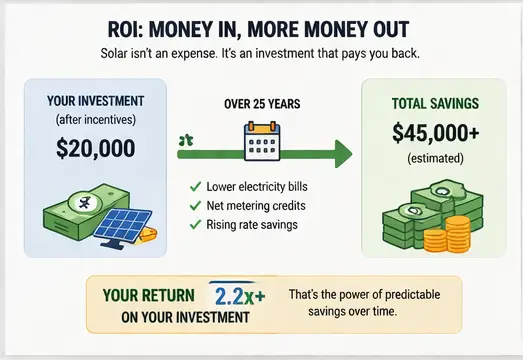
The part most people miss: time is doing more work than you think
Solar isn’t a flat, one-time return.
It evolves over time because:
- electricity prices change
- your usage changes
- seasons affect output
- systems behave differently year to year
So the “return” is not happening in a straight line. It’s happening over time, with compounding effects.
And that’s where the confusion usually comes from:
two systems with the same ROI can perform very differently in real life
Because ROI alone doesn’t fully capture when and how that value is delivered.
IRR: the point where clarity comes back
Cost vs Savings vs Changing Value vs Time
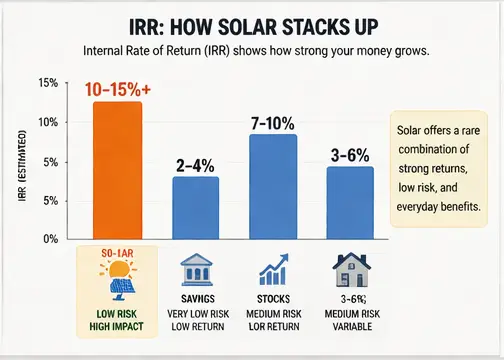
This is where IRR (Internal Rate of Return) comes in. The solar investment Efficiency Rate Internal Rate of Return (IRR) is a bit more advanced but easy to grasp: it measures how efficiently your money grows each year. Think of it like an interest rate for your solar investment.
Example: If your system costs $20,000 and your IRR is 12%, it’s like earning 12% per year on that $20,000 — with very little risk, since the “interest” comes in the form of energy savings.
You don’t need to love finance to understand this part.
IRR simply asks: “What is the average yearly return of this system over its entire lifetime, considering time?”
That’s it.
It takes all the messy parts:
- upfront cost
- yearly savings
- changing value over time
And turns it into one number that reflects reality more accurately over the long term.
This is why IRR is often used when people want a clearer comparison between options.
Because it answers a different question:
“If I think of this as a long-term decision, how does it actually perform year by year?”
And when you see it that way, a lot of the confusion around ROI starts to settle.
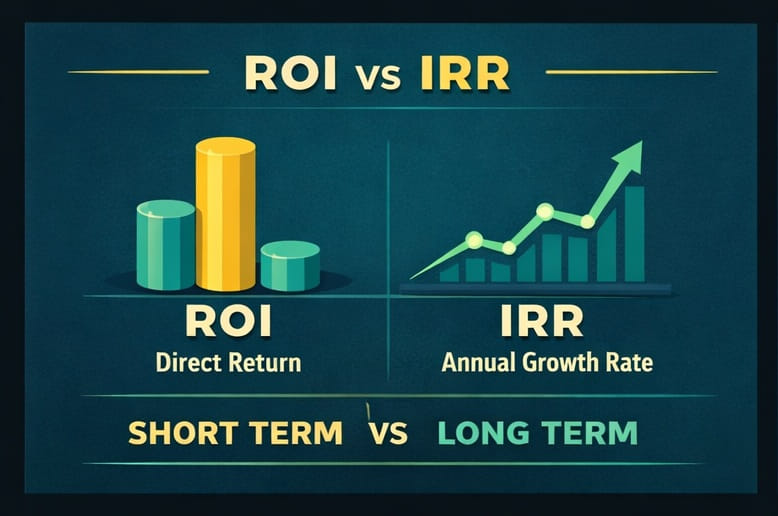
The difference between ROI and IRR: ROI shows total gain, while IRR shows annualized efficiency. Both are valuable — one tells you the big picture, the other shows how fast your system pays itself off relative to other investments.
So why do people talk about 200%–300% ROI?
This is where things get interesting. Those numbers usually come from this idea:
You are not earning money in the traditional sense. You are:
- replacing a bill you would have paid anyway
- over a long period of time
- with a system that keeps producing value
So over time, the “return” becomes larger than the initial investment. But it depends heavily on:
- how long you measure it
- how you use energy
- your system design
- local electricity pricing
That’s why two people can look at the same idea and see completely different results.
It’s not that one is wrong. It’s that the assumptions are different.
What this actually means in real life
When you strip away the jargon, here’s what all of this is really telling you:
- Payback tells you when you stop being “in the red”
- ROI tells you how much value you get overall
- IRR tells you how efficiently that value is delivered over time
But underneath all of it is something simpler:
Solar is not just a purchase — it’s a long-term shift in how exposed you are to rising energy costs.
And that’s where the real value sits.
Not just in numbers — but in control over time.
Why this matters more than it seems
Energy prices don’t stay still.
Usage patterns don’t stay still.
And systems don’t perform in a perfectly flat line either.
So the real question isn’t just:
“Is solar worth it?”
It’s:
“How much uncertainty do I remove from my future energy costs?”
That’s what these metrics are really trying to describe in different ways.
How Solar Savings Are Calculated
Solar ROI is influenced by far more than panel pricing alone.
Energy inflation, incentives, Time-of-Use rates, battery storage, and self-consumption behaviour all shape long-term value differently.
Understanding your potential savings comes down to a few key factors:
- Energy offset: How much of your home’s electricity the panels cover.
- Electricity rates: What you would have paid for the same energy.
- Net metering credits: Extra energy sent back to the grid can reduce your bills.
- Electricity inflation: Utility rates usually rise over time, which increases savings.
Even if your energy use varies, every kWh your system produces adds value. Small habits, like running appliances at optimal times, can slightly improve savings, but the system works whether your lifestyle is constant or changing.
But here’s the interesting part :
The Dual Solar Value
Daily Use + Long-Term Asset
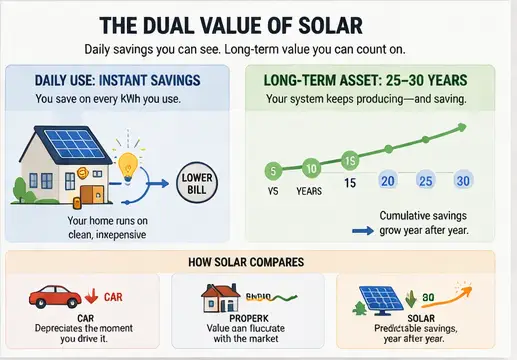
Solar is unique because it gives you immediate and long-term benefits:
- Daily use: You save on every kilowatt-hour consumed.
- Long-term value: Your panels produce energy for 25–30 years, effectively acting as an appreciating asset.
Compare this to a car (depreciates the moment you drive it) or property (value can fluctuate). Solar is predictable, and it produces something you use every day.
Mini Case Study: Jane installs a $20,000 solar system. After 8 years, her system is paid off, and she continues saving $2,500 per year. By year 20, that’s $30,000+ in real, tangible savings — all while powering her home.
Common Questions & Misconceptions
“What if I move?” Solar panels often increase property value and incentives can transfer with the home. Your investment doesn’t disappear.
“Will electricity prices drop?” Historically, utility rates rise over time. Solar protects you from inflation while providing predictable savings.
“Do panels degrade?” Yes, about 0.5% per year — but warranties cover 25–30 years, and the energy production remains strong.
“Are there hidden costs?” Maintenance is minimal. Occasional inverter replacement is the main cost, but net savings remain significant.
A Step-by-Step guide
“Can I calculate my savings accurately?”
Yes, but before comparing installer proposals, it helps to understand the financial logic behind system sizing, savings projections, and long-term return expectations.
The calculators below can help you model potential savings and estimate how different system choices may affect your overall return.
Using our independent System Size Cost Calculator, solar ROI calculator, Solar Savings Calculator you can input your energy use, location, and costs to get an estimated idea before approaching installers.
Click to Open your Step-by-Step Guide to NavigatingSolar in the US in 2026
Comparing Solar to Other Investments
| Investment | Expected IRR | Risk | Daily Use Benefit | Asset Longevity |
|---|---|---|---|---|
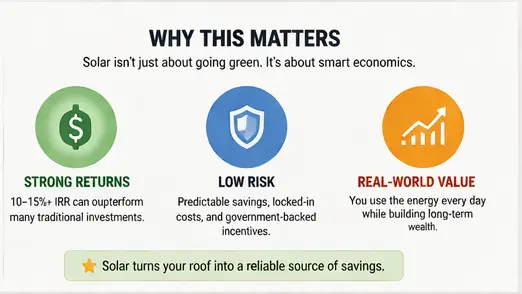
| Solar Panels | 10–15%+ | Low | High | 25–30 years |
| Savings Account | 2–4% | Very Low | None | Liquid |
| Stocks | 7–10% avg | Medium | None | Variable |
| Property | 3–6% | Medium | Only if lived in | Variable |
Solar stands out because it is predictable, dual-purpose, and low-risk. Unlike most investments, you use it daily and watch your “interest” in real time.
How Incentives & Rebates Boost Your ROI
Federal tax credits can reduce upfront costs by up to 30%. Local rebates and utility programs can cut even more.
Example:
- System cost: $20,000
- Federal tax credit: $6,000
- Local rebate: $1,500
- Net cost: $12,500
This dramatically shortens your payback period and boosts your ROI and IRR. Incentives are time-sensitive, so acting sooner maximizes your benefits.
Your Personal Solar ROI: Take Action
Now that you understand the math, you can see exactly what solar does for you. Focus on:
- Payback period
- Projected ROI
- IRR for your system
It’s the easiest way to see how solar transforms from expense to investment — all while powering your home every day.
Final thought
Solar isn’t just about saving money; it’s about making a smart investment that works for you daily and over decades. ROI, payback, IRR — they’re not there to confuse you —by understanding these 3 factors you can confidently evaluate solar’s real value.
They’re just different ways of describing the same thing:
How value builds over time when your energy costs stop being unpredictable.
Once that clicks, the whole solar decision becomes a lot less abstract — and a lot more practical.
Before you decide anything
Take a few minutes today to calculate your personal solar ROI — it could be the most rewarding investment you ever make.
If you’re trying to understand your own situation, don’t rely on generic numbers you see online.
They’re usually based on assumptions that don’t match your setup. The only way to make sense of it properly is to run your own numbers based on your usage and system design.
That’s where the real clarity comes in.
After you’ve decided
Visit our Resources page.
There you will find the last piece of the puzzle
- how to prepare to speak to installers,
- what to know and ask
- what to know about solar insurance and full system protection
When you are ready
Reach out to Solar Intsallers that are
- Verified Installers
- Local – they should know about incentives and best system design for your area
- Can help you plan for future expansion
Get multiple quotes
That’s where this tool comes in handy:
Quote Requesting Tool
Connect with Local US Installers trusted by homeowners nationwide — step-by-step, practical, and pressure-free.
Affiliate Disclaimer:
This link may connect you with solar providers through our partner network.
We may earn a commission if you choose to engage — at no extra cost to you.
Why Use This Tool?
Options vary by location.
You can start by seeing which providers are actually available in your area.✔️ Fast connection to available solar providers
✔️ Used by homeowners across the US
✔️ No obligation to move forward
✔️ Simple, guided process
✔️ Options based on your location
✔️ Explore your options at your own pace
Must Reads
➡️ Solar ROI Leverage : Strategy, Sequence and Timing
➡️ Solar Incentives by State in 2026
➡️ UNDERSTANDING INCENTIVES (Bonus Cheat Sheet)
➡️ 7 Solar Installation Mistakes to Avoid (Including Hidden Costs Most People Miss)
Credible Industry / Research
National Renewable Energy Laboratory (NREL)
– Solar research & ROI analysis
https://www.nrel.gov/
SEIA – Solar Energy Industries Association
→ Market growth, trends, policy
https://www.seia.org/
Lawrence Berkeley National Lab – Utility Rate Database
→ Helpful for real TOU examples when discussing solar ROI timing.
https://emp.lbl.gov/utility-rate-database