 Navigating
Fear Counts The Cost – Understanding Counts The Return.
With Solar The Price Is Easy To See, The Value Isn’t.
Fear of Investment isn’t fear of solar. It’s fear of making an expensive decision you don’t yet understand.
For many homeowners, the hardest part about going solar is not understanding the technology. It is understanding the price.
The moment people start researching solar, they often experience what could be called FOI — Fear Of Investment.
Why? Well, the numbers suddenly become real:
- panels
- batteries
- installation
- permits
- financing
- electrical upgrades
and the upfront cost can feel intimidating.
That reaction is normal, because we are used to thinking about electricity as a monthly bill — small payment amounts at an expected time. We don’t perceive our connection to electricity as a packaged one-time payment with hardware to interact with, and most of the time, even less as a long-term system to own and control.
But solar changes the structure of that relationship.
And that is where the conversation shifts from fear to understanding. That begins with understanding whar Solar ROI truly means.
ROI in solar is not one thing
Most content collapses ROI into Financial Terms:
- payback period
- savings
- incentives
- cost
but
financial ROI becomes a subset of system ROI, not the headline
In reality, solar ROI splits into distinct value types that behave differently depending on system design and user profile.
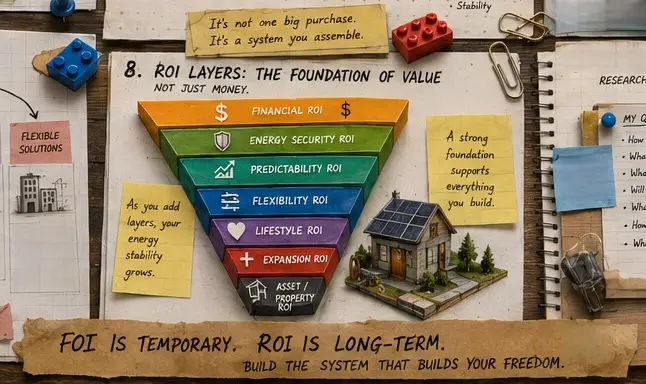
So instead of one ROI, you get ROI layers.
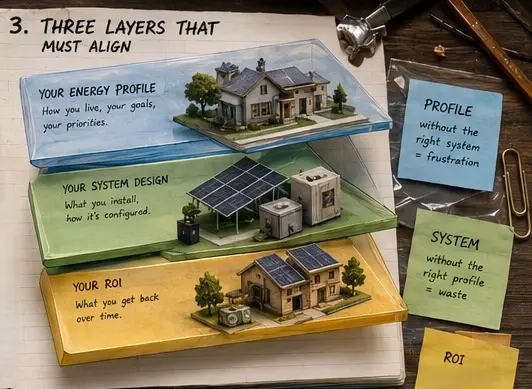
🧩 Energy Profiles, Systems Types, and ROI Are Different Layers
Energy decisions often look like they are about equipment.
But they are actually built from three separate layers:
Your energy profile describes how you live.
Your system design describes what you install.
Your ROI describes what you actually get back from it.
When these three align, solar feels predictable and intentional.
When they don’t, even good systems can feel inefficient or expensive.
⚙️ The Different ROI in Solar
Solar ROI is not limited to savings on electricity bills. It actually shows up in several different ways depending on how the system is designed and how it is used.
The most direct is financial ROI, which comes from reduced utility costs, incentives, and long-term savings over time.
But there are other returns that matter just as much in real-world use.
1. 💰 Financial ROI (classic version)
This is the one everyone talks about. This ROI is most variable as it heavily depends on your location and utility.
It includes:
- reduced electricity bills
- net metering credits
- incentives / tax rebates
- payback period
- long-term savings
Key trait: → measurable in money, but often oversimplified. Arbitrage features as one of the main savings mechanisms.
2. 🛡 Energy Security ROI
This is where things start separating from finance a little. Paying for peace of mind or security… how do you put a universal price tag to things like that?
This ROI is:
- reduced exposure to outages
- backup during grid failure
- ability to maintain essential loads
- independence from utility instability
Key trait: → value shows up during disruption, not monthly bills
This is where battery systems change the ROI structure completely.
3. 📈 Predictability ROI
This is subtle but huge.
Solar creates:
- stable portion of energy cost
- reduced sensitivity to price hikes
- partial “locking in” of energy rates
Key trait: → ROI is not savings, but reduced uncertainty
This is often the real driver behind suburban adoption, even if they don’t say it.
4. ⚡ Flexibility ROI (system behavior ROI)
Here lifestyle needs and system types play a big role.
It includes:
- ability to shift between energy sources
- charging options (solar / grid / vehicle / generator)
- adaptability to different usage scenarios
- system responsiveness
Key trait: → ROI is how easily the system adapts to life changes
This is system architecture ROI, not financial ROI.
5. 🧠 Lifestyle ROI
This is often ignored in technical writing.
It includes:
- less mental load about electricity usage
- reduced “energy anxiety”
- feeling of control over consumption
- freedom from watching utility bills closely
- disaster preparedness
- availability of backup power
Key trait: → ROI is psychological, not technical
This is especially strong in:
- RV users
- off-grid builders
- outage-prone suburban homes.
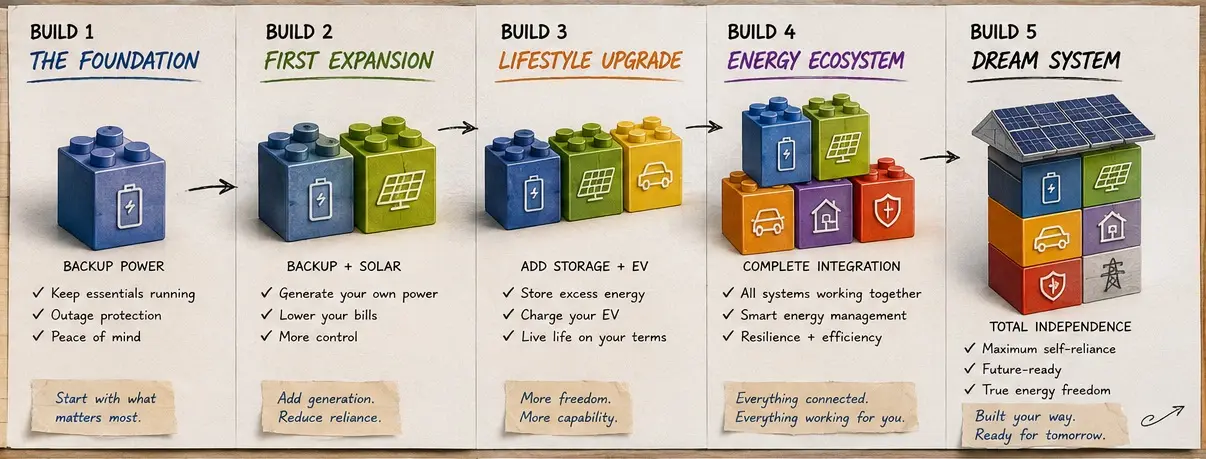
6. Expansion ROI (modular ROI — the building block concept)
This has become a popular option, driven by demand. Introducing solar into a home ecosystem in a modular way, is not only a battery backup solution, but has become an option for small budgets to also partake in the renewable energy movement.
It allows you :
- the ability to start small – maybe with backup power
- the ability to scale later – a way to recharge with solar panels, or add more battery storage
- future expansion – home climate control, EV charging, growing family
- enter the renewable market in a staged investment approach
Key trait: → ROI is future optionality, not current output
This is where “solar as a system you assemble” becomes structurally important.
7. 🏠 Asset / Property ROI
Not just resale value—broader than that.
It includes:
- perceived home value increase
- buyer attractiveness
- reduced operating cost profile of property
- energy independence as a property feature
Key trait: → ROI is embedded in the asset, not the utility bill. Keep in mind, here location is a huge factor.
Solar Is Not Just a Purchase — It Is a Long-Term Energy Decision
Understanding Solar ROI in Practical Terms
One of the biggest misconceptions around solar is the idea that people are simply “buying panels.” In reality, most homeowners are making a longer-term decision about an energy system that can evolve over time.
This is where things start to shift into a more modern way of thinking:
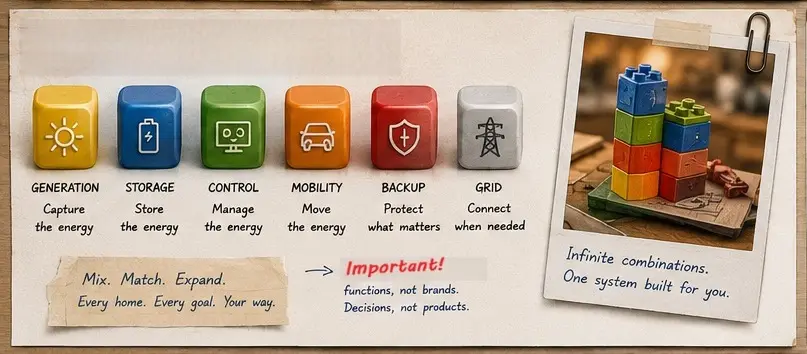
Instead of one large purchase, solar behaves more like a set of building blocks:
- generation (panels)
- storage (batteries)
- control (inverters / management systems)
- optional backup layers
Each part can be introduced at different stages depending on budget, urgency, and goals.
This is also why no two solar setups are identical, even in similar homes. For some households, it starts with bill reduction. For others, it starts with backup resilience. And for many, it evolves gradually as energy needs change.
 In reality, rather than one single driving factor, most homeowners are making a longer-term decision due to a combination of :
- energy costs
- grid dependence
- future utility pricing
- backup resilience
- and household operating expenses
When it comes to the ROI of solar or any renewable energy, it’s valid to take into consideration that Return on Investment often shows up , not only as money and savings, but as an emotional or psychological dimension to investment.
Those are much harder to evaluate, cost and price. ROI here is a very personal thing…
ROI in solar is not a fixed number It’s a relationship between your usage pattern and your local energy cost structure.
This is why solar should never be viewed through blanket promises or “one-size-fits-all” savings claims.
The numbers only make sense when viewed in the context of your own situation. The exact outcome varies depending on:
- location
- utility rates
- energy usage
- financing method
- system size
- and local incentives
The Payback Period: When Savings Catch Up to Cost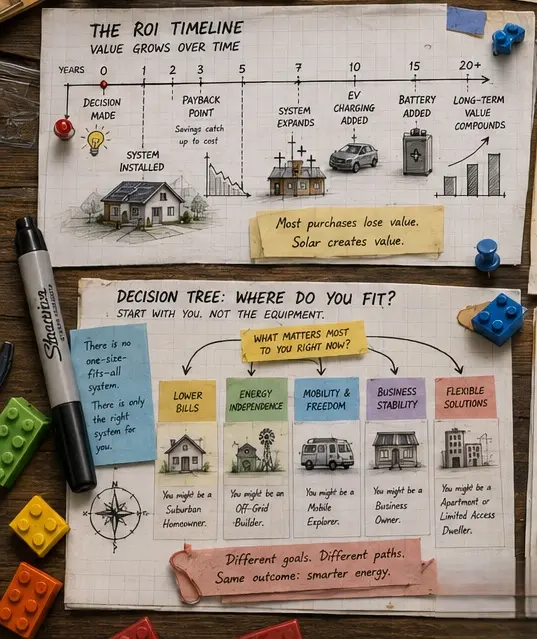
One of the simplest ways to understand solar financially is through the payback period.
This refers to the amount of time it takes for accumulated energy savings to equal the net cost of the solar system.
Simply put:
- System Cost → what you paid for the system
- Energy Savings → what you no longer spend on electricity
- Payback Period → when those savings eventually offset the upfront investment
For many residential systems in the United States, estimated payback periods often fall somewhere between 6 and 12 years depending on:
- local electricity prices
- available incentives
- financing structure
- and system performance
Location is one part of how some households recover costs faster, and others take longer.
But this is where most people oversimplify the idea. The important point is not chasing the best incentives or shortest possible payback period. It is understanding how the system performs over its operational lifetime.
Solar creates stability in an unstable energy market
At a deeper level, solar is rarely just a financial optimization tool.
Savings get people interested. Stability keeps them in the system.
For many homeowners, the real value of solar is not chasing maximum financial returns.
Generating your own power is not just cost reduction, but cost predictability long-term household expenses.
Electricity prices, grid structures, and energy policies continue changing over time.
Solar helps some households offset part of that uncertainty by producing a portion of their own energy.
Payback period is useful, but it only describes one type of return. It measures when the system pays for itself financially. Renewable energy offers you a type of ROI that sale brochures often abuse, and the math of costs don’t take into consideration. It does not account for:
- eliminating discomfort, and extra costs like food spoilage during outages
- reduced exposure to rising energy prices that you do not dictate or control
- changes in how energy is used day to day
- or how the system can evolve over time as a family needs or affords more
This is where most solar comparisons become misleading.
So the real question is not only “when does it pay back?”
It is also:
what kind of value is this system delivering while it is doing it?
Understanding Solar as a Long-Term Household Asset
Unlike many household expenses, solar systems continue producing value after installation through ongoing energy generation.
When Systems Start Working for You
One of the alluring thing about a solar investment is the fact that solar systems don’t stop working after payback. They continue producing energy beyond that point.
Which means the real question isn’t:
“How fast do I break even?”
It becomes:
“How long does this system continue reducing my exposure to rising energy costs after it has already paid for itself?”
For many households, that second phase is where the real value sits.
That does not automatically make every system financially perfect. But it does mean solar behaves differently from short-term consumer purchases.
For example:
- kitchen renovations may improve aesthetics
- vehicles typically depreciate over time
- appliances eventually require replacement without generating savings
Solar systems, by contrast, are designed to continue offsetting part of a household’s electricity usage over longer periods.
For some homeowners, this creates a stronger sense of energy control and predictability. Especially in regions with:
- high utility rates
- unstable grid conditions
- or long-term electricity inflation concerns
The biggest mistake in solar is assuming the system you install is the system you will live with.
Most systems evolve, they are not installed
The “final system” is not always the system people start with.
Unlike most other investments, solar systems are not static. They behave more like an evolving asset system.
This is where the modular building block concept becomes important.
A system can grow in stages:
- start with panels only
- add batteries later
- upgrade inverters
- integrate backup or EV charging
- expand generation or storage as needs change
Each stage builds on the last.

➡️ Curious how these different grid-tied systems are actually put together?
Seeing how different manufacturers build grid-tied, hybrid and modular solar systems makes it much easier to understand the architecture behind installer quotes.
So before talking to installers, spend a little time exploring what’s available on the market.
Looking at complete systems types, individual components and different brand compatibility make it much easier to understand the recommendations you’ll receive later.Understand how each system links to your home and utility, before settling on product choice.
Explore what these systems look like, how they work and what the modules are for each.For excellent diagrams, product layouts and system illustrations, making it one of the easiest places to visualize how different solar systems are assembled before making decisions.
Here’s a visual aid:
Steps: Follow the link below – Choose a system (hybrid, grid-tied or off-grid) – Choose a size (essentials:3-5kW to whole-home: 10kw+) – Hover over the product image and see how it transforms into a home energy system.
Solar Investments, Home Value and Buyer Perception
Solar systems can sometimes improve home appeal by reducing expected operating costs for future buyers particularly where energy costs are high or grid reliability is unstable. Rather than treating solar as a guaranteed property value increase, it is more realistic to view it as one factor that may influence buyer perception, monthly expenses, and long-term energy expectations.
Because, the impact on resale value varies depending on:
- system ownership structure
- local utility rates
- regional demand
- financing agreements
- system age
- and installation quality
Owned systems are generally viewed more favorably than leased systems, because they represent reduced ongoing energy costs for the next homeowner.
However, solar should not be treated as a guaranteed value multiplier.
It is better understood as a cost-shaping feature of the property, rather than a fixed investment return.
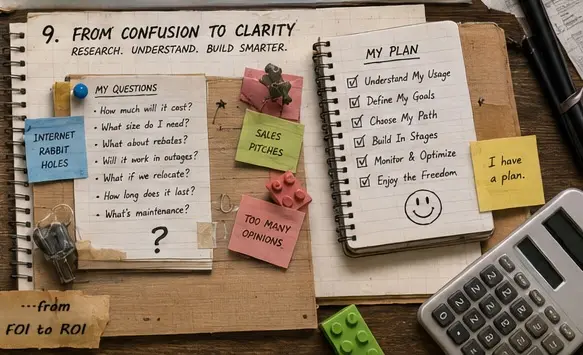
From Fear Of Investment to Informed Decisions
The fear people feel at the beginning usually fades once they understand three things:
- solar is a system, not a product
- systems can be built in stages
- ROI depends on personal energy patterns, not averages
At some point, every homeowner stops asking “is solar expensive?” and starts asking “what version of the system do I actually want to build?”
This is where Fear Of Investment turns to understanding of Return On Investment.
Not because the numbers change. But because the structure of the decision becomes understandable.
Solar is not about perfect timing or perfect systems. It is about building a system that gradually reduces uncertainty in your energy life.
The fear surrounding solar usually becomes smaller once people understand:
- what systems actually do
- how savings work
- what limitations exist
- how solar fits into broader household energy planning
- understanding trade-offs, priorities, and long-term goals.
That is where FOI turns into informed decision-making and better ROI.
Continue Exploring Your Solar Journey
Understanding FOI vs ROI is only one layer of the decision.
The next step is understanding how your system actually takes shape over time:
- how much energy you actually use
- what parts of the system to build first
- how storage and generation interact
- and how your energy profile evolves
The NavigatingSolar framework helps map those decisions into a clearer structure, so systems are built intentionally rather than all at once.
➡️ Visit our official website to unlock your free toolkit of independent solar calculators, step-by-step guides and resources.
- ➡️ Discover Which Solar System Fits Your Energy Profile ➡️ Understanding Home Battery Storage
➡️ Estimate Your System Size & Cost (calculator)
Not every solar journey begins with a rooftop installation. Portable power stations and modular battery systems can be practical ways to experience energy storage, understand your own usage, and build confidence before committing to a larger system. Some think: “I need an installer.” Others think: “I want to experiment first.”
➡️ Compare Solar Installation Quotes
➡️Visit & Compare Systems at a Solar Energy Marketplace
You do not need to figure everything out at once.
You simply need a structured place to begin.
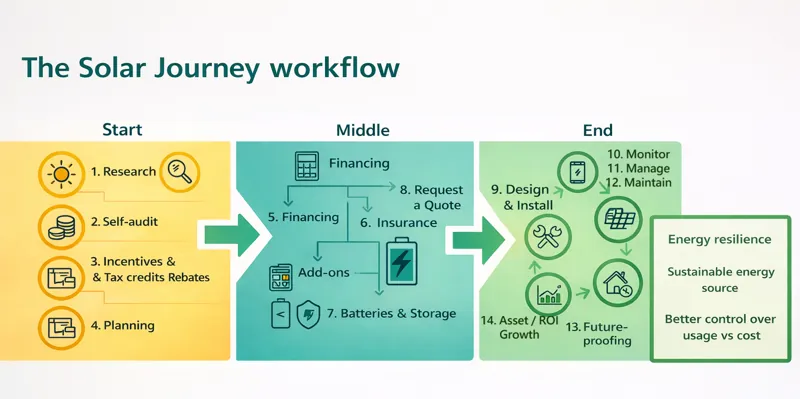
Map your journey with a workflow.
Recommended Further Reading:
Solar ROI, IRR & Payback Explained
Solar Incentives by State in 2026
US Solar Tax Credits : 2026 Updated Facts
Solar ROI Leverage : Strategy, Sequence and Timing
Official Sites to Explore
1. U.S. Department of Energy — Energy Saver Program
2. Internal Revenue Service — Energy Efficiency Credits
3.National Renewable Energy Laboratory