 Navigating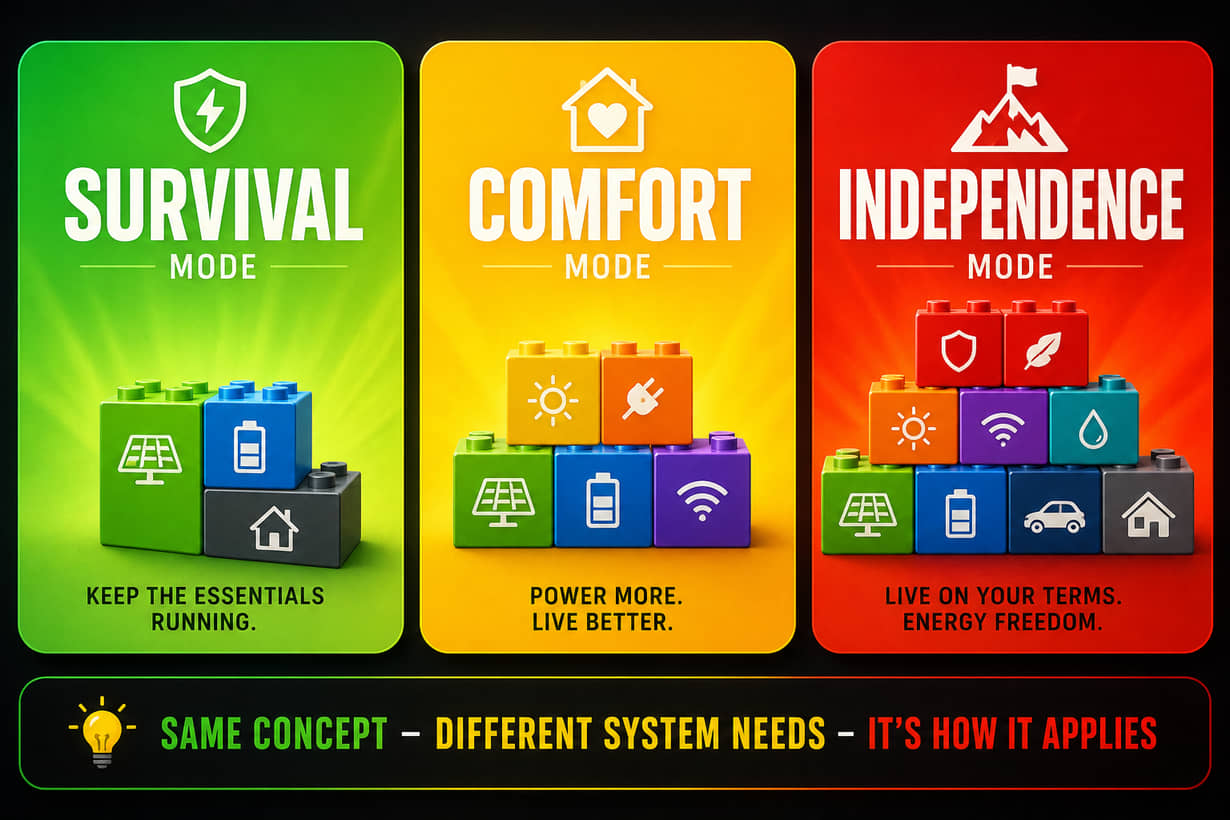
Summary
This article explains how solar batteries work beyond storage covering system protection sizing decisions and long term value to help homeowners plan smarter energy systems.
The Difference Isn’t Capacity. It’s Possibility.
Because Humans Have Battery Modes Too
A $900 solar battery backup power kit can be a complete waste of money.
A $15,000 battery system can be one of the smartest investments you ever make.
The difference isn’t the battery. It’s the issues people face.
People don’t buy batteries.
Nobody actually wants a battery.
They want solutions to problems
They buy…
- certainty
- control
- convenience
- resilience
- fewer arguments during outages
- home security
- food security
The battery is almost incidental.
Once you realize that, battery shopping starts making a lot more sense.
Why battery value is so hard to judge
The real confusion comes from a simple mistake:
People compare price vs product instead of cost vs lifestyle outcome.
A battery is expensive if you only look at the upfront cost.
But that number doesn’t tell you what it actually does inside your home – what returns it offers to justify the cost.
It normally starts off with one of the most misleading parts of battery systems: its physical size.
From photos and marketing, many systems look similar — a compact box on a wall or a neat portable unit. But in reality, they can represent very different levels of capability.
You’ll generally see three physical forms:
A full installation becomes a wall-mounted energy cabinet system with a collection of panels.
A mid-range system looks like one or two stacked bar fridges, possibly another 2 small wall boxes and maybe panels.
Small portable units are the most confusing! One is smaller than Wife’s vanity case, but can power the fridge and essentials, another is about the same size as her vanity box but this one only allows 1 person a day of work on the laptop alone…
This is why judging by appearance and price tags lead to bad decisions.
You are not choosing a box, but what’s inside it and what it can do.
You are choosing what parts of your home it can keep running at one time.
And only 3 numbers stand between you, the sales guy and your ideal size battery system.
What the Watts?!?!
Batteries tend to be the same “category” in conversation, but you quickly learn size matters.
Things get tricky when you are left to choose a battery system with only 3 little numbers, a bunch of sales pitches and price tags to inform you about the different real-world outputs.
So, Ignore the marketing for five minutes. Ignore the glossy photos. Ignore the guy telling you his battery changed his life.
Look at three numbers:
W (Watts) = How much power an appliance draws
kW (Kilowatts) = Output (kW) – What can it run at the same time?
kWh (Kilowatt-hours) = Capacity (kWh) – How long will it last? How much energy is available before the battery is empty?*
If a homeowner understands those three numbers, they can ignore about 80% of the marketing fluff.
W = Watts (right now)
Watts tell you how much power something is using at this exact moment.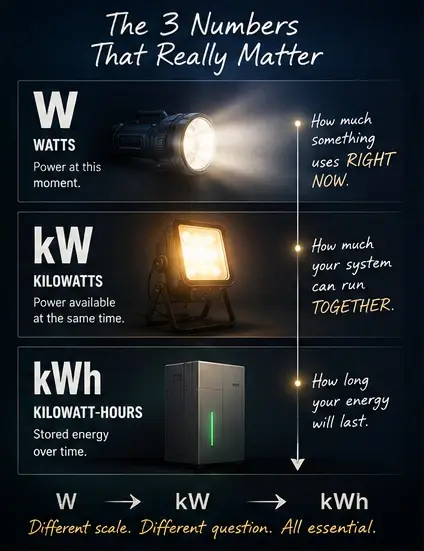
It’s an instantaneous measurement, when you see:
- LED light = 10 W
- Laptop = 65 W
- Microwave = 1,200 W
- Hair dryer = 1,800 W
kW = Kilowatts (lots of watts)
A kilowatt is simply:
kW = 1,000 W
This number answers
How much can I run at one time?
Example:
A 5 kW inverter or battery can deliver up to 5,000 watts at once. So:
- kettle (2,000 W)
- microwave (1,200 W)
- TV (200 W)
- lights (300 W)
= 3,700 W
No problem. Turn on the oven as well…
Now you’re pushing the limit.
kWh = Kilowatt-hours (stored energy)
This is the one that confuses everyone.
A kWh is not power. It’s how much energy is stored or used over time.
Example:
A battery rated at 10 kWh stores roughly 10 kilowatts worth of energy for one hour.
Or:
- 5 kW for 2 hours
- 2 kW for 5 hours
- 1 kW for 10 hours
Same stored energy – different plans/uses for it.
And if you are really stuck working out What is Watt, here is a helpful resource:
➡️ Solar and Electrical Calculators
Batteries do three jobs – You pay once
Most homeowners think of batteries as backup power. Maybe storage at best.
But in reality, a battery influences your system in several different ways at once—some obvious, some almost invisible until you’ve lived with it.
Batteries don’t just store energy. They:
stabilize your whole ecosystem
protect individual components
and quietly improve long-term value
And understanding that is what separates: a system that “works” from one that actually delivers what you expected.
1. Energy storage (what most people think they’re buying)
This is the obvious one.
A battery stores excess solar energy so you can use it later when the sun isn’t shining. That typically means evening and night usage, and it also covers you during outages or grid interruptions.
So yes, it provides backup power. It reduces reliance on the grid. It increases self-consumption.
But here’s the important part: storage only creates real value when it solves a specific problem in your home.
It is not automatically beneficial just because it exists in the system.
For some homes, storage is mainly about keeping essentials running during outages.
It is a way of shaping how your home behaves when energy is available — and when it isn’t.
And then the real question is not: “How big should my battery be?”
It is: “What level of disruption am I willing to accept when the power goes out?”
For others, TOU Arbitrage is the game, and it’s about shifting usage into cheaper solar hours and reducing expensive evening electricity consumption through Time-of-Use optimization.
And the question then shifts again to: “What size benefits the system strategy?”
In other words, a battery is not a product choice. It’s a system behavior choice.
This is why battery sizing and intention matter more than the battery itself.
Without clarity on usage patterns, storage becomes guesswork rather than strategy, and batteries become unnecessary extra expenses.
That’s where tools like a Battery Capacity Calculator become useful, because they translate lifestyle into actual system size instead of assumptions.
2. Overall Power System Stabilization and Protection
This is the role most people only notice indirectly, and the part nobody explains properly. It’s the part that goes unseen, but is especially important for solar owners and DIYers to consider
A solar system is not perfectly smooth. Production fluctuates constantly—cloud cover, appliance spikes, voltage dips, and shifting loads all create instability.
In systems designed to use battery storage, the battery can absorb short-term changes in production and demand, allowing energy flow to become smoother and reducing how often the inverter has to react to rapid changes. The system becomes more buffered and controlled. The result is not just convenience—it’s technical protection.
Fewer sudden shutdowns. Less stress on components. More stable operation across the entire system.
In many setups, this stability is one of the most underrated benefits of adding battery storage, especially when paired with sensitive electronics or inconsistent grid supply.
3. Long-term value optimizations
This is where the battery stops being a “device” and becomes part of a financial system.
Over time, batteries allow you to shift more of your solar production into actual usable consumption instead of exporting or wasting it.
That means more of your own energy is being used directly in your home.
It doesn’t feel dramatic day-to-day. But over months and years, it changes the economics of your system.
You see it in accumulated bills that shrunk. You feel it after payback even more.
You notice you buy less electricity during peak pricing periods.
You waste less excess generation. You increase the proportion of self-used solar energy.
You worry less about outages, loss and demand – the emotional and psychological ROI layers of battery investments.
So while a battery doesn’t instantly “save money,” it gradually improves how efficiently your entire system operates financially over its lifetime.
Power your Lifestyle: The 3 battery modes for humans
Instead of thinking in technical specs first, it helps to think in real-world usage: how watts apply to what, who and why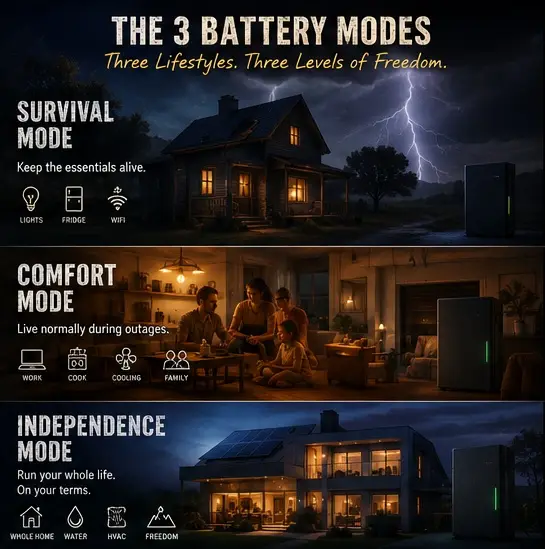
Every battery system falls into one of three practical modes, because most battery decisions come from three motivations:
Security — keeping power during outages
Savings — reducing electricity bills
Independence — reducing reliance on the grid
Almost every homeowner fits into one or a mix of these.
But these motivations don’t describe systems.
They describe expectations. These expectations normally come from a usage pattern, that leads to one of 3 system modes and designs
🔋 Survival Mode
This is the essential backup setup – the “keep the house from falling apart” setup when the grid goes down.
This is the lowest-cost entry point into battery storage. But the key trade-off is simple: You are not buying comfort. You are buying continuity.
What actually matters in this mode:
- fridge stays on so food doesn’t spoil
- lights stay on so the house is usable at night
- WiFi stays on so communication and basic security systems still work
That’s it. Nothing extra. Just stability.
What it does NOT cover:
- everyone charging devices freely
- entertainment systems running normally
- multiple appliances running at the same time
This is not about living normally during an outage. If you want that level of comfort, you are already moving into the next tier.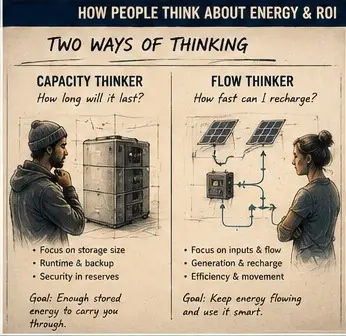
🔋 Comfort Mode
This is where most households end up. Now the goal shifts from survival to normal life continuity.
You are no longer just protecting food and light. You are trying to keep life moving without interruption.
That means:
- essentials still covered (fridge, lights, WiFi)
- plus selective appliances depending on load
- people can still function, work, and stay comfortable during outages
So instead of “just getting through it,” the house still feels usable.
This is often the best balance between cost and real-world usability. This is where most people actually land once they experience outages a few times.
But there is still a limit.
You are choosing what runs at the same time.
So you might be able to cook or run a pump or use an aircon — but not everything together without planning.
This is where real trade-offs start showing up.
Comfort Mode is where people start realizing: “Okay, battery backup is actually changing how I live, not just keeping lights on.”
Mostly because at this stage, you are conscious of it – you have to plan around the awareness of when to run what – this tends to lead to huge family discussions…
If you recharge on solar, then you might even see the savings becoming more.
🔋 Independence Mode
When people start looking at solar batteries, the conversation usually starts simple and leads to:
“Can I go fully off-grid?”
“Will this make me energy independent?”
“Do I still need the grid?”
I think “energy independence” is the wrong phrase because it’s become marketing jargon.
The solar industry loves talking about energy independence.
As if there’s a finish line where one day you unplug from the grid forever and never think about electricity again.
But here is the trade-off most people underestimate: You are not just paying for backup.
You are paying to remove restrictions from how your home operates.
And that is why this mode gets expensive quickly.
To understand whether “full independence” is realistic —or even necessary—you first need to deeply understand what the battery is actually doing inside your system.
Independence Mode is where the system starts behaving like a self-contained home energy ecosystem.
Now you are not thinking in “what survives an outage.”
You are thinking in “what does my home normally operate like, regardless of the grid.”
So you can support:
- heavy appliances like cooking systems
- water pumps or pressure systems if needed
- air conditioning or high-draw loads
- full household operation with multiple systems running at once
But once you move past the surface, the answer looks less like independence is a switch you flip — and more about how your system behaves over time, without any external support or backup – no safety-net.
Because you are no longer limiting usage.
You are enabling it.
Energy Independence: Where Whole-home Design Decisions Differ, Again
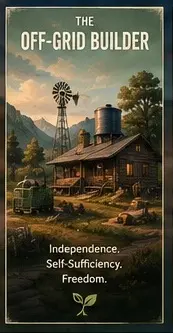 “Grid goes out, power stays on” only speaks to one of type of energy consumer
Imagine 2 systems: 1 system powering a home in suburbia.…
…and another system powering a home off-grid:
- RV owners: older retired couple, smaller living space, less physical power to lug big systems, traveling around the country after Summer.
- … or cabin owner.
- …or someone worried about disaster prep, hurricanes or wildfire shutoffs.
- or a family completely reliant on solar power and batteries for water pumps, heating water, cooking, cleaning, washing, security, food storage and the rest a family requires in the modern life..
The realization: Energy independence is not a binary state. It’s a spectrum.
A fully designed off-grid setup can approach self-sufficiency—but even then, it depends on weather, consumption habits, and system design.
The real shift is not independence itself. It’s control. The ability to decide what stays on when conditions change.
The picture changes – often from one huge single system to smaller separate systems.
Energy gets allocated jobs, for instance water pumps run a separate system to the main house’s power supply. Not always more expensive, but more effective regarding resource management.
And that changes the question entirely. Instead of asking: “Can I disconnect from the grid?”
The better question is: “What do I want my system to run, and how do I run it when there is no grid?”
That single shift in thinking is usually what determines whether a system feels disappointing—or exactly what was expected.
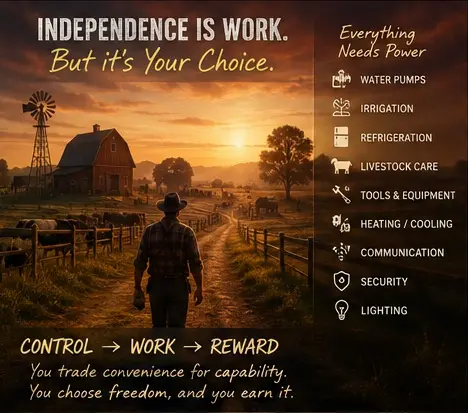
So how close can you get to true energy independence?
For most homeowners, that’s neither realistic nor necessary. A better question is:
How dependent do you want to be?
Some people simply want enough backup to ride out the occasional outage or prep against disaster.
Some lower utility bills, focus on TOU arbitrage and long-term ROI.
Some are building toward mobility and travel.
Others want to support a family off-grid, protect a well pump, keep crops and livestock watered, and all needs are taken care of around the clock.
They’re all using batteries. They’re just solving different problems, serving different needs.
That’s why there isn’t a single “right” battery system. And why physical size of a little black box can be misleading.
The best system is the one that solves the problems you actually have—not the ones lifestyle marketing creates.
Whatever your goal is, the path usually starts the same way:
Understand what matters most when the power isn’t there.
Then build your system around that.
For real-world examples and comparisons follow the link below, choose a system, hover over the product image and it’ll show you the full diagram of components, size and price.
➡️ Compare system types, sizes and battery solutions to match
Modular systems vs Energy Ecosystems
So, back to building value.
Once you understand that a battery is doing three jobs at the same time, and which mode you are operating in, something else becomes clearer.
…Not all systems are built the same way.
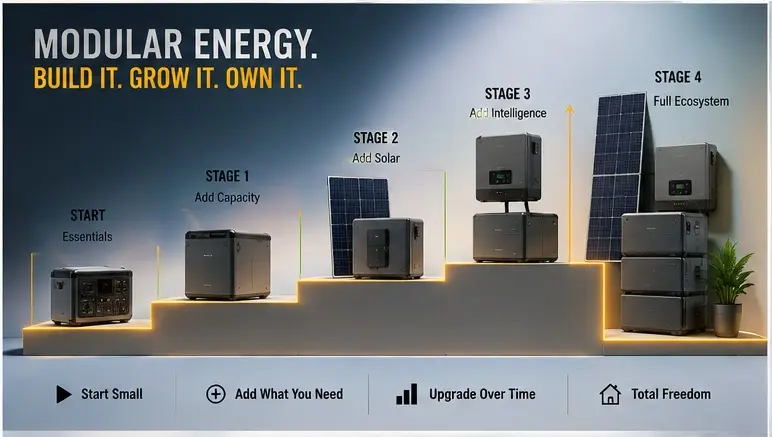
Some setups are designed to be added onto in stages.
Others are designed to behave like a complete system from day one like more often in the case of traditional rooftop solar installations
This is where two ideas start to matter:
Modular systems = staged independence One of the biggest mistakes people make is believing they have to build their forever system on day one. Most don’t.
They build the system that solves today’s problem, then expand it as understanding, budgets, technology, and priorities change.
That’s one of the biggest advantages of modular energy ecosystems. You start small, then expand as your needs grow. One battery, then another. More panels later. It’s flexible, and it matches budget reality for most people.
Whole-home energy ecosystems = integrated energy behavior
Here everything is designed to work together from the beginning.
Battery, inverter, solar production, and load management all behave like one coordinated system instead of separate parts.
Examples include:
Traditional EPC or turnkey rooftop installs,
Alternative solar panel mounting solutions with battery storage,
Portable Power Stations for whole-home energy storage systems
Smart Energy Management Ecosystems where automation enters the conversation
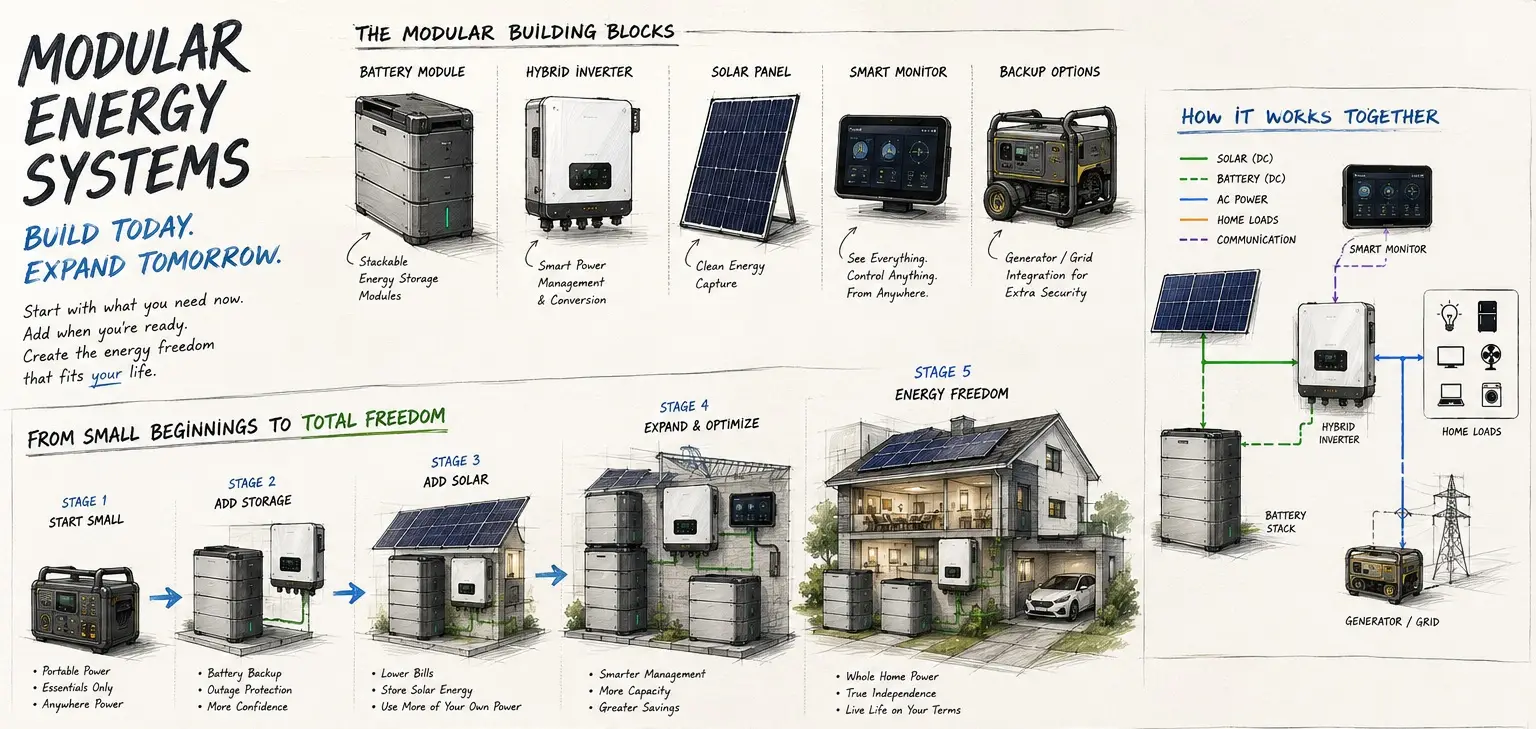
Most homeowners don’t arrive at a complete energy ecosystem on day one. The journey usually starts much smaller.
A few outages become one outage too many. Electricity prices climb.
Backup power becomes a practical need rather than a luxury.
So the first purchase is often a battery or portable power station because it solves an immediate problem without the cost and complexity of a full solar installation.
Then something interesting happens.
Once people own storage, the next question is rarely about having backup anymore.
It becomes: “How do I recharge it more cheaply?”
That’s where solar panels, system expansion and long-term energy planning begin entering the conversation.
Some homeowners continue building piece by piece as their budgets and needs evolve.
Others eventually decide an integrated, fully automated system makes more sense for simplicity, installation, monitoring, and support.
Both paths solve the same problem—they simply start from different places and grow in different ways.
Most Importantly, the difference isn’t just technical. It changes how you experience the system over time.
A modular setup feels like upgrading. Maybe controlled building.
An ecosystem setup feels like the house already knows how to manage energy.
Neither is “better” in general. They just reflect different ways of approaching control, cost, and growth – at different stages of life or for different lifestyle needs.
And once you see these distinctions, the decision shifts from size alone to your personal choice in system type and design.
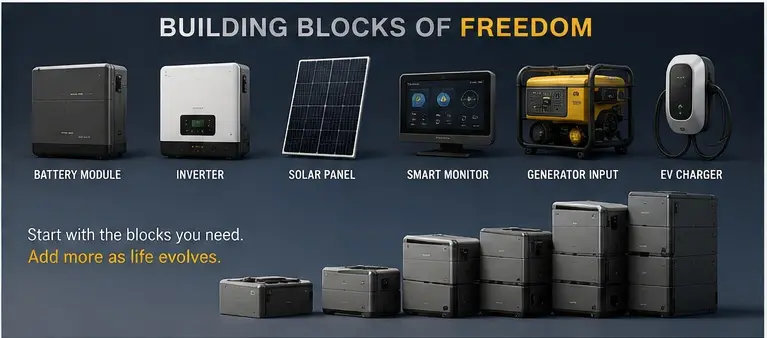
➡️ For real-world use-case examples, system specs and costing
I’d suggest looking at some of these industry leaders when it comes to modular solar systems, both portable and whole-home integrated:
Bluetti – Portable Power, Battery Backup Solutions
EcoFlow – Whole-home energy ecosystems with smart automation management systems
A1 Solar Store – A solar marketplace where you can compare modular components, manufacturers and prices
All three websites offer great visual comparisons, system layout diagrams and information to help you make decisions that fit your situation.
Living with a battery: feeling the value more than seeing it
Once it’s installed, it quietly becomes part of the background of your home. In fact, after a few weeks, most people stop thinking about the battery altogether.
What they do notice is everything that doesn’t happen anymore.
The lights don’t flicker every time the neighborhood loses power.
The fridge doesn’t become a race against the clock.
Working from home doesn’t suddenly depend on whether the utility company is having a good day.
You simply get on with life.
That doesn’t mean a battery is a “fit and forget” purchase, though. Living with one changes the way many homeowners think about electricity.
At first, you’ll probably open the monitoring app far more often than you should. Everyone does.
You’ll watch the battery charge in the morning, discharge in the evening, and probably smile the first time your house keeps running while the neighbors go dark.
Then something interesting happens.
You begin to understand where your electricity actually goes.
You start seeing patterns instead of just receiving a monthly bill.
Over time, those little observations often lead to small changes in how or when you do things.
None of it feels like sacrifice. You’re simply working with your system instead of against it.
Perhaps the biggest surprise is psychological.
When people ask whether a battery is “worth it,” they’re usually looking for a financial answer.
But after living with a battery setup, many homeowners discover that some of its biggest benefits were never going to appear on an electricity bill.
Knowing the power can go out without turning your evening upside down, removes a layer of stress that most people don’t realize they’ve been carrying.
You’re no longer constantly checking weather reports before a storm or wondering whether frozen food will survive another outage.
Or worrying if home security is another “sleep with one eye open” event.
That’s difficult to put a dollar value on.
Next Steps to Your Future Renewable Energy System
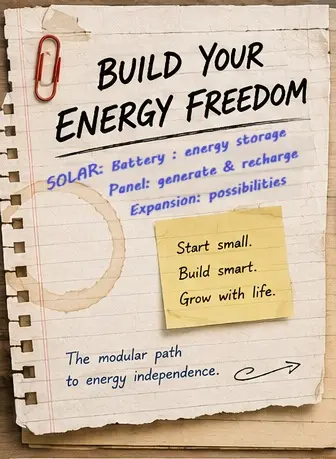
Don’t get quotes first. Get clarity first.
If you’re ready to start planning your own system, begin by estimating the overall size of installation your home is likely to need.
➡️ Navigating Solar System Size & Cost Calculator
Once you have a clearer picture of your household’s energy needs, decide what you actually want your battery to do—keep essentials running, reduce electricity bills, or support a more independent lifestyle.
➡️ Home Battery Capacity Calculator
With those two decisions made, you’ll be in a much stronger position to compare systems, understand installer recommendations, and request quotations with confidence instead of guesswork.
➡️ Request Multiple Battery Quotes
Related articles
Different Types of Solar-Powered Systems
Which Type of Solar Consumer Are You?
The Homeowner’s Solar Decisions Manual: Built on Choices