 Navigating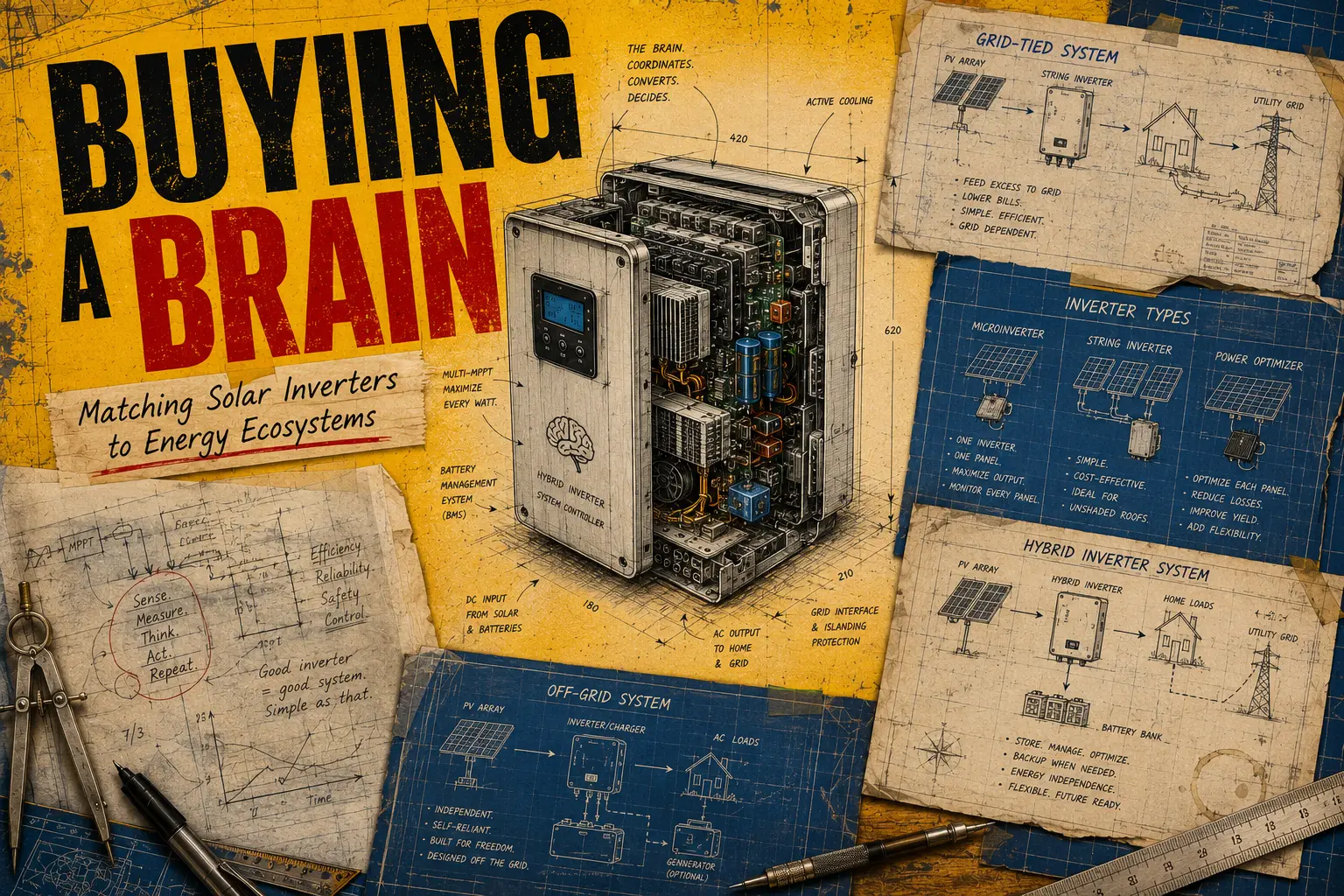
The Mastermind behind your Energy Production, Storage and Distribution
A Long Story about a Little Box with Big Decisions
Despite what some sales brochures might lead you to believe, sunshine doesn’t come with a built-in 120-volt wall socket.
Impressive panels sparkling in the sun.
The big battery module boasting backup.
Everything looks grand.
But that’s still just a very expensive roof decoration and an oversized rechargeable box.
WHY?!
Well, somewhere between the sunlight hitting your roof and the coffee brewing in your kitchen, something has to translate, organize, protect and manage all that electricity.
That’s the inverter’s job.
Ask most people what an inverter does and you’ll probably hear: “It converts DC into AC.”
Technically… yes.
That’s a bit like saying a smartphone is something you use to make phone calls.
It’s true.
It’s also missing about 95% of the story.
In many homes, solar inverters are quietly becoming the operating system of the entire energy ecosystem.
And that’s where things start getting interesting.
Because the inverter isn’t just the bridge between your panels and your home anymore.
It’s becoming the traffic controller, safety officer, communications hub, energy accountant, battery manager, and decision-maker for everything connected to your system.
Whether you’re building a simple grid-tied installation, planning a whole-home backup system, living off-grid, or simply trying to understand what your installer is talking about, understanding the inverter changes how you see the entire solar system.
If you’ve already worked through our guides on solar panels and batteries, you’ve learned two important lessons.
Solar panels determine how much energy you can collect.
Batteries determine how much energy you can store.
This guide completes the picture by explaining the piece of hardware that determines how effectively you can use that energy.
So, let’s flip the lid on this one… figuratively, of course. There are enough high voltages inside to ruin anyone’s afternoon.
Inspecting the Inverter
The poor inverter is the middle child of the solar family.
It does most of the work, gets very little attention, and only becomes interesting when it stops working.
That’s a shame, because if solar panels are the muscles of a solar system, the inverter is the brain making sure those muscles don’t punch themselves in the face.
It is constantly thinking, measuring, checking and reacting.
Without an inverter, your solar panels produce electricity that your home can’t use.
Without an inverter, your battery is simply storing direct current with nowhere useful to send it.
Without an inverter, your home’s electrical system can’t safely interact with the utility grid.
Without an inverter, there is no monitoring app,
no battery charging, no backup switching,
no intelligent load management,
no exporting excess power,
and no way to coordinate all the different pieces of your solar system.
In other words, the inverter isn’t just another component.
It’s the component that turns a collection of expensive hardware into a functioning energy system.
The true control center of your home’s energy ecosystem.
More Than Just DC to AC
If conversion was all an inverter did, we’d still be using the same technology we had twenty years ago.
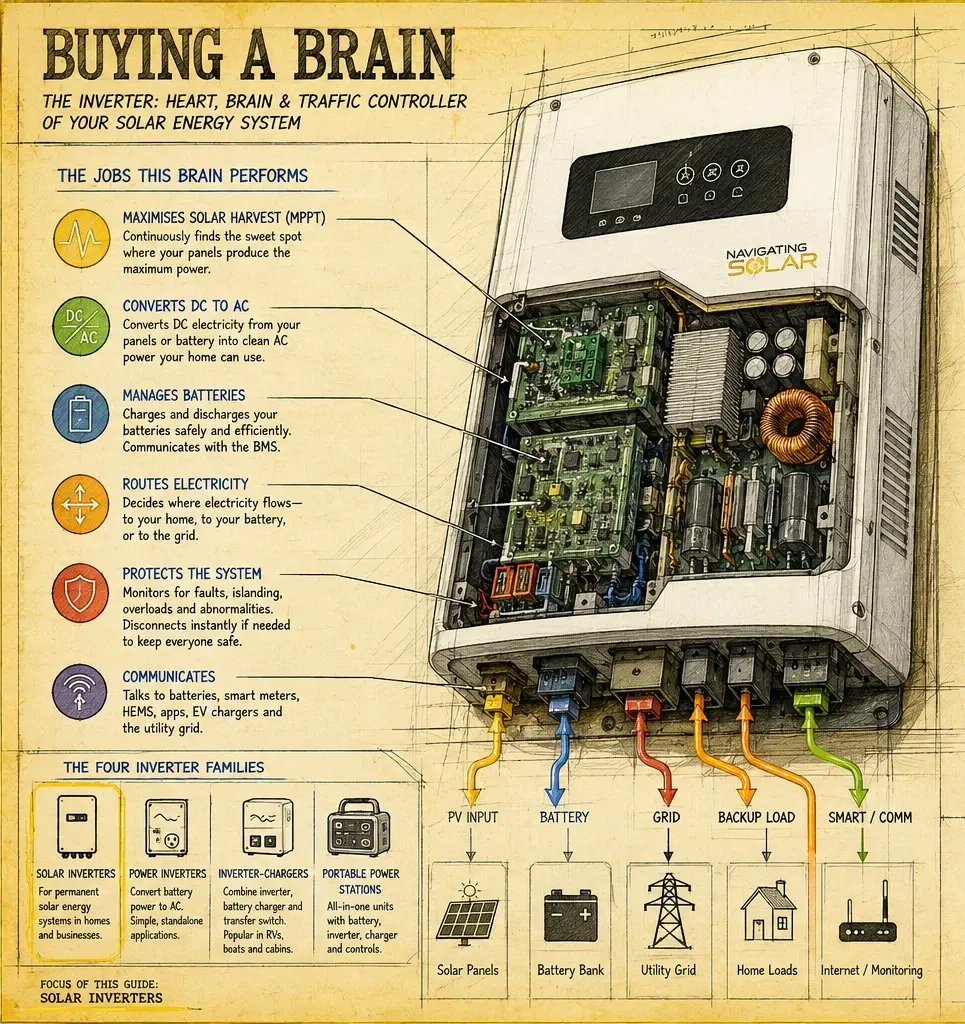
Instead, today’s inverters have evolved into intelligent control centers that constantly monitor, manage and protect your entire energy system.
Converting electricity is simply where the job begins.
It Converts
The obvious one.
Solar panels produce DC electricity. Homes use AC electricity.
The inverter translates between the two.
The inverter bridges those two worlds, turning the energy collected on your roof into electricity your lights, appliances and power outlets can actually use.
It optimizes
The inverter constantly looks for the sweet spot where your solar panels can produce the most power.
This is called Maximum Power Point Tracking (MPPT).
Solar panels don’t produce the same amount of electricity all day.
Sunlight changes, temperatures rise, clouds drift overhead and shadows move across the roof.
The inverter continuously adjusts itself to harvest as much energy as possible under those changing conditions.
This process, is one of the biggest reasons modern solar systems are so efficient.
We’ll unpack that in the next chapter because it deserves more than a paragraph.
It Manages
Electricity isn’t simply produced and used.
Every watt of electricity has somewhere to go.
It has to be directed.
Should the house use it?
Should the battery charge?
Should excess power be exported?
Should the system draw from the grid?
These decisions happen automatically.
It Protects
Your inverter watches for faults.
It constantly monitors voltage, current, frequency and temperature.
Power surges.
Grid failures.
Overheating.
Electrical problems.
If something isn’t safe, it disconnects or shuts down before damage occurs, to protect both your home and the wider electrical network.
It Communicates
Modern inverters are surprisingly social nowadays.
They talk to batteries.
Smart meters.
Monitoring apps.
EV chargers.
Sometimes even the utility company and, in many systems, other smart devices throughout the home.
This allows the entire energy system to work together rather than as a collection of separate components.
The days of the introverted inverter quietly sitting in a corner are long gone.
It Learns and Evolves
Unlike many household appliances, today’s inverters continue to improve after they’re installed.
Firmware updates can introduce new features, improve battery compatibility, support changing grid regulations and unlock smarter ways to manage energy.
As Home Energy Management Systems (HEMS) become more common, the inverter is increasingly becoming the central computer that coordinates everything connected to your solar system.
Affiliate Disclaimer:
Navigating Solar is an independent educational resource. We don’t manufacture or install solar systems—we research technologies, compare solutions, and help homeowners make informed decisions.
These links may connect you with solar providers through our partner network.
We may earn a commission if you choose to engage — at no extra cost to you.
Learn more about how we choose partners.
This guide is not here to teach electricity, but to answer a questions most people never actually get to ask.
The goal isn’t to make you understand electrical engineering.
It’s to make you understand why the inverter exists at all.
Speaking Two Different Languages
Ever tried speaking to a foreigner who can’t speak English?
Electricity has the same problem.
Solar panels speak one language.
Your home speaks another.
The inverter is the translator standing between them.
Solar panels produce Direct Current (DC) electricity.
In a DC circuit, electricity flows continuously in one direction, making it ideal for generating energy from solar panels and storing it in batteries.
Your home, on the other hand, runs on Alternating Current (AC).
Instead of flowing in one direction, AC constantly changes direction many times every second.
In the United States, that happens 60 times per second, or 60 Hertz (Hz).
Why the difference?
Because each type of electricity is good at different jobs.
DC is excellent for generating and storing energy.
That’s why solar panels, batteries, laptops, phones and electric vehicles all use it internally.
AC is far better for distributing electricity over long distances and safely powering homes.
That’s why the utility grid—and almost every wall outlet in your house—uses AC.
So, every time your solar panels produce electricity, the inverter has to translate it before your home can use it.
And that’s only half the story.
If you store that energy in a battery, it’s converted back into DC.
When you use that stored energy later, the inverter converts it back into AC again.
Every conversion costs a little energy.
No system is 100% efficient, which is why inverter efficiency matters. The goal isn’t to eliminate these losses. That’s impossible.
The goal is to minimize them while making sure the right type of electricity reaches the right place at the right time.
DC-Coupled vs AC-Coupled: Where Does the Battery Connect?
Not every battery connects to a solar system in the same way.
Some connect before the inverter.
Others connect after it.
That one decision changes how electricity flows through the system.
DC-Coupled Systems
In a DC-coupled system, both the solar panels and the battery connect directly to the hybrid inverter.
The electricity produced by the panels stays as DC power while the battery is charging.
It only gets converted to AC electricity when your home needs to use it.
Because the electricity is converted fewer times, DC-coupled systems are generally more efficient.
They’re also the most common choice for new solar installations, where the entire system is being designed from scratch.
AC-Coupled Systems
An AC-coupled battery is different.
Here, the solar panels already have their own inverter producing AC electricity for the home.
The battery is added later using its own battery inverter, allowing it to charge from that AC power and discharge back into the home’s electrical system when needed.
Although electricity passes through an additional conversion step, AC-coupled systems have one major advantage:
They’re usually much easier to retrofit.
If you already have a grid-tied solar system and decide to add battery storage a few years later, an AC-coupled battery often avoids replacing the original solar inverter.
Which Is Better?
Neither. They’re designed for different situations.
A DC-coupled system usually makes the most sense when installing a complete solar and battery system at the same time.
An AC-coupled system often becomes the smarter choice when adding batteries to an existing solar installation.
Chasing the Sweet Spot: Understanding MPPT
Solar panels don’t produce a fixed amount of electricity.
A panel rated at 450 watts isn’t making 450 watts every second the sun is shining.
In fact, most of the day it isn’t even close.
Clouds drift past. The sun changes angle.
Panels heat up. Leaves cast shadows.
Even a cool breeze can affect performance.
The amount of power a solar panel can produce is constantly changing.
So how does the inverter know how much power to draw?
It doesn’t. It has to keep looking.
This is where Maximum Power Point Tracking, or MPPT, comes in.
Think of it like finding the perfect gear on a bicycle.
Pedal too hard in the wrong gear and you waste energy.
Pedal too softly and you don’t get the most from your effort.
There’s a “sweet spot” where everything feels just right.
Solar panels have exactly the same sweet spot.
At every moment, there’s one combination of voltage and current where a panel produces the most usable power.
As conditions change throughout the day, that sweet spot moves.
The inverter’s MPPT system constantly searches for it.
Not once. Not every hour.
Continuously.
It makes tiny adjustments to stay locked onto the panel’s maximum available output, helping harvest every practical watt the array can produce.
Without MPPT, your solar panels would still work.
They just wouldn’t work nearly as well.
But before the inverter can translate electricity, it has another challenge.
It has to squeeze as much power as possible out of the solar panels in the first place—and that’s where MPPTs show up
Why More Than One MPPT Matters
An inverter can have one MPPT… or several.
Why the differences?
Because not every roof is the same.
Imagine half your solar panels face east and the other half face west.
The east-facing panels wake up first, while the west-facing panels produce more electricity later in the day.
They’re operating under completely different conditions.
If they’re all connected to a single MPPT, the inverter has to find one operating point for the entire array.
If each group of panels behaves differently, one group of panels will almost always be compromising for the other.
A dual-MPPT inverter solves this by treating each group of panels independently.
Each roof section is allowed to operate at its own optimum point, improving overall energy production.
The same applies if part of your system is mounted on a garage, pergola or carport, or if sections of the roof experience different amounts of shading throughout the day.
Why should you care?
When comparing inverters, don’t just ask “How many kilowatts?”
Also ask “How many MPPTs?”
For a simple roof with all panels facing the same direction, one MPPT is often all you need.
For more complex roof layouts, multiple MPPTs can recover energy that would otherwise be lost—all without adding more solar panels. It’s a simple feature that can make a noticeable difference on complex roof layouts.
MPPT Isn’t the Same as a Microinverter
This is where many people get confused.
MPPT is a function, not a type of inverter.
Almost every modern solar inverter uses MPPT.
The difference is where that tracking happens.
- A string inverter usually has one or more MPPT trackers managing groups of panels.
- A microinverter effectively performs this optimization on each individual panel.
- Power Optimizers also optimize each panel before sending the electricity to a central string inverter.
Different approaches. Same goal.
Get as much energy from the panels as conditions allow.
Why Are Some MPPTs Sold as Charge Controllers?
If you’ve browsed solar equipment online, you’ve probably noticed something confusing.
Some products are sold as solar inverters.
Others are sold as MPPT charge controllers.
Both talk about MPPT, so are they the same thing?
No.
A charge controller has one job: manage the electricity flowing from the solar panels into the battery.
It finds the panels’ maximum power point (MPPT) and charges the battery safely without overcharging or damaging it.
An inverter has a different job: convert DC electricity into the AC electricity your home uses.
In many modern hybrid inverters, these functions are combined into a single unit.
The MPPT charge controller is built inside the inverter, along with the battery management and power conversion electronics.
In a modern hybrid system, that same chain often becomes:
Solar Panels → Hybrid Inverter → Home & Battery
In many DIY, RV and modular off-grid systems, they’re still separate devices:
Solar Panels → MPPT Charge Controller → Battery → Inverter → Home
The hardware looks different, but the jobs are exactly the same.
Compare the difference here:
vs
How this affects your choice
You don’t buy an inverter because it has MPPT.
You buy an inverter because you want your solar panels to produce as much electricity as they reasonably can over the next 20 or 30 years.
MPPT is one of the reasons modern solar systems consistently outperform older designs.
I think this is a perfect stopping point before the next chapter, because now you’ve seen what the inverter does inside.
The next logical leap is: “Okay… if every inverter does these things, why are there so many different kinds?”
That’s where we look the two biggest mistakes people make:
⚠️ Confusing System Type (Grid-tied, Hybrid, Off-grid) with…
⚠️ Inverter Architecture (String, Optimizers, micro-inverters).
That’s where people get things mixed up and the industry often throws terms around interchangeably. They throw six inverter types into one list as if they’re all alternatives.
They’re not.
They’re answering two completely different questions.
Let’s first unravel this from a the point of view of the user: what do you normally see when searching for inverters?
The 4 Inverter Families
One of the biggest sources of confusion in solar is that we use the word “inverter” to describe several completely different pieces of equipment.
They all convert electricity from DC to AC, but that’s often where the similarity ends.
Some are designed to manage an entire home’s solar installation.
Some simply power appliances from a battery.
Others combine an inverter, battery charger and automatic transfer switch into a single unit for RVs, boats and mobile living.
Portable power stations form a fourth family. Rather than being a single device, they integrate an inverter, battery, MPPT charge controller, battery management system and monitoring into one portable unit.
Although they all carry the name “inverter”, they’re built for very different jobs.
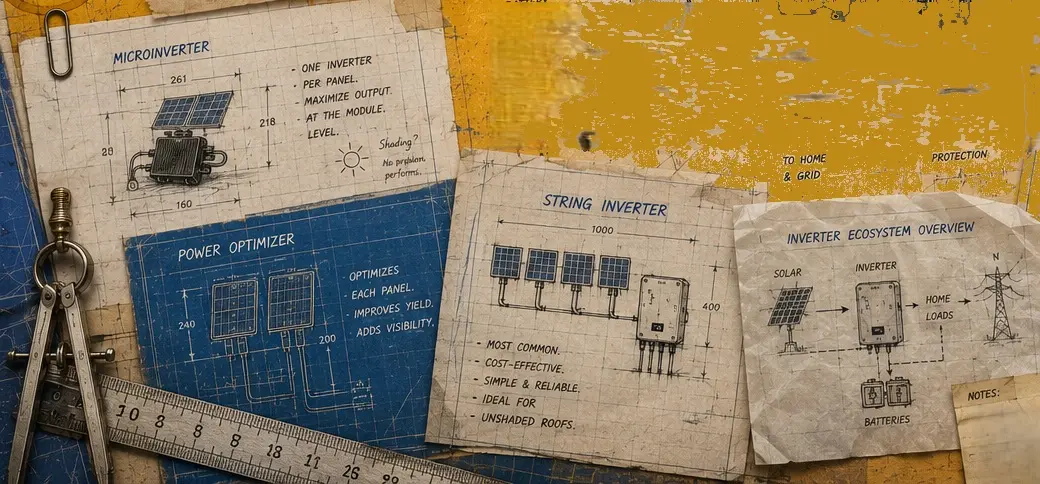 1. Solar Inverters (what this article is about)
These are connected to solar panels.
Their job is to harvest the maximum energy from the panels (MPPT) and convert it into usable electricity. Examples:
These speak “solar.” They expect DC coming from a PV array.
2. Battery / Power Inverters
Standalone power inverters are connected to batteries. Their primary job is simply to turn battery DC into household AC.
They don’t necessarily know anything about solar.
Many don’t have MPPTs.
Many don’t have battery management.
They’re just DC → AC converters.
These are common in:
- RVs
- Boats
- Backup systems
- Workshops
- Portable power carts
If you want solar, you usually add a separate MPPT charge controller.
3. Inverter-Chargers
This is where RVs and mobile systems live. They’re a combination of several devices:
- inverter
- battery charger
- automatic transfer switch
Often they also communicate with: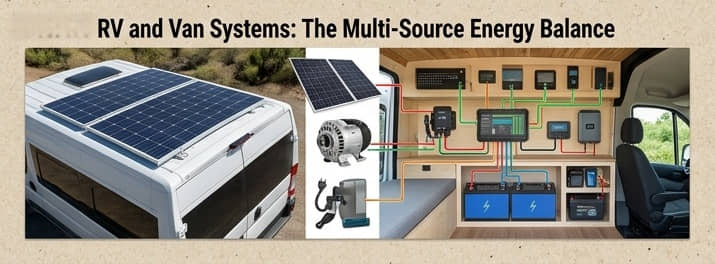
- MPPT charge controllers
- Battery Management Systems (BMS)
- generators
- shore power
- alternators
- HEMS (in larger systems)
Often modular equipment resembles the idea of Lego blocks. You build the system you need, module by module.
Here’s the key difference:
A residential hybrid inverter is trying to manage an entire building.
An RV inverter-charger is trying to manage multiple charging sources.
For example, an RV battery might be charged from:
- Solar panels
- The vehicle’s alternator while driving
- Shore power at a campsite
- A portable generator
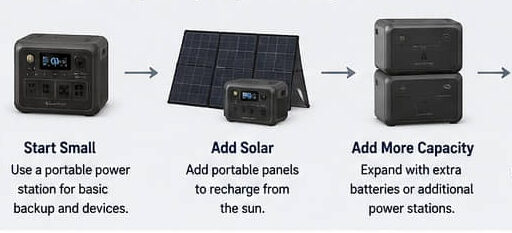 Then there are Portable Power Stations…
They’re essentially an entire electrical system in one box:
- battery ✔
- inverter ✔
- MPPT ✔
- AC charger ✔
- BMS ✔
- transfer logic ✔
- monitoring ✔
These as often referred to as Portable Backup Power or Portable Power Stations / Generators when adding solar panels.
They’re a complete, integrated energy ecosystem, and come in different sizes and capacities. Plug-and-Play style, where battery modules and panels can be added and removed for mobility.
You can’t really separate the inverter from the rest of the product.
For the rest of this guide, we’re focusing on the solar inverter family—the inverters used in residential solar systems.
These are the devices that sit between your solar panels, your batteries (if you have them), your home and, in many cases, the utility grid.
Solar Inverter Choice: It’s Two Decisions, Not One
By now you’ve seen terms like grid-tied, hybrid, off-grid, all lumped together with string inverter, microinverter and power Optimizers.
That makes choosing an inverter seem far more confusing than it really is. The trick is understanding that you’re actually making two separate decisions.
The first question is: How will my solar system connect to the world?
The second is: How will the electricity from my solar panels be converted and managed?
Those aren’t the same decision.
Decision One: The Type of Solar System
This is about how your home gets its electricity.
Will you remain connected to the utility grid?
Will you have batteries?
Do you need backup power during outages?
Are you living completely off-grid?
That’s where terms like grid-tied, hybrid, and off-grid come from.
They describe the type of energy system you’re building—not the hardware inside the inverter.
Just remember that this decision is about how energy flows between your home, your battery and the grid.
We’ve already explored these in our guide to Solar System Types, so we won’t repeat everything here, but have a look at how these systems are constructed.
Explore what these systems look like, how they work and what the modules are for each.
Here are the steps to an interactive visual aid:
Follow the link below – Choose a system (hybrid, grid-tied or off-grid) – Choose a size – Hover over the product image and see how it transforms into a home energy system.
➡️See how Home Energy Systems connect
Decision Two: How the Inverter Does Its Job
Once you’ve decided what kind of system you’re building, you still have another choice.
How should the inverter manage the electricity coming from the solar panels?
This is where string inverters, power Optimizers and micro-inverters come in.
They all perform the same basic job.
They simply do it in different ways.
The right choice depends on things like your roof layout, shading, budget and how much monitoring you want.
We’ll unpack each of these in the next few sections.
Why This Matters
Think of It Like a Car
Imagine you’re buying a vehicle.
First you decide what you need it for.
A family SUV.
A sports car.
A pickup truck.
That’s your system type.
Then you choose how it’s built.
Front-wheel drive.
Rear-wheel drive.
All-wheel drive.
Manual or automatic.
That’s your inverter architecture.
They’re related. But they’re answering completely different questions.
Solar works exactly the same way.
A hybrid solar system can use a string inverter. It can also use micro-inverters.
A grid-tied system might use power Optimizers.
An off-grid system could use a completely different inverter designed for battery-first operation.
The system type doesn’t automatically determine the inverter architecture.
Understanding this one distinction removes a huge amount of confusion.
Instead of comparing six different “types” of inverter, you’re really making two independent choices.
Once you separate those decisions, the rest of the buying process becomes much easier.
And this is where the article starts becoming a buyer’s mental model instead of a product catalogue.
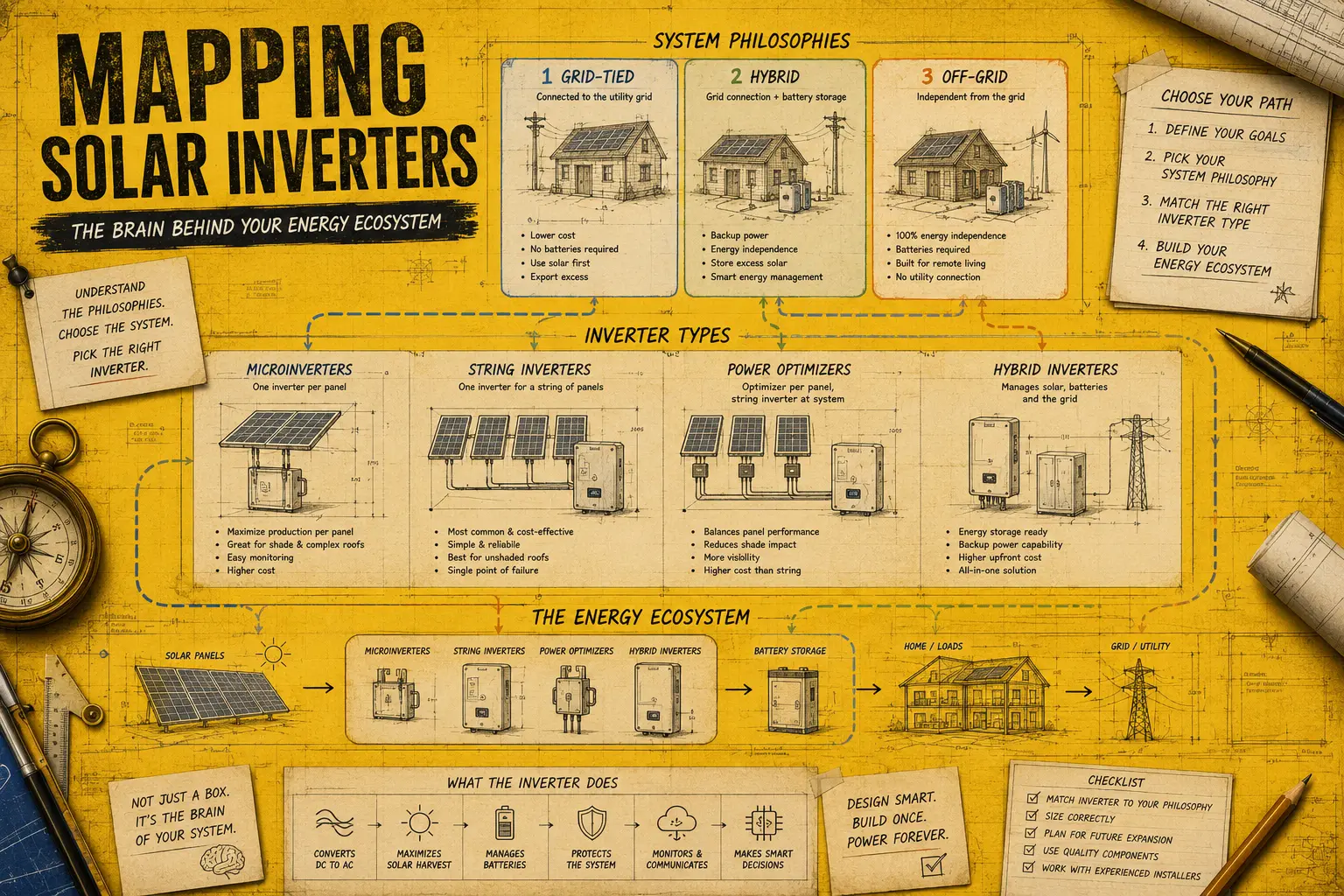
Types of Inverters:
String Inverters: One Brain, Many Panels
For many years, this was the standard way to build a residential solar system—and for millions of homes, it still is.
A string inverter is exactly what it sounds like.
Instead of each solar panel working on its own, several panels are connected together in a string. Like Christmas lights.
That string sends all of its electricity to one central inverter, which converts it into usable power for your home.
String Inverters Work Best When:
- Your roof faces mostly one direction.
- Shading is minimal or predictable
- You want a proven, cost-effective solution.
- Panel-level monitoring isn’t a priority.
They May Not Be Ideal When:
- Different sections of the roof receive very different amounts of sunlight.
- Trees, chimneys or neighboring buildings create regular shading.
- You want to monitor the performance of each individual panel.
If one panel in a string is heavily shaded, covered in leaves or underperforming because of dirt or damage, the entire string is affected.
Modern inverters do a much better job of minimizing these losses than older systems, but the string is still limited by its weakest point.
That doesn’t mean string inverters are a poor choice.
Far from it.
It’s simply designed for a different job.
On a simple roof with little or no shading, they’re often the most cost-effective solution.
They use fewer electronic components, are easier to install, and generally cost less than panel-level alternatives.
That’s why they’re still the most common choice for straightforward residential installations.
And that’s where the next option comes in.
Sometimes you want the simplicity of a string inverter—but without allowing one underperforming panel to hold the rest of the system back.
That’s exactly the problem power Optimizers were designed to solve.
Power Optimizers: Giving Every Panel a Fair Chance
Imagine a relay race where every runner has to match the pace of the slowest teammate.
That’s essentially how a traditional string inverter works.
Power Optimizers were developed to make that race a little fairer.
A power optimizer is a small electronic device installed behind each solar panel.
Its job isn’t to convert DC electricity into AC—that still happens in the central string inverter.
Instead, each optimizer fine-tunes the output of its own panel before sending that electricity down the string.
This means a shaded or underperforming panel has much less impact on the rest of the system.
The result is better performance on roofs with multiple angles, occasional shading or panels facing different directions.
Another advantage is panel-level monitoring.
If one optimizer or panel develops a problem, you can usually see exactly which one through the monitoring software instead of trying to troubleshoot the entire array.
Of course, there’s no free lunch.
Adding Optimizers means adding more hardware to the roof, increasing both cost and the number of components that could eventually require replacement.
Power Optimizers Work Best When:
- Parts of the roof receive different amounts of sunlight.
- Chimneys, trees or nearby buildings create intermittent shading.
- You want panel-level monitoring without moving to a full micro-inverter system.
- You’re looking for a balance between performance and cost.
Micro-inverters: Every Panel Works for Itself
Instead of one central inverter managing a group of panels, every solar panel gets its own miniature inverter mounted underneath it.
Each panel generates DC electricity and immediately converts it into AC before sending it to the rest of the system.
That means every panel operates independently.
If one panel is shaded, dirty or develops a fault, the others continue producing electricity as normal.
This makes micro-inverters particularly attractive for complex roofs where sunlight varies throughout the day.
They’re also popular because every panel can be monitored individually, making it easy to spot changes in performance over time.
The trade-off is cost.
You’re replacing one inverter with many smaller ones, which generally increases equipment and installation costs.
While modern micro-inverters are extremely reliable, servicing a failed unit may require accessing the roof rather than replacing a single wall-mounted inverter.
For many homeowners, however, the extra flexibility and panel-level performance are worth the investment.
Micro-inverters Work Best When:
- Roofs have multiple orientations or significant shading.
- Maximum energy production is the priority.
- Detailed panel-level monitoring is important.
- Long-term flexibility and system expansion are part of the plan.
High Frequency vs Low Frequency:
Ever wonder why one inverter weighs three times as much and why someone living on a farm might deliberately choose it.
What’s Going On Inside the Box?
From the outside, two 5kW inverters might look almost identical.
Inside, however, they can be very different.
One may rely on a high-frequency electronic design, while the other uses a low-frequency transformer-based design.
Most homeowners never notice the difference.
Until they compare the size, weight, price—or what happens when a heavy motor starts.
High-Frequency Inverters
Most modern residential solar systems use high-frequency inverters.
Instead of relying on a large internal transformer, they use high-speed electronic switching to convert electricity efficiently.
The result is an inverter that is:
- Smaller and lighter.
- More energy efficient.
- Easier to install.
- Usually less expensive to manufacture.
For the average home connected to the grid, a high-frequency inverter is the obvious choice.
They’re compact, efficient and perfectly suited to the way most households use electricity today.
Low-Frequency Inverters
Low-frequency inverters take a different approach.
Instead of replacing the transformer with electronics, they use a large, heavy transformer to handle power conversion.
That’s why they’re noticeably heavier than similar-sized high-frequency models.
That extra weight isn’t wasted.
It gives them one major advantage: They’re exceptionally good at handling large startup surges from demanding equipment like well pumps, workshop machinery and heavy-duty motors.
This is one of the reasons they’re still popular in off-grid homes, farms and industrial applications where reliability under difficult loads is often more important than size or efficiency.
Which One Should You Choose?
For most homeowners, the answer is simple.
A modern high-frequency inverter is likely to meet your needs.
It’s efficient, compact and well suited to residential solar systems.
Low-frequency designs still have their place, but they’re usually chosen for specialized applications where high surge capability outweighs the extra cost, size and weight.
Like many things in solar, this isn’t about one technology replacing another.
It’s about choosing the right tool for the job.
💡 A Quick Reality Check
Don’t assume “low frequency” means old technology or “high frequency” means better quality.
They’re simply different engineering approaches.
One prioritizes efficiency and compact design.
The other prioritizes robustness and handling demanding electrical loads.
Don’t assume “low frequency” means old technology or “high frequency” means better quality. They’re simply different engineering approaches. One prioritizes efficiency and compact design. The other prioritizes robustness and handling demanding electrical loads.
Before We Compare…
At this point, it should be clear that there isn’t a single “best” inverter architecture, right?
Each solves a different problem.
A simple, south-facing roof with no shade may perform perfectly with a string inverter.
A roof surrounded by trees might benefit from Optimizers.
A complex roof with multiple angles and future expansion plans may justify micro-inverters.
Forget the Brand. Start With Your Roof.
That’s the real lesson. In reality, the roof usually narrows the right architecture long before the brand matters.
That’s a much more useful way to think.
| Feature | String Inverter | Power Optimizers | Micro-inverters |
|---|---|---|---|
| Upfront cost | Lowest | Medium | Highest |
| Shading performance | Good on unshaded roofs | Better | Best |
| Panel-level monitoring | No | Yes | Yes |
| Components on the roof | Few | Moderate | Most |
| Best for | Simple roof layouts | Mixed conditions | Complex roofs & maximum flexibility |
The “Aha!” of the Guide: Energy Ecosystems and Solar Inverters
This is where we stop talking about what inverter you buy…
…and start talking about what inverter you’re buying into.
Because in 2026, you’re no longer just buying hardware.
You’re buying an ecosystem.
The electricity hasn’t changed. The decisions have.
Ten years ago, choosing an inverter was mostly about one job: Convert electricity.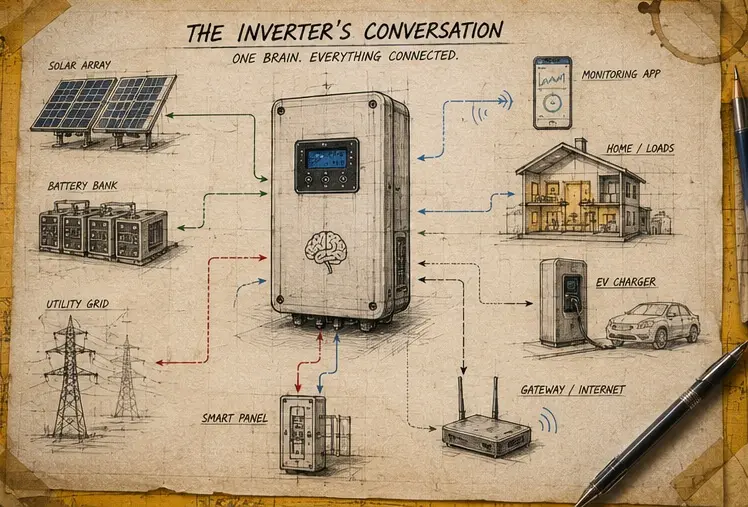
Today, it’s about something much bigger.
Modern inverters have become the hub of an entire energy ecosystem.
They’re connected to batteries.
EV chargers.
Smart meters.
Monitoring apps.
Generators.
Heat pumps.
Smart home devices.
And increasingly, they’re making decisions about all of them.
This is where you’ll often hear the term HEMS, or Home Energy Management System.
Think of HEMS as the strategist that decides when and where electricity should be used.
The inverter is the field commander that actually makes it happen by controlling the flow of electricity.
Sometimes the HEMS software lives inside the inverter itself.
Sometimes it’s a separate controller.
Either way, the two are becoming inseparable.
Closed Ecosystems vs Open Ecosystems
It would be nice if every battery worked with every inverter.
Unfortunately, that’s not how the industry works.
Some manufacturers build complete, tightly integrated systems, where the inverter is designed to work only with approved batteries that have been tested and certified for that platform.
Everything—from the inverter and battery to the app and EV charger—is designed to work together.
Companies like EcoFlow and Bluetti follow this approach for many of their residential energy storage products.
It makes installation simpler and the user experience more seamless.
This often allows more advanced features, simplified installation and a single point of support if something goes wrong.
The trade-off is flexibility.
Adding equipment from another manufacturer may be limited or unsupported.
Other manufacturers, including many brands commonly used in DIY and professional residential installations, build more open systems.
Open systems offer more flexibility and often allow homeowners to shop around as battery technology evolves.
If one manufacturer introduces a better or more affordable battery a few years from now, there’s a good chance it can be added to the existing system.
A reputable solar marketplace showcases brands such as Sol-Ark, Victron, EG4, SMA, and others that are designed to work with a wider range of compatible batteries, solar panels and monitoring platforms.
That flexibility is one reason they’re popular with experienced installers and homeowners planning to expand their systems over time.
Neither approach is inherently better. Personal choice, energy goals, and level of involvement and skill play a role in choosing components
How this connects batteries and inverter choice
Compatibility isn’t just about voltage.
It’s about communication.
Behind the scenes, the inverter and battery are constantly exchanging information such as battery temperature, state of charge, charging limits and fault conditions.
This communication usually happens through protocols such as CAN Bus or RS485, allowing the inverter to manage the battery safely and efficiently.
Before choosing an inverter, ask which batteries it officially supports.
You’re not just buying today’s battery—you’re choosing the platform your future battery upgrades will need to work with.
So… what should I actually compare?
Understanding Inverter Specifications
The specification sheet can look intimidating.
Pages of numbers.
Voltage ranges.
Efficiency ratings.
MPPT inputs.
Peak power.
Continuous power.
IP ratings.
Communication protocols.
Fortunately, you don’t need to understand every line to make a good decision.
A handful of specifications tell you almost everything you need to know. If you look at Type, Size, Connection and Phase to start with, the prices will start making sense too.
Continuous Power vs Surge Power
Every inverter has two important power ratings.
Continuous Power
This is the amount of power the inverter can supply continuously.
Think of it as the inverter’s normal working capacity.
If your home is using more electricity than this rating allows, the inverter has to limit output or draw additional power from the grid, depending on how the system is configured.
Surge Power
Surge power is the short burst of extra power it can provide for appliances that need a little help getting started.
Many household appliances use far more electricity for a few seconds when they switch on than they do while they’re running.
Refrigerators, air conditioners, well pumps and power tools are common examples.
A refrigerator might only use a few hundred watts while running, but require two or three times that amount for a second or two when the compressor starts.
A good inverter needs enough surge capacity to handle those brief moments without shutting down or triggering a fault.
The surge rating tells you how much extra power the inverter can provide for those short bursts.
A system that comfortably runs your refrigerator may still struggle to start it if the surge rating is too low.
Efficiency
Every conversion wastes a little energy.
Modern residential inverters are typically between 96% and 99% efficient, and while those numbers are impressive, they don’t tell the whole story.
An inverter spends surprisingly little time operating under perfect laboratory conditions, so what matters more is how efficiently it performs throughout a normal day as sunlight constantly changes.
That’s why experienced designers don’t choose an inverter simply because it claims the highest efficiency.
They choose one that will perform well across the way the system will actually be used.
A difference of one percent may look impressive on a brochure, but in practice it usually has far less impact than choosing the right inverter architecture or correctly sizing the system.
Inverter Sizing
So how do installers decide what size inverter you need?
They don’t simply total up every appliance in the house.
Instead, they look at the purpose of the system.
A grid-tied solar system is usually sized around the solar array and expected energy production.
A hybrid system also considers battery charging and backup loads.
An off-grid system has to be sized for everything the home might need because there is no utility grid to help when demand suddenly increases.
The inverter becomes part of the overall system design—not a component that’s chosen on its own.
Residential Inverters with 120V/240V Split-Phase Power Output
If you’ve looked through inverter specifications, you’ve probably noticed 120V/240V split-phase mentioned over and over.
That’s simply the standard electrical supply used in most American homes.
Some appliances, such as lights, televisions and wall outlets, run on 120 volts.
Larger appliances—including electric ovens, clothes dryers, well pumps, water heaters and many air conditioners—use 240 volts.
A residential inverter therefore has to supply both.
That’s why you’ll often see 120/240V split-phase output listed on residential inverter specifications.
Why it matters: If you’re installing solar on a typical American home, this isn’t really a feature to compare—it’s a requirement.
A residential inverter should be capable of supplying the same types of circuits your home already uses, whether they’re 120V or 240V.
Understanding the DC:AC Ratio
Solar panels produce DC (Direct Current) electricity.
Your inverter converts that into AC (Alternating Current) for your home.
The relationship between the total DC power of your panels and the AC output rating of your inverter is called the DC:AC ratio.
Many homeowners assume these numbers should be exactly the same.
In reality, they often aren’t. And that’s completely intentional.
Why More Solar Panels Can Be a Good Thing
Imagine you install 10kW of solar panels.
Most people assume you also need a 10kW inverter.
Not necessarily.
Your panels rarely produce their maximum output.
The sun moves, clouds pass.
Panels heat up during summer.
Winter days are shorter.
Most of the year, your array is producing well below its nameplate rating.
Because of this, installers often pair a slightly smaller inverter with a larger solar array.
This allows the inverter to operate closer to its most efficient range for much more of the day,
while the extra panel capacity helps boost production during mornings, afternoons and cloudy weather.
During perfect solar conditions the inverter simply limits, or clips, any production above its maximum output.
While a small amount of peak power is lost, the extra energy collected during the rest of the day usually more than makes up for it.
💡 Bigger isn’t always wasteful.
A solar array that’s 10–25% larger than the inverter is common practice and is often recommended by designers.
The goal isn’t to produce more power at noon—it’s to produce more energy across the entire year.
What Is Clipping?
If you’ve oversized the solar array, what happens on those rare perfect sunny days when the panels briefly produce more power than the inverter can convert?
The answer is called clipping.
The inverter simply limits its output to its maximum rated capacity.
Think of filling a glass with water. Once the glass is full, any extra water simply spills over the edge.
For a short period around midday on the best solar days, a small amount of potential energy is “clipped.”
At first that sounds wasteful. In reality, it usually isn’t.
The extra production gained during mornings, evenings, winter and cloudy conditions almost always outweighs the small amount lost during those few peak hours.
It’s a deliberate design choice, not a design flaw.
MPPT Inputs
Earlier we explained how MPPT continually finds the panel’s maximum power point.
Here, you’re simply checking how many independent MPPT trackers the inverter has.
More trackers provide greater flexibility for roofs with multiple orientations or different shading conditions.
Battery Compatibility
If you’re installing batteries now—or think you might later—check compatibility carefully.
Not every inverter works with every battery.
Some manufacturers support a wide range of battery brands.
Others are designed primarily for their own ecosystem.
This can influence future upgrade options just as much as today’s purchase price.
Monitoring and Connectivity
Most modern inverters include some form of monitoring.
Some provide basic production data.
Others allow you to track every panel, monitor battery performance, schedule charging times and control the system remotely through a smartphone app.
The better the monitoring, the easier it becomes to understand how your system is performing.
Environmental Protection
If the inverter will be installed outdoors, pay attention to its IP rating.
This indicates how well it is protected against dust and water.
An indoor-rated inverter isn’t designed to spend years exposed to the weather.
Certifications
For grid-connected systems, certifications matter.
In the United States you’ll often see standards such as UL 1741 SB, IEEE 1547, and NEC rapid shutdown compliance.
These aren’t marketing features.
They’re safety and grid-interconnection requirements that help ensure your system meets local regulations.
Anti-Islanding: Why Your Solar Switches Off During a Blackout
Imagine there’s a power outage in your neighborhood.
The utility company sends technicians to repair the damaged power lines. They expect those lines to be dead.
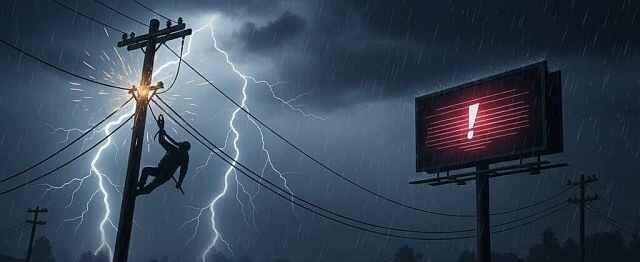 Now imagine your solar system keeps producing electricity and happily feeds power back into those same lines.
Suddenly, a line that’s supposed to be safe is carrying live electricity.
That’s extremely dangerous for the people trying to repair it.
This situation is called “islanding.”
An “island” is a small section of the electrical grid that’s become disconnected from the main utility network but is still being powered by local generation, such as rooftop solar.
To prevent this, every grid-connected inverter continuously monitors the utility grid.
The moment it detects that the grid has disappeared—or that the voltage or frequency has moved outside safe limits—it disconnects itself automatically, usually within a fraction of a second.
This safety feature is called anti-islanding protection.
No grid. No connection.
No electricity exported. No risk to utility workers.
Why It Matters
Many first-time solar buyers assume they’ll still have electricity during a power outage because the sun is still shining.
Unfortunately, that’s not how a standard grid-tied system works.
Without a battery or another source of backup power, a grid-tied inverter must shut down as soon as the utility grid fails.
That’s why a normal solar system cannot power your home during a blackout, even on a bright sunny day.
If backup power is important, you’ll need a hybrid inverter with battery storage, or an off-grid inverter that’s designed to create its own stable electrical network independently of the utility.
The Biggest Number Isn’t Always the Best Choice
It’s tempting to assume a larger inverter is automatically a better inverter. Usually it isn’t.
Like almost every piece of solar equipment, the goal is matching.
Match the inverter to the solar array.
Match it to the battery.
Match it to your home’s electrical needs.
A correctly matched system almost always performs better than one built around oversized components.
Once you understand these power ratings, you’ll understand why two quotes with similar-sized solar systems can recommend completely different inverter sizes—yet both may be technically correct.
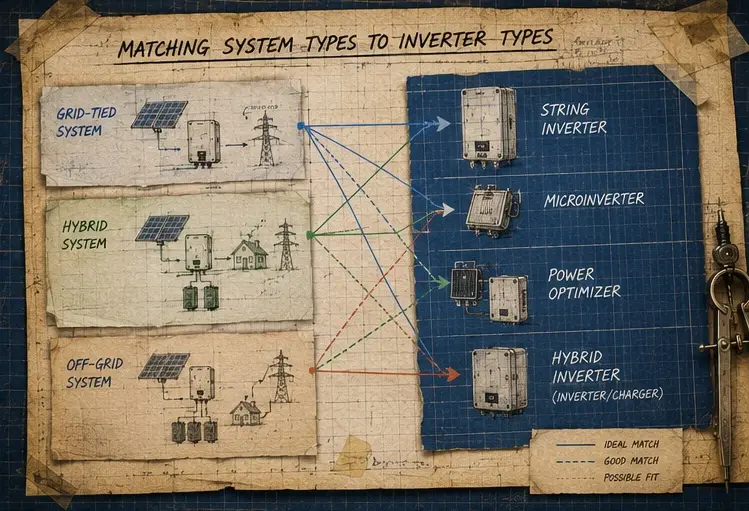
The Four Energy Philosophies
I wouldn’t call these Energy Profiles.
These are philosophies—the way people think about energy.
One’s energy profile determines which philosophy you are likely to follow.
That distinction is important.
The Energy Profiles says: Who are you? What’s your lifestyle?
The philosophy asks: How do you think about energy?
Those are different things.
I placed it after the technical chapters (MPPT, inverter types, specs, sizing), because now you understand the hardware a little better, and we zoom back out and connect it all.
The next section isn’t “buying advice”—it’s the conceptual shift that ties the hardware to the homeowner’s goals – how you would live with an inverter.
Maybe better viewed as how the inverter is going to live with you – what is its full job description?
If there were a single “best” inverter, manufacturers would only build one.
Instead, there are dozens of designs because homeowners don’t all want the same thing.
Some want the lowest electricity bill.
Some want backup during power outages.
Some want complete energy independence.
Others are building a fully connected smart home that manages electricity automatically.
The inverter you choose says as much about your energy goals as it does about your financial goals.
1. Grid-Tied Inverters: The Grid Is Part of My System
A grid-tied solar system is still the most common approach for residential solar.
- Lowest upfront cost
- Net metering and incentive programs matter
- No battery backup
- anti-islanding
- The utility is part of the system
A grid-tied inverter has the simplest job – one source, one destination.
Its world consists of just 3 things: Solar panels → House → Utility grid
It’s the simplest, most efficient and usually the lowest-cost inverter because it only has one energy source to manage.
There’s no battery to maintain, no stored energy to manage and fewer components to install.
The inverter’s job is simply to keep the solar panels operating at maximum performance while synchronizing perfectly with the utility grid.
Generate electricity during the day, use what your home needs when it’s actively producing power.
Any surplus electricity can be exported to the utility grid, earning credits where net metering or similar programs exist.
When the sun goes down, you simply buy electricity from the utility.
In effect, the grid becomes your energy backup system.
It’s the lowest-cost solution and often delivers the fastest return on investment, especially in areas with reliable electricity and favorable net metering policies.
The trade-off is equally simple: If the grid goes down, so do you.
For many homeowners, that’s an acceptable compromise.
2. The Hybrid Inverter: Multiple Sources, Multiple Destinations
- Multiple source power input and output
- Security comes first
- Essential loads or whole-home?
- Resilience, not complete independence
People think: Hybrid = battery.
No.
A hybrid system means multiple energy sources.
This philosophy usually leads to a hybrid inverter paired with battery storage, solar panels and the grid.
The hybrid inverter monitors both the grid and the battery, and constantly decides where electricity should come from and where it should go.
During normal operation it behaves much like a grid-tied system, but the moment the grid fails it automatically disconnects from the utility and begins powering the home’s backup circuits or, in some cases, the entire house.
Some homeowners aren’t trying to leave the grid, and the monthly electricity bill isn’t the only concern.
Here, the battery isn’t there to maximize savings every day.
It’s there because losing power has a real cost—whether that’s spoiled food, a home office going offline, or home security.
In the case of medical equipment, it’s installed because uncontrolled power failures have dire consequences.
This philosophy values resilience more than maximum financial return.
Think of it as: buying peace of mind rather than chasing every kilowatt-hour.
The grid still does most of the heavy lifting, but the battery automatically steps in whenever it’s needed.
Solar panels offer the battery a way to recharge cheaply during the day, and the grid is there when it’s needed.
3. Off-grid Inverters: The Home Becomes Its Own Power Station
Off-grid = same hardware, completely different mission, because there is no utility to rescue you – you become the utility company.
- Generate, store, distribute
- Monitor, manage, maintain
- Zero reliance on utilities
- Designed around self-sufficiency
- Management, Planning and Resource Allocation is your safety net
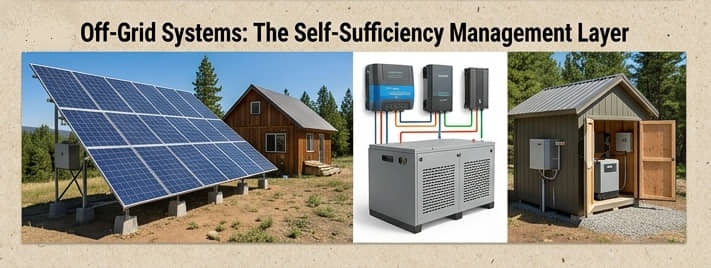
Now you have to think about:
weather
battery reserve
winter
generator
backup
well pumps
load management
maintenance
future expansion
Instead of relying on the utility whenever solar production falls short, the goal is to generate, store and manage as much energy as possible on site.
In many cases backup power comes in the form of a fuel generator, these days even duel-fuel generators designed to work with solar and energy storage.
Off-grid systems with large solar arrays, and substantial battery storage, the inverter becomes the heart of a self-contained energy system:
balancing solar production, battery charging and protection from over-discharge,
managing generator charging, and heavy appliance loads,
and ensuring enough energy remains available until the sun comes up again.
In an off-grid system, poor planning doesn’t result in a bigger electricity bill.
It results in running out of electricity, and core systems grinding to a halt.
That’s why off-grid systems are designed around energy management first, convenience second.
💡Black Start: Can Your Inverter Recover on Its Own?
An off-grid system has one job: keep itself running.
But what happens if everything shuts down?
Imagine several cloudy days in a row.
The batteries become completely discharged and the inverter switches itself off to protect them.
Overnight, the entire house goes dark.
The next morning the sun comes up. The solar panels are generating electricity again.
But there’s a problem.
The inverter’s electronics need enough power to start before they can begin managing and converting the energy coming from the solar panels.
This creates a classic “chicken-and-egg” situation.
Without enough power to start the inverter, the solar panels can’t recharge the batteries.
Without charged batteries, the inverter can’t start.
Some modern hybrid and off-grid inverters solve this with a feature called black start.
On systems that support black-start operation, the inverter can automatically wake up once the solar panels produce enough power to start its internal electronics. It then begins charging the batteries and gradually brings the system back online—all without anyone touching a switch. Older or simpler systems may require a manual restart, an external battery charger or even a generator before the inverter can begin operating again.
Why It Matters
For a grid-connected home, this feature is rarely noticed because the utility grid is always available to restart the system.
For an off-grid home, it’s a completely different story.
It’s one of those features you hope never matters—until the day it does.
If your entire home depends on that inverter, knowing how it recovers after a total shutdown is just as important as knowing how much power it can produce.
When comparing off-grid inverters, don’t only ask: “How many kilowatts can it deliver?”
Also ask: “If everything goes flat… how does it come back to life?”
4. The Intelligent Energy Home
This is the evolution.
This is where the industry is heading.
Not only “solar.”
Not just “battery storage”.
An energy ecosystem.
A whole self-contained, self-regulating operation.
The inverter becomes the operating system of the house.
Instead of simply asking “Where is electricity available?” the system begins asking “Where will this electricity create the most value?”
This is where technologies like HEMS (Home Energy Management Systems),
EV charging.
Smart tariffs.
Load shifting.
Virtual Power Plants.
Vehicle-to-Home.
AI, smart management and automation, all begin working together.
The goal is no longer simply producing electricity.
It’s using every watt in the smartest possible way.
For homeowners, this doesn’t necessarily mean doing less—it means making fewer manual decisions while getting more value from the energy the home already produces
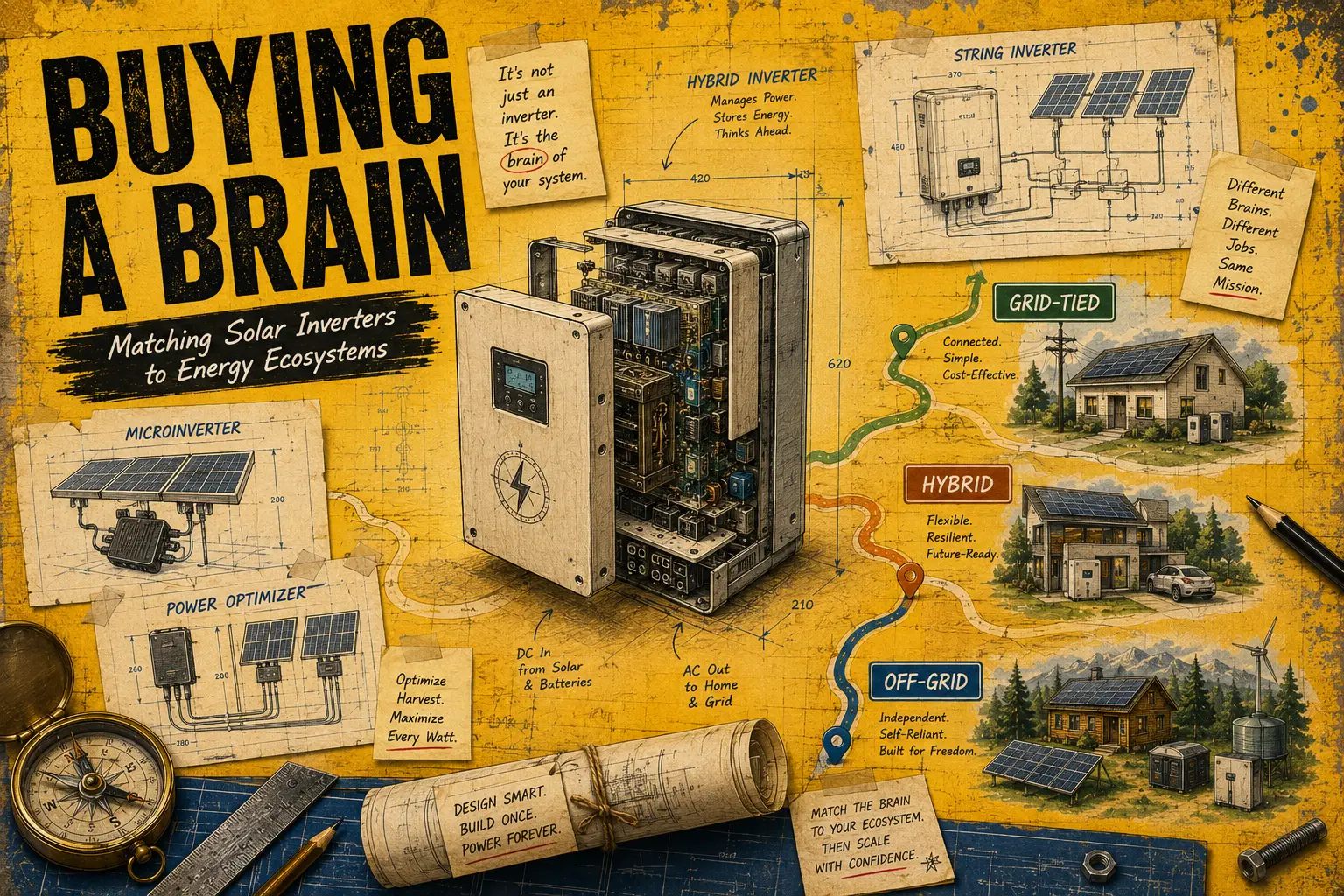
What About RVs, Boats and Mobile Solar System Inverters?
Everything you’ve learned in this guide still applies. Solar panels still produce DC electricity.
Batteries still store it.
An inverter still converts it into usable AC power.
What changes is the design philosophy.
Instead of powering an entire house connected to the utility grid, mobile systems are built around limited battery capacity, portable solar panels, shore power connections and generators.
Weight, available space and energy efficiency become just as important as electrical output.
Many RVs use 12V inverter-chargers, combining battery charging, automatic transfer switching and DC-to-AC conversion in a single compact unit.
Larger motorhomes increasingly move to 24V or even 48V systems to reduce cable sizes and improve efficiency.
While the hardware looks different, the principles remain exactly the same.
If you understand how a residential inverter works, you’ve already learned the fundamentals of every mobile energy system.
Which Philosophy Is Right?
Here’s the interesting part.
Most homeowners don’t stay in the same philosophy forever.
Many begin with a simple grid-tied system.
A few years later they add batteries.
Or sometimes its batteries before panels…
Then an electric vehicle.
Perhaps upgrade to a smart water heater or automated home energy management system.
What started as a solar installation gradually becomes an energy ecosystem.
Very few homeowners install their “forever system” on day one.
That’s why it’s worth thinking beyond today’s electricity bill, and consider which problems a system should solve over time.
Choose it for the home you have today… but make sure it’s capable of growing into the home you’ll have tomorrow.
Ownership and Lifespan vs Capability and Evolution
Now the question turns from: “Which inverter should I buy?”
to: “What kind of energy future am I trying to build?”
That’s a much more powerful question, and one that will future-proof your plans and investment much better.
Next, let’s look at where all of this is heading:
- AI and automation – Is it real or futuristic marketing?
- Bidirectional EV charging.
- More open standards or more manufacturer lock-in?
- Grid codes changing.
- Software-defined features.
- Cybersecurity and solar
- VPPs.
- Dynamic tariffs.
Let’s make it a homeowner’s roadmap. Every subsection answers “Why should I care?” because that’s the whole point of this guide.
No predictions for the sake of predictions, just:
These trends are already happening. Here’s why they matter before you spend $20,000 today.
Where Inverters Are Heading
If you compare a modern inverter with one from ten or fifteen years ago, you’ll notice the biggest changes haven’t been in efficiency.
They’ve been in capability.
That trend isn’t slowing down.
If you’re investing in a solar system today, it’s worth understanding where inverter technology is heading—not because you need every new feature, but because your inverter is likely to be the part of a system that determines what you can add later.
Stacking Capability
Some inverter platforms allow multiple units to operate together, often called stacking or parallel operation.
Instead of replacing the original inverter, a second unit can be added to increase the available power or expand battery capacity.
Not every inverter offers this flexibility.
Some systems are designed as a complete platform that can be expanded over time, while others are intended to remain exactly as they were installed.
Why it matters: An inverter is one of the longest-term investments in a solar system.
Understanding whether it can be expanded later may save you from replacing perfectly good equipment simply because your energy needs have changed.
Home Energy Management Will Become Standard
We’ve already looked at HEMS (Home Energy Management Systems) earlier in this guide.
Today it’s still seen as an advanced feature.
Over the next decade, it’s likely to become standard equipment.
Instead of simply converting electricity, the inverter will increasingly coordinate
when batteries charge,
when electric vehicles charge,
when major appliances run and
when electricity is exported to the grid.
Why it matters: Even if you don’t need these features today, choosing an inverter that supports future energy management could save replacing it later.
Open Systems vs Closed Ecosystems Will Become More Important
Earlier we looked at the difference between open ecosystems and manufacturer-specific systems.
That decision is becoming more important every year, with the demand for smarter management and automation.
Some manufacturers continue expanding closed ecosystems where the inverter, battery, EV charger and monitoring platform are designed to work together.
Others focus on broader compatibility with equipment from multiple manufacturers.
Neither approach is automatically better.
It depends on how much flexibility you expect to need over the next decade.
Why it matters: Your first inverter purchase may influence every future upgrade you make.
The Grid Is Changing Too
For longer than you or I can remember, the electricity grid worked in one direction.
Power was generated at large power stations, transmitted across the country and delivered to homes.
Electricity only flowed one way.
Solar changed that.
Today, millions of homes are generating electricity during the day and exporting surplus power back into the grid.
Instead of managing a few hundred power stations, utilities are suddenly managing millions of tiny ones.
That creates new challenges.
At lunchtime, when solar production is high, the grid may have more electricity than it needs.
By early evening, the sun begins to set just as people arrive home, demand rises sharply while solar production disappears.
This has become known as the “duck curve”—a growing mismatch between when electricity is produced and when people actually need it.
To manage this, utilities are changing the way electricity is bought and sold.
Time-of-use tariffs, dynamic electricity pricing and utility demand-response programs are becoming more common in many parts of the world.
Time-of-Use Tariffs
Electricity is no longer worth the same amount throughout the day. That where Time-of-Use or TOU comes in.
In many areas, power is cheaper when solar production is high and significantly more expensive during the evening peak.
Instead of paying one flat rate, homeowners may pay different prices depending on the time they use electricity—and receive different rates when exporting solar power back to the grid.
A modern inverter can respond to these changing prices automatically.
Rather than exporting every spare kilowatt-hour as soon as it’s produced, the system can decide whether storing that energy in a battery, using it immediately or exporting it later will provide the greatest financial benefit.
Why should you care? Because in the future, when you use electricity may become just as important as how much electricity you produce.
Old Infrastructure needs Virtual Power Plants (VPPs)
Now imagine thousands of homes, each with a solar system and a battery.
Individually they’re small.
Together they represent one enormous power station.
That’s the idea behind a Virtual Power Plant (VPP).
Instead of building another gas-fired power station to meet short periods of high demand, utilities can ask thousands of participating homes to contribute a small amount of stored battery power at exactly the same time.
The homeowner gets paid.
The utility avoids switching on expensive emergency generators.
Everyone benefits from a more stable grid.
Of course, there are trade-offs.
Using your battery more often increases battery cycling over its lifetime.
Participation is usually voluntary, program rules vary between utilities, and some manufacturers only support VPP participation within their own ecosystem.
Why should you care? If Virtual Power Plants become common in your area, the inverter you buy today may determine whether your home can participate—and whether your battery becomes another source of income instead of simply an emergency backup.
Export Limiting: Sometimes You Can’t Send Everything to the Grid
This is one that I think homeowners are going to start hearing about more and more over the next decade.
It’s not just “another feature”—it’s a response to how electricity grids are changing.
…and one of the biggest surprises for new solar owners, discovering that producing electricity doesn’t always mean you’re allowed to export all of it.
As more homes install solar, some local electricity networks are reaching the limits of what they were originally designed to handle.
Neighborhood transformers, distribution lines and substations were built to deliver electricity to homes—not to receive large amounts of electricity flowing back from hundreds of rooftop solar systems.
In some areas, utilities now place limits on how much electricity a home may export, even if the solar system is capable of producing much more.
This is where export limiting comes in.
Instead of sending every surplus kilowatt-hour to the grid, a compatible inverter can automatically reduce its output to stay within the utility’s export limit.
The excess energy doesn’t have to be wasted, though. Depending on the system, it can often be redirected to charge a battery, heat water, charge an electric vehicle or power other appliances in the home.
Why Utilities Do This
It is not about preventing people from owning solar.
It’s about keeping the electricity network stable.
The grid was designed around predictable, one-way power flow. As rooftop solar becomes more common, voltage can rise, equipment can become overloaded and electricity quality can be affected if too many homes export power at the same time.
Rather than stopping new solar installations altogether, many utilities simply limit how much each home may feed back into the network.
Why It Matters A modern inverter isn’t just converting electricity anymore. It’s also managing where that electricity delivers the most value.
As electricity networks continue to evolve, features such as export limiting are becoming increasingly important—not because they produce more energy, but because they help your solar system work with the grid instead of against it.
Smarter Systems need More Intelligent Inverters
As the grid changes, so do the rules for connecting solar systems.
Solar inverters are increasingly required to interact with the external grid to
monitor grid voltage,
respond to frequency changes,
disconnect safely during outages,
support utility stability and
receive software updates as regulations evolve.
That’s why today’s inverters contain far more computing power than older models.
They’re becoming intelligent energy controllers rather than simple electrical devices.
Why you should mind this? Because the residential inverter you’re buying today isn’t just designed for a home system, but for connecting to a grid too.
And it’s being designed for the grid your utility expects to operate over the next 10 to 20 years.
And that’s why choosing a modern, well-supported inverter platform is becoming just as important as choosing efficient solar panels.
Software Will Matter Almost As Much As Hardware
Modern inverters are no longer just electrical devices.
They’re computers that happen to move electricity.
And are fast becoming software platforms. That’s why many modern inverters can receive firmware updates that improve how they operate throughout their lifetime.
Manufacturers regularly release firmware updates that improve:
compatibility with new batteries,
monitoring features,
Home Energy Management System (HEMS) integration,
Virtual Power Plant compatibility,
cybersecurity and support for new communication standards,
or introduce new functions that weren’t available when the inverter was first installed,
Sometimes it’s needed because the utility changes its grid requirements, introducing new rules that connected solar systems must follow.
Some ecosystems receive regular updates. Others change very little after installation.
Some updates happen automatically through an internet connection. Others are installed by your installer during routine service.
While you’ll probably never notice most of these updates, they have become a normal part of owning a modern solar system.
Why it matters: When comparing manufacturers, don’t just compare today’s specifications.
It’s also worth asking how the manufacturer supports the product over the next ten or fifteen years.
Does the company regularly release firmware updates?
Can those updates be installed remotely?
Will the inverter remain compatible with future batteries, EV chargers and smart home technologies?
These questions don’t usually appear on a specification sheet, but they can have a significant impact on how useful your inverter remains long after it’s been installed.
Cloud Security and Connectivity Will Matter More
As inverters become permanently connected to home networks and cloud services. It’s coordinating information.
Cybersecurity and long-term software support, for that reason, become increasingly important.
Behind the scenes, this information travels through communication standards such as CAN Bus, RS485, Ethernet, Wi-Fi or, in some systems, cellular connections.
Reliable updates, secure communication and ongoing manufacturer support help ensure the system continues operating safely throughout its life.
Most homeowners never need to understand these protocols.
What’s important is knowing that these components all speak to each other, and the more devices you plan to add over the next decade, the more important communication compatibility becomes.
Why it matters: Electricity is only half the job. Information is the other half.
Choosing an established manufacturer with a good support record is about more than warranty—it’s also about software support that will still be supportive in 10 to 15 years from now…
Keep an Eye on Your System
One of the biggest advantages of today’s inverters is visibility.
Most include a monitoring app that lets you see how your system is performing in real time.
A sudden drop in production, an unexpected warning or a battery that’s no longer charging properly is often spotted there long before it becomes a bigger problem.
A quick glance a few times a month is usually enough to know everything is behaving as it should.
Expect to Replace the Inverter First
…It all circles back to compatibility
When planning the long-term cost of a solar system, it’s sensible to assume the inverter may be replaced at least once during the lifetime of the panels.
Solar panels often carry performance warranties of 25 to 30 years.
Modern lithium batteries typically last 10 to 20 years, depending on their chemistry, depth of discharge and the number of charge cycles they experience.
Most residential inverters, however, come with warranties of 10 to 15 years, with some premium products offering longer coverage or optional warranty extensions.
That doesn’t mean they’ll fail the day the warranty ends. Many continue operating for years afterwards. But compared with the rest of the system, the inverter is usually the first major component likely to need repair, replacement or upgrading.
That isn’t a sign of poor quality. It’s simply the nature of electronic equipment.
Today’s inverter may have been designed before bidirectional EV charging became common. Before Home Energy Management Systems matured. Before Virtual Power Plants existed in your area. Before your home even had a battery.
Fifteen years is a long time in technology.
By the time an inverter eventually reaches the end of its life, your home’s energy needs may look very different from when it was first installed.
Electric Vehicles Are Becoming Part of the System
For decades, electricity only flowed in one direction.
The grid powered your home. Your home powered your appliances. Then along came solar…
…and then electric vehicles change that relationship, again.
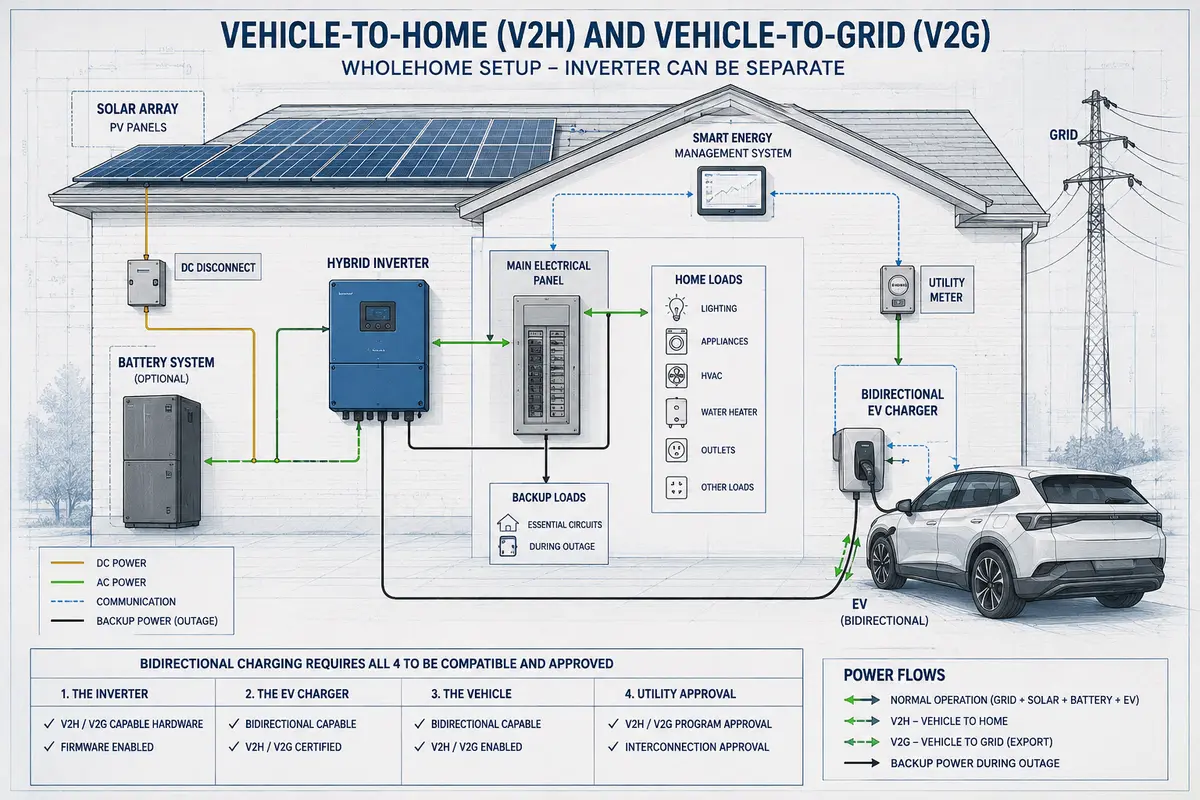
As bidirectional charging technologies such as Vehicle-to-Home (V2H) and Vehicle-to-Grid (V2G) become more common, compatible inverters will increasingly be able to treat an electric vehicle as another energy source. Instead of being just another appliance that consumes electricity, modern EVs are becoming large mobile batteries that can both store and, in some cases, return electricity.
For the inverter, this introduces an entirely new job.
Instead of managing only solar panels and a stationary home battery, it may also need to communicate with an EV charger, decide when the vehicle should charge, and in compatible systems even use the vehicle as part of the home’s energy storage.
With Vehicle-to-Home, the inverter can draw electricity from the vehicle to help power the house during an outage or during expensive evening electricity tariffs.
With Vehicle-to-Grid, the inverter can even export electricity from the vehicle back to the utility when the grid needs additional power.
Not every inverter supports this today. Not every vehicle does either.
But compatibility is becoming an important consideration for homeowners planning to own an EV during the lifetime of their solar system.
Why it matters: If an electric vehicle is part of your future plans, ask whether the inverter platform is designed to support bidirectional charging as the technology becomes more available. Some manufacturers build tightly integrated ecosystems where the inverter, EV charger and vehicle communicate seamlessly. Others rely on open standards that are still evolving.
The Best Inverter Is the One That Fits Your Home
If you’ve chosen well, your inverter won’t become something you think about very often.
Technology will continue evolving.
New features and products will appear.
Marketing departments will always find something new to advertise.
That doesn’t change the most important lesson in this guide.
Every future addition or new technology—HEMS, VPPs, dynamic tariffs, EVs—should answer one question:
“What extra job will my inverter have to do?”
That’s what makes a solar system future-ready, and what makes today’s choice a sensible one.
Not predicting the future…
…but leaving yourself room to grow into it.
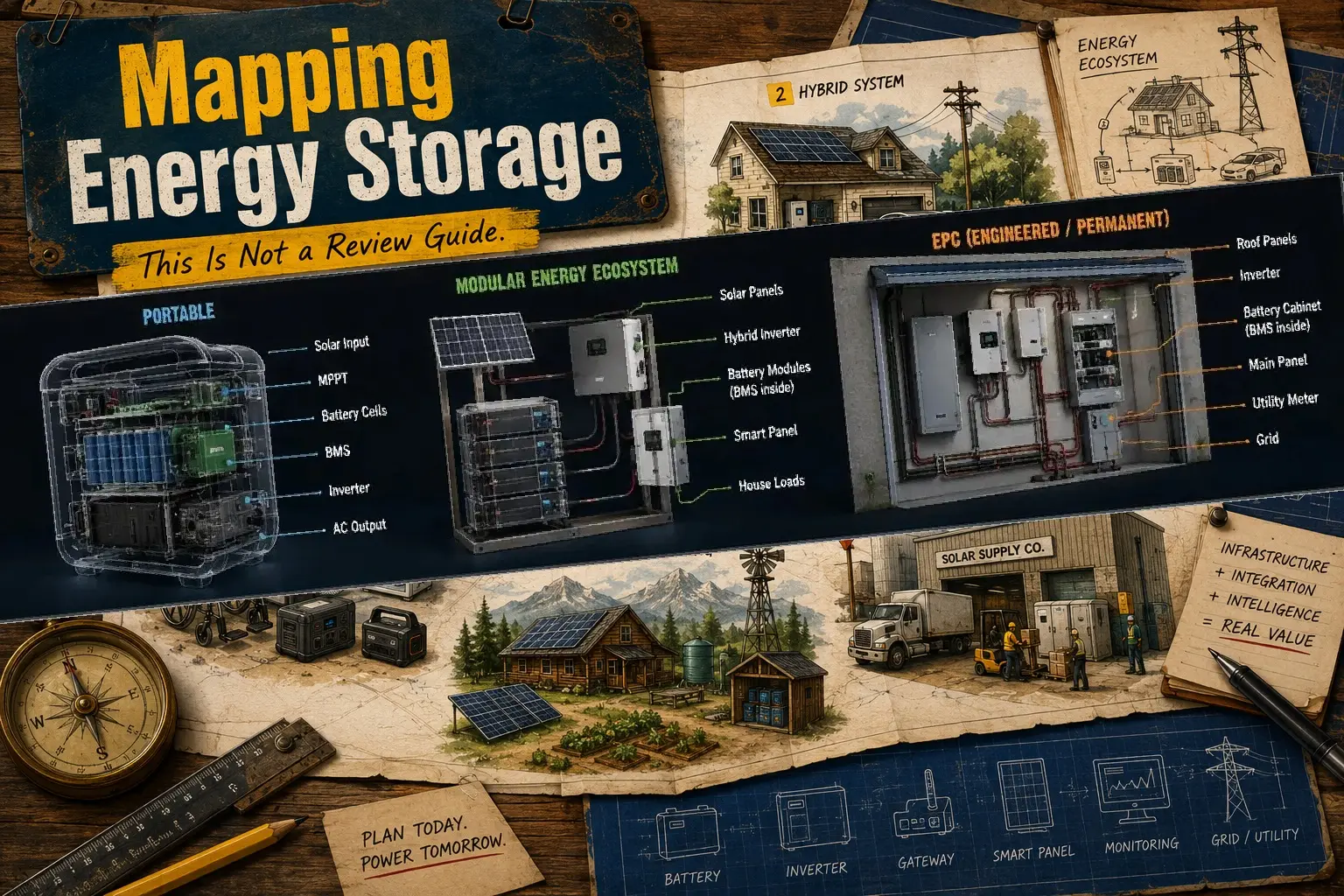
Designing a Future-Proof Solar System
The right inverter depends on your roof layout, shading conditions, monitoring preferences, battery plans, and long-term energy goals.
Understanding these factors can help determine which type of system best suits your needs, how large it should be, and how easily it can adapt as your energy requirements change over time.
Most homeowners typically follow one of three paths:
Traditional Turnkey Solar Installations
If your goal is lower electricity bills and a professionally installed system, a turnkey solar installation is usually the simplest route.
The installer designs the system, selects compatible equipment, obtains permits, completes the installation and commissions the system for you.
Comparing more than one proposal is one of the smartest things you can do.
Different installers may recommend different equipment, warranties, battery options and system designs—even for the same home.
Compare multiple US installers, equipment options and pricing before making a decision.
Quote Request Tool
Connect with Local US Installers trusted by homeowners nationwide — step-by-step, practical, and pressure-free.
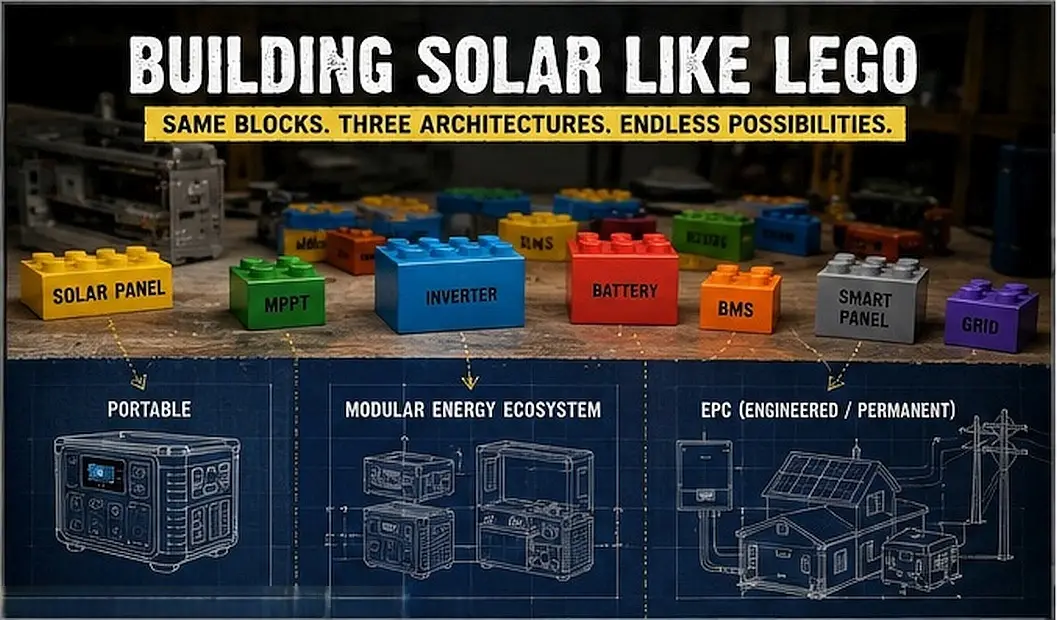 Battery Backup and Modular Energy Ecosystems
Not every homeowner wants a traditional rooftop solar installation, and not everyone wants to build a DIY system from individual components.
Modern energy platforms offer a third option: modular energy ecosystems. These systems can start as a portable power station or backup battery, expand with additional storage and solar panels, and in many cases grow into professionally installed whole-home energy systems.
Manufacturers such as Bluetti and EcoFlow now offer complete ecosystems that combine
battery storage, hybrid inverters,
smart energy management, EV charging integration
and whole-home backup.
Whether you’re looking for portable power, RV solutions, emergency backup or an intelligent home energy platform, these systems are designed to grow as your energy needs evolve.
➡️ Explore Bluetti Whole-home Energy Storage Solutions
➡️ Explore EcoFlow’s Intelligent Energy Ecosystem
Build Your Own Solar System: DIY & Component-Based Systems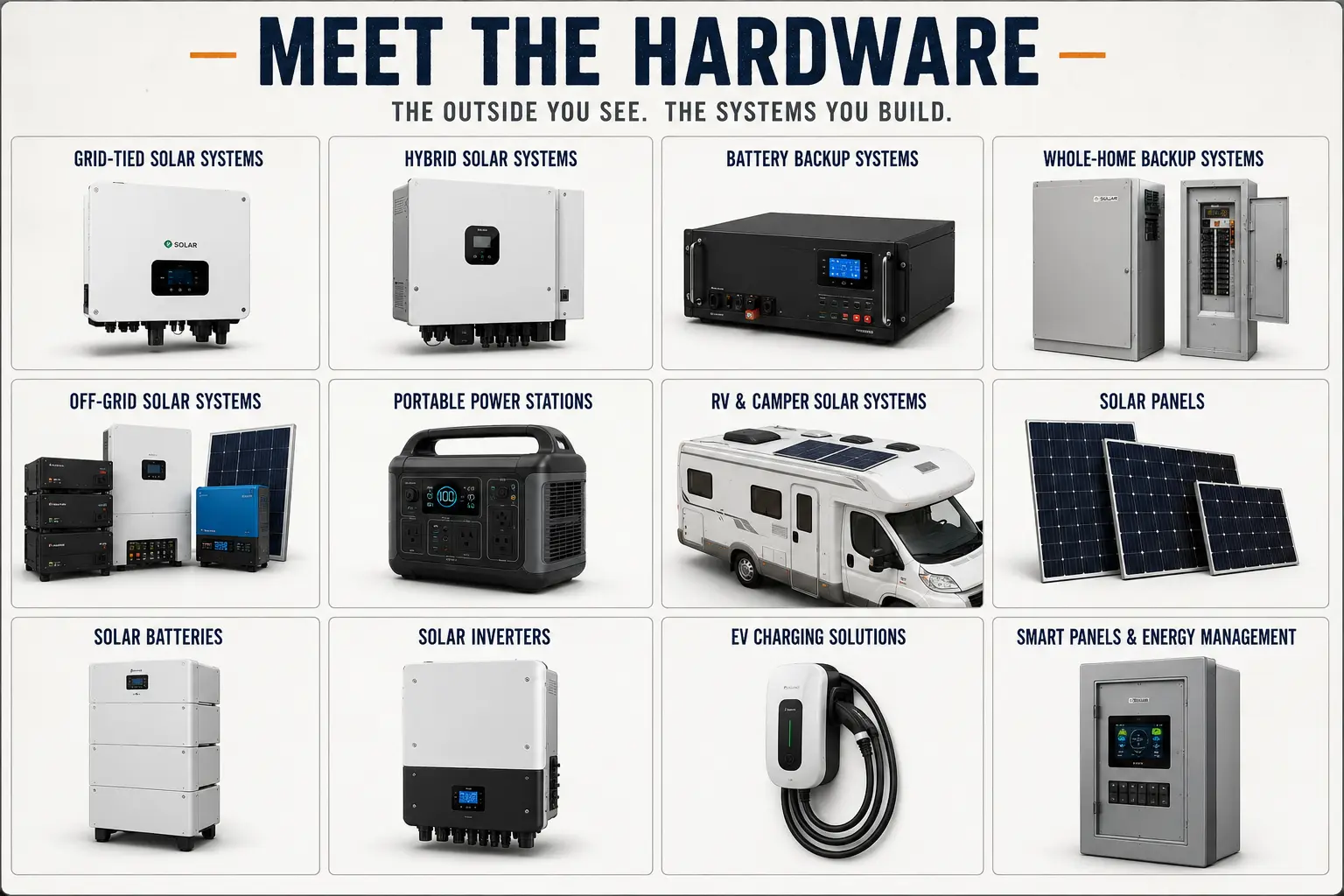
Some homeowners prefer choosing each component themselves.
Rather than purchasing a complete installation, you select the solar panels, inverter, batteries and supporting equipment that best suit your energy goals, budget and future expansion plans.
This approach offers the greatest flexibility and often the widest choice of equipment. It also requires the greatest understanding of system design and compatibility.
It’s popular with experienced DIY enthusiasts, off-grid homeowners, homesteaders, RV owners and anyone wanting more control over the design of their energy system.
The trade-off is that compatibility becomes your responsibility. Every component—from the inverter and batteries to the charge controller and monitoring platform—needs to work together as a complete system.
If you’ve worked through the hardware guides on NavigatingSolar, you’ll already have a much better understanding of the decisions involved.
Explore the Solar Marketplace
Compare solar panels, inverters, batteries, charge controllers, mobile power and accessories from trusted suppliers.
➡️ Browse Solar Equipment by Category
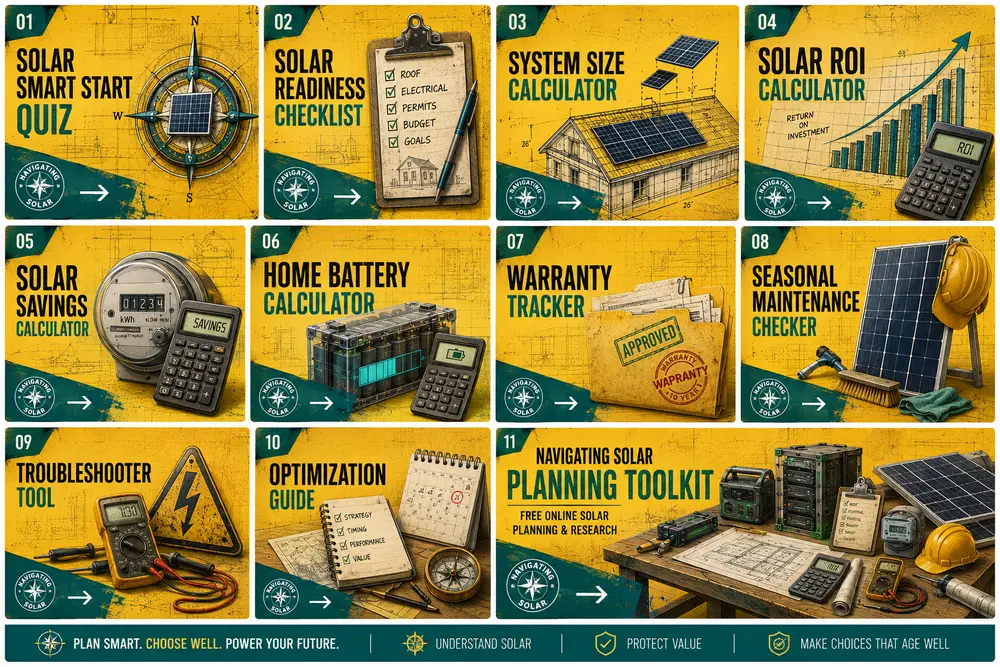
Researching and Planning Home Solar Systems?
Find tools for every phase of going solar- all in one place.
Whether you starting out, looking for optimization strategies, or upgrading and expanding an existing system,
your toolkit is packed with free resources, checklists and independent calculators.
Educational transparency.
NavigatingSolar is an Independent Educational Resource. We are not solar manufacturers or installers – we research them.
Why these suggestions?
Navigating Solar doesn’t recommend companies simply because they offer affiliate programs. We believe readers should always understand why something is being recommended. We begin with the homeowner’s decision—not the product. We identify where people struggle to make informed choices, then evaluate products, services and partners that genuinely solve those problems.
Not every recommendation earns us a commission. Partnerships are selected to fit the educational framework—not forcing the educational framework to fit whatever affiliate programs happened to exist. If a company doesn’t fit the decision framework and ethos, we don’t include it—whether it has an affiliate program or not. If we believe a better solution exists, we’ll recommend it regardless of whether it generates a commission.
➡️ Our goal is to help you make the right decision—not the fastest purchase.
Related Articles:
Types of solar-powered systems
Picking Panels or Picking Brains? Solar Panel Guide to the Marketplace
Solar Batteries: Storage, Backup Power & Energy Independence
Solar Battery Storage: Value vs Expense
How to Monitor Solar Production: 3 Best Ways
References
[1] Paradise Solar Energy. “Understanding Solar Inverters: Types, Benefits, How They Work.”
[2] EnergySage. “Microinverters Vs. String Inverters: Which Is Right For You?”
[3] Paradise Solar Energy. “Understanding Solar Inverters: Types, Benefits, How They Work.”
[4] SRNE Solar. “String vs Micro vs Hybrid: Which Type of Solar Inverter Is Best.”
[5] Rich Solar. “Hybrid Inverters Explained: Combining Solar and Battery.”
[6] BLUETTI
“What is an Inverter Generator?”
“What is kWh in the Electricity bill?”